
Power Supply, AC/DC, DIN Rail, Economical Ultra Slim Industrial, 24VDC, 20A, 480W
$150.00
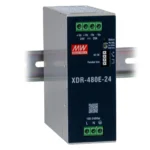
Power your device using our 24V, 20A, 480W AC/DC Economical Ultra Slim Industrial Power Supply. XDR-480E-24
- US-based technical support.
Share the product:

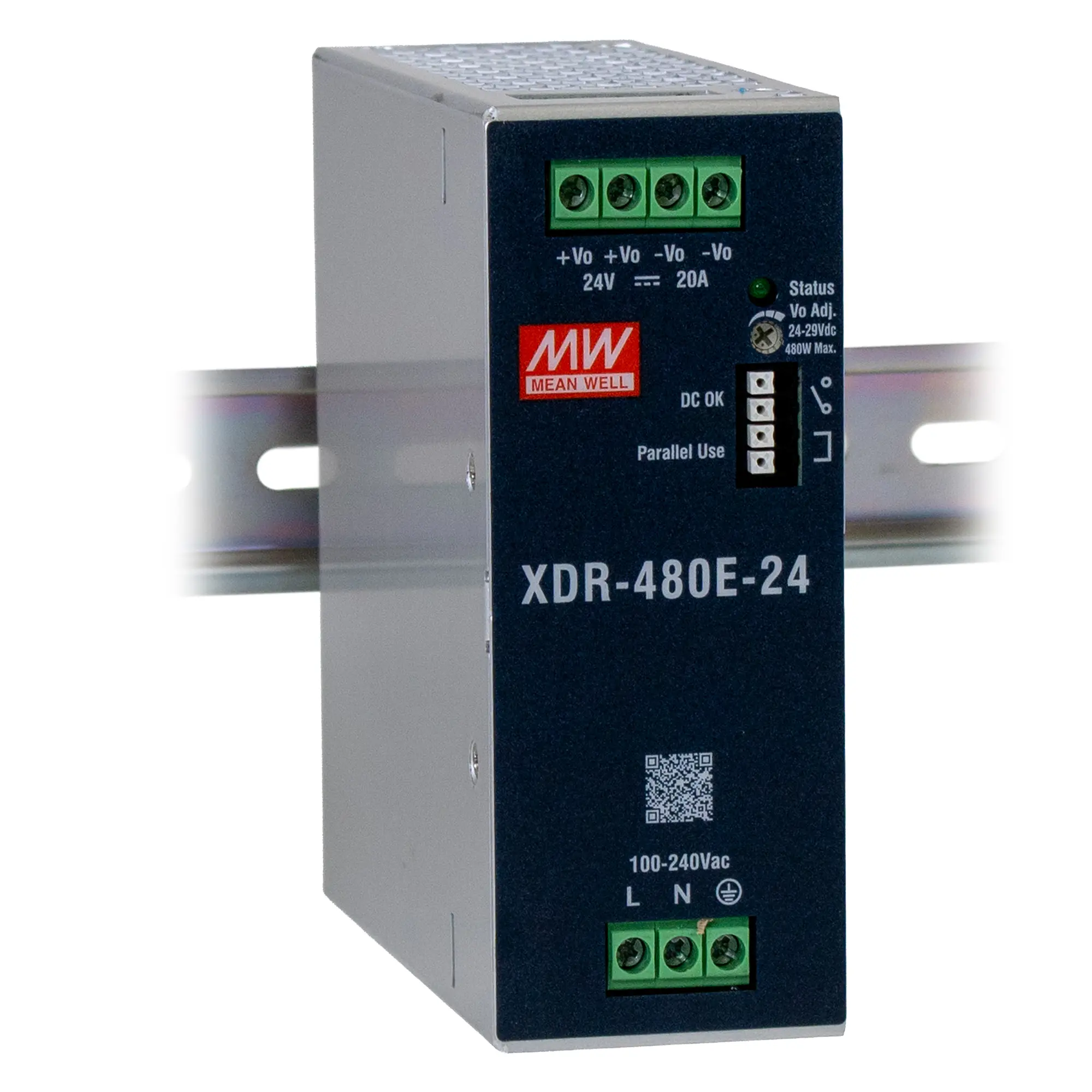
- 85~264VAC Input with PFC
- High efficiency up to 96% and no-load power dissipation 1 ~ 1.2W
- Built-in constant current limiting circuit
- Current sharing up to 1920W (3+1) for parallel use
- Protections: Short circuit / Overload / Over voltage / Over Temp.
- Fanless design, cooling by free air convection
- Over voltage category III (OVC III)
- -40~+70°C wide range operation temperature (>+50°C derating)
- Built-in DC OK relay contact
- Can be installed on DIN rail TS-35/7.5 or 15
- Installation clearances: 40mm on top, 20mm on the bottom, 5mm on the left and right side are recommended when loaded permanently with full power. In case of adjacent device is a heat source, 15mm clearance is recommended on the left and right side
OEM
| Mean Well | XDR-480E-24 |
|---|
Output
| DC Voltage | 24V |
|---|---|
| Rated Current | 20A |
| Current Range | 0 ~ 20A |
| Rated Power | 480W |
| Peak: Current (5 sec.) | N/A |
| Peak: Power (5 sec.) | N/A |
| Ripple & Noise (max.) | 120mVp-p |
| Voltage Adj. Range | 24 ~ 29V |
| Voltage Tolerance | ±1.0% |
| Line Regulation | ±0.5% |
| Load Regulation | ±1.0% |
| Setup, Rise Time | 1500ms: 150ms/230Vac – 3000ms: 150ms/115Vac at full load |
| Hold Up Time (Typ.) | 15ms/230Vac – 15ms/115Vac at full load |
Input
| Voltage Range | AC: 85 ~ 264VAC – DC: 120 ~ 370VDC |
|---|---|
| No Load Power Consumption (Typ.) | 1W @ 115/230Vac |
| No Load Power Consumption with Remote Power (RP): RP OFF | N/A |
| No Load Power Consumption with Remote Power (RP): RP ON | N/A |
| Frequency Range | 47~ 63Hz |
| Power Factor (Typ.) | PF>0.95/230Vac – PF>0.98/115Vac at full load |
| Efficiency (Typ.) | 95.5% |
| AC Current (Typ.) | 6A/115Vac – 3A/230Vac |
| Inrush Current (Typ.) | COLD START 15A/115Vac – 30A/230Vac |
| Leakage Current | <1mA/240Vac |
Protection
| Overload | 105 ~ 130% rated output power Hiccup mode when output voltage <30%, recovers automatically after fault condition is removed. Constant current limiting without shutdown within 30%-100% rated output voltage, recovers automatically after fault condition is removed |
|---|---|
| Over Voltage | Max 35V Protection type: Hiccup mode, recovers automatically after fault condition is removed |
| Over Temperature | Protection type: Shut down o/p voltage, recover automatically after temperature goes down |
Function
| Parallel (Droop Mode) | Up to 1920W Max (3+1) units; Please refer to Function Manual for more details |
|---|---|
| DC OK Relay Contact | Relay Contact Ratings (max.): 30Vdc/1A, 30Vac/0.5A resistive load |
| Remote Control | Power ON: N/A Power OFF: N/A |
| MODBus Interface | N/A |
| Transient Peak Current Capability | N/A |
Mechanical
| Terminal Connector Type | Screw-based Connector |
|---|---|
| Dimensions WxHxD | 48 x 125.2 x 125mm |
| Weight | ~ 1.96 lbs [890g] |
| Mean Time Between Failures (MTBF) | 1482.0K hours min. Telcordia SR-332 (Bellcore): 258.3K hours min. MIL-HDBK-217F (25°C) |
Environmental
| Storage Temperature | -40°F~185°F (-40°C~85°C) |
|---|---|
| Storage Humidity | 10 ~ 95% RH non-condensing |
| Temperature Coefficient | ±0.03%/°C (0 ~50°C) |
| Vibration | Component:10 ~ 500Hz, 2G 10min./1 cycle, 60min. each along X, Y, Z axis; Mounting: Compliance to IEC60068-2-6 |
| Working Temperature | -40 ~ +70°C (Refer to "Derating Curve")
|
| Working Humidity | 20 ~ 95% RH non-condensing |
Safety & EMC
| Certifications | CB: IEC 62368-1, IEC 61558-1/2-16, IEC 61010-1/-2-201 TUV: BS EN/EN 62368-1, BS EN /EN 61558-1/-2-16, BS EN/EN 61010-1/-2-201 UL: UL/CUL 61010-1/-2-201 CCC: GB4943.1 BSMI: CNS15598-1 EAC: TPTC004 approved |
|---|---|
| Over Voltage Category | IEC/EN 61558-1/-2-16 (OVC Ⅲ, altitude up to 2000m ) IEC/EN/UL 61010-1/-2-201 (OVC Ⅱ, altitude up to 5000m ) IEC/EN 62368-1 (OVC Ⅱ, altitude up to 5000m ) |
| Safety Extra-Low Voltage (SELV) | IEC/EN 61558-2-16 (SELV ) IEC/EN 62368-1 (SELV / ES1 ) |
| Withstand Voltage | I/P-O/P: 4KVac I/P-FG: 2KVac O/P-FG: 1.5KVac O/P-DC OK: 0.5KVac |
| Isolation Resistance | I/P-O/P, I/P-FG, O/P-FG: 100M Ohms/500Vdc/25°C/ 70%RH |
| EMC Emission (Parameter/Standard/Test Level) | Conducted: BS EN/EN55032 (CISPR32) / BS EN/EN61204-3 / CNS15936 / KS C 9832 – Class B Radiated: BS EN/EN55032 (CISPR32) / BS EN/EN61204-3 / CNS15936 / KS C 9832 – Class B Harmonic Current: BS EN/EN61000-3-2 – Class A Voltage Flicker: BS EN/EN61000-3-2 – N/A |
| EMC Immunity (Parameter/Standard/Test Level) | BS EN/EN55035, BS EN/EN61204-3, BS EN/EN61000-6-2(BS EN/EN50082-2), KS C 9835 ESD: BS EN/EN61000-4-2 – Level 3, 8KV air; Level 2, 4KV contact; criteria A Radiated: BS EN/EN61000-4-3 – Level 3, 10V/m; criteria A EFT/Burst: BS EN/EN61000-4-4 – Level 3, 2KV; criteria A Surge: BS EN/EN61000-4-5 – Level 4, 2KV/Line-Line; Level 4, 4KV/Line-Line-Chassis; criteria A Conducted: BS EN/EN61000-4-6 – Level 3, 10V; criteria A Magnetic Field: BS EN/EN61000-4-8 – Level 4, 30A/m; criteria A Voltage Dips and Interruptions: N/A – N/A |
How do I choose the right DIN Rail power supply?
Choose a power supply based on your equipment’s required DC output voltage, total current consumption, power rating, AC input voltage and operating environment. Allow additional capacity for startup surges and future system expansion. Also consider temperature ratings, available cabinet space, and any required safety certifications.
What is a DIN Rail power supply?
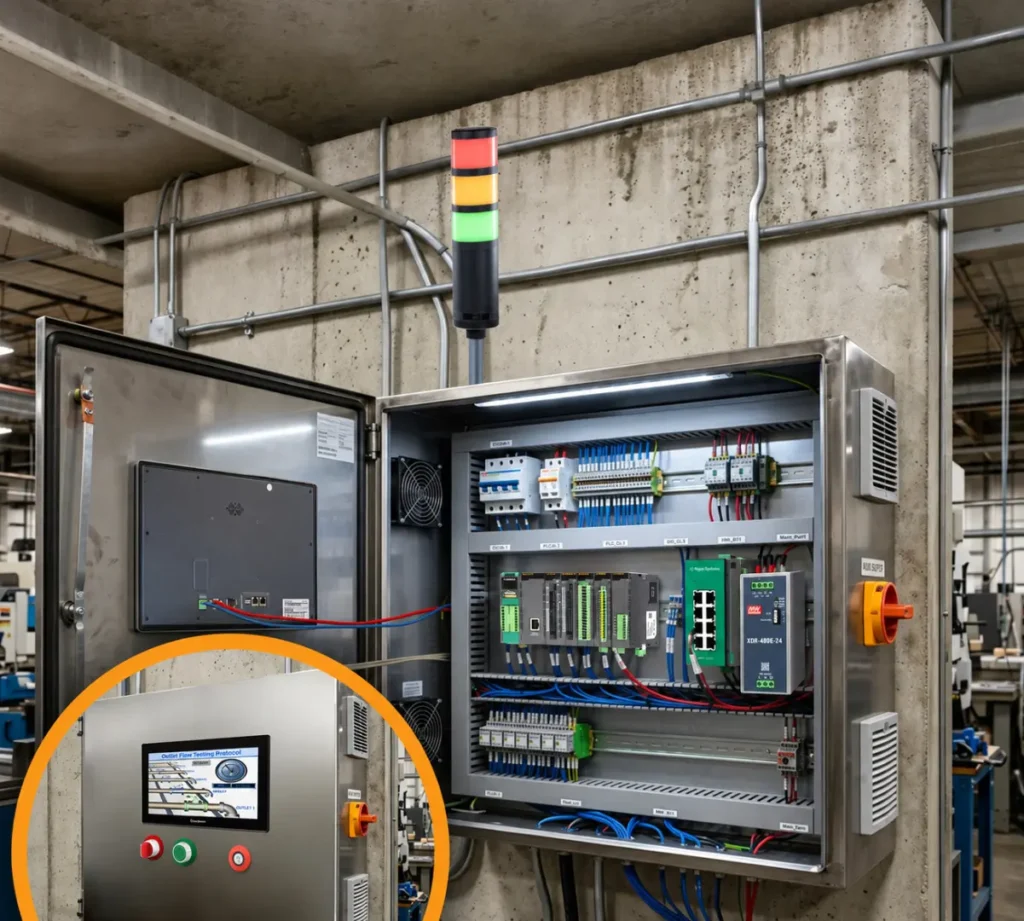
A DIN Rail power supply converts AC input voltage into regulated DC power for industrial automation equipment, including PLCs, HMIs, sensors, relays and other control components. It mounts directly onto a standard DIN rail inside an Electrical control cabinet.
Products:
What does DC OK signal indicate on your DIN Rail power supplies?
The DC OK signal indicates whether the power supply’s DC output is operating within its specified voltage range.
Depending on the model, this indication may be provided through the LED, relay contact, or a communication interface. It can be connected to a PLC or monitoring system to help identify power supply faults or abnormal output conditions.
This feature is especially useful in industrial applications where monitoring power availability is important for system reliability.
What is the difference between peak power and rated power?
Rated power is the continuous amount of power a power supply is designed to deliver under specified operating conditions. Peak power is the higher output level that a power supply can temporarily provide to accommodate short-duration increases in demand.
For example, a 240W power supply with 200% peak power capability may temporarily deliver up to 480W under the manufacturer’s specified conditions. This can be useful when powering equipment with high startup currents, such as motors, Solenoids, and capacitive loads.
Peak Power is not intended for continuous operation.
What protection features are built into your DIN Rail power supplies?
Our DIN Rail power supplies include built-in protection features designed to help protect the power supply and connected equipment from electrical faults. Depending on the model, these may include:
- Short-Circuit Protection: Helps prevent damage when the output terminals are shorted.
- Overload Protection: Limits output current or shuts down the supply when connected equipment draws excessive power.
- Overvoltage Protection: Helps prevent excessive output voltage from damaging connected devices.
- Overtemperature Protection: Protects the power supply if internal temperatures exceed safe operating limits.
These protections help improve system reliability and reduce the risk of equipment damage.
What is the difference between single-phase and three-phase DIN rail power supplies?
Single-phase power supplies operate from a single-phase AC input, commonly used in smaller industrial control panels and automation systems. Three-phase power supplies accept three-phase AC input, making them suitable for larger industrial installations with higher power requirements.
What is the formula used to figure out Watts?
By multiplying Volts (V) with Amps (A), you can figure out Watts (A). You can rearrange the basic electrical power equation depending on what you need to solve:
Watts = Volts x Amps
Amps = Watts ÷ Volts
Volts = Watts ÷ Amps
Products:
Does temperature affect power supply sizing?
Yes. Some power supplies require output derating at elevated temperatures. Always compare the expected enclosure temperature with the manufacturer’s derating specifications before selecting the supply.
When sizing a power supply, consider the maximum expected ambient temperature inside the enclosure, not just the room temperature. In high-temperature environments, you may need to select a power supply with a higher wattage rating to ensure reliable operation and prevent overheating.
Why Does Higher Voltage Require Less Current?
Higher voltage allows electrical power to be delivered using less current. According to the power formula (Watts = Volts x Amps), increasing voltage reduces the amount of current needed to deliver the same amount of power. Lower current also reduces heat generation, voltage drop, and power losses in wiring, making higher-voltage systems more efficient for transmitting power over longer distances.