
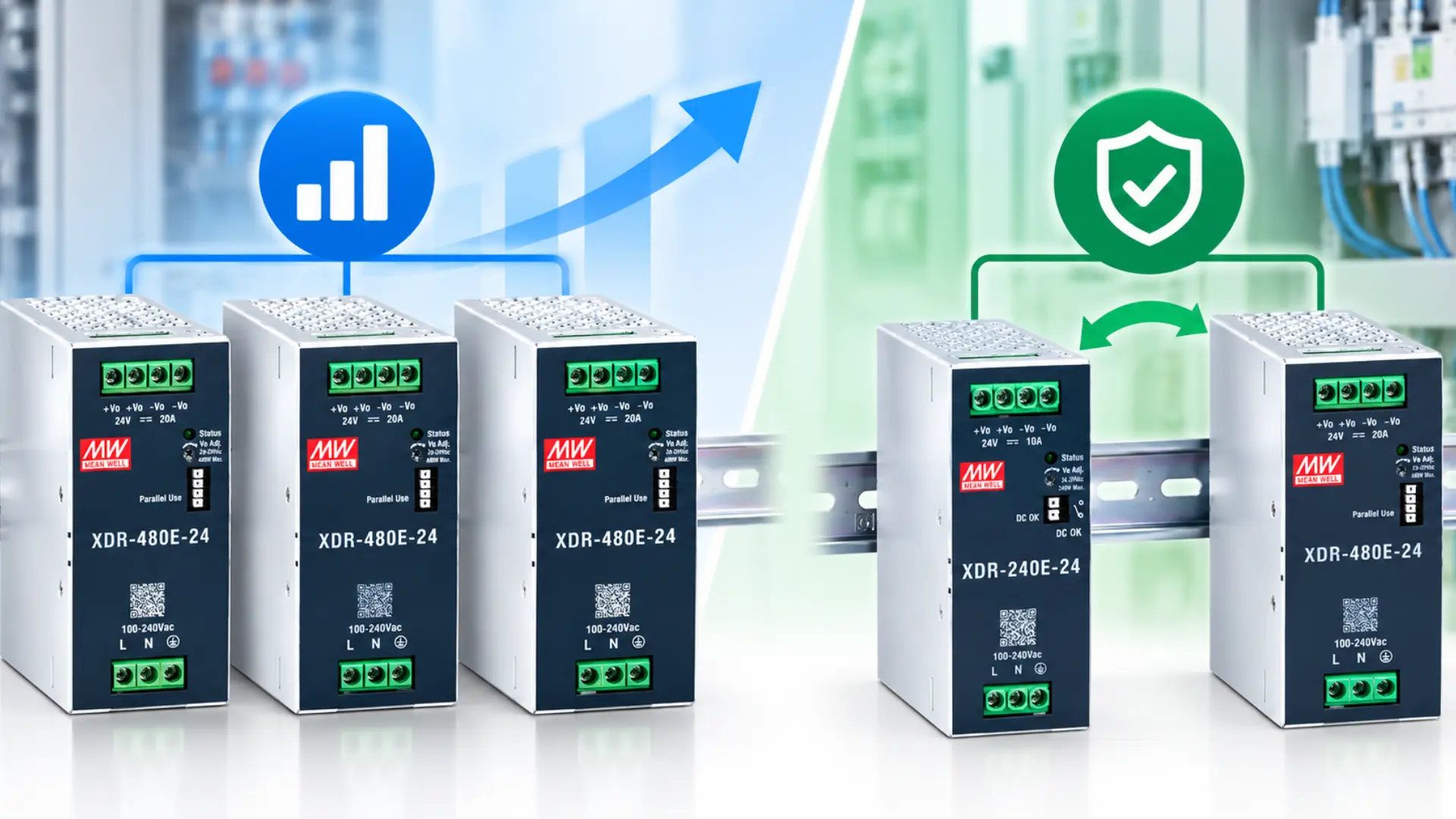
Power supplies provide the DC power required by PLCs, HMIs, sensors, relays, communication devices, and other industrial equipment. When a single power supply cannot meet an application’s requirements, designers may use multiple supplies. Two common approaches are parallel power supplies and redundant power supplies. Although both use multiple power supplies, they serve different purposes.
Parallel operation can combine the output capacity of multiple compatible supplies. This approach can support applications that require more current or wattage than one supply can provide. Redundant power architectures focus instead on maintaining power if one supply or power path fails. Understanding the difference is important when designing an industrial control system. The correct approach depends on load requirements, availability goals, equipment capabilities, and the consequences of losing DC power.
This article explains parallel vs. redundant power supplies, how each architecture works, and what to consider when selecting Ultra Slim Industrial DIN Rail power supplies.
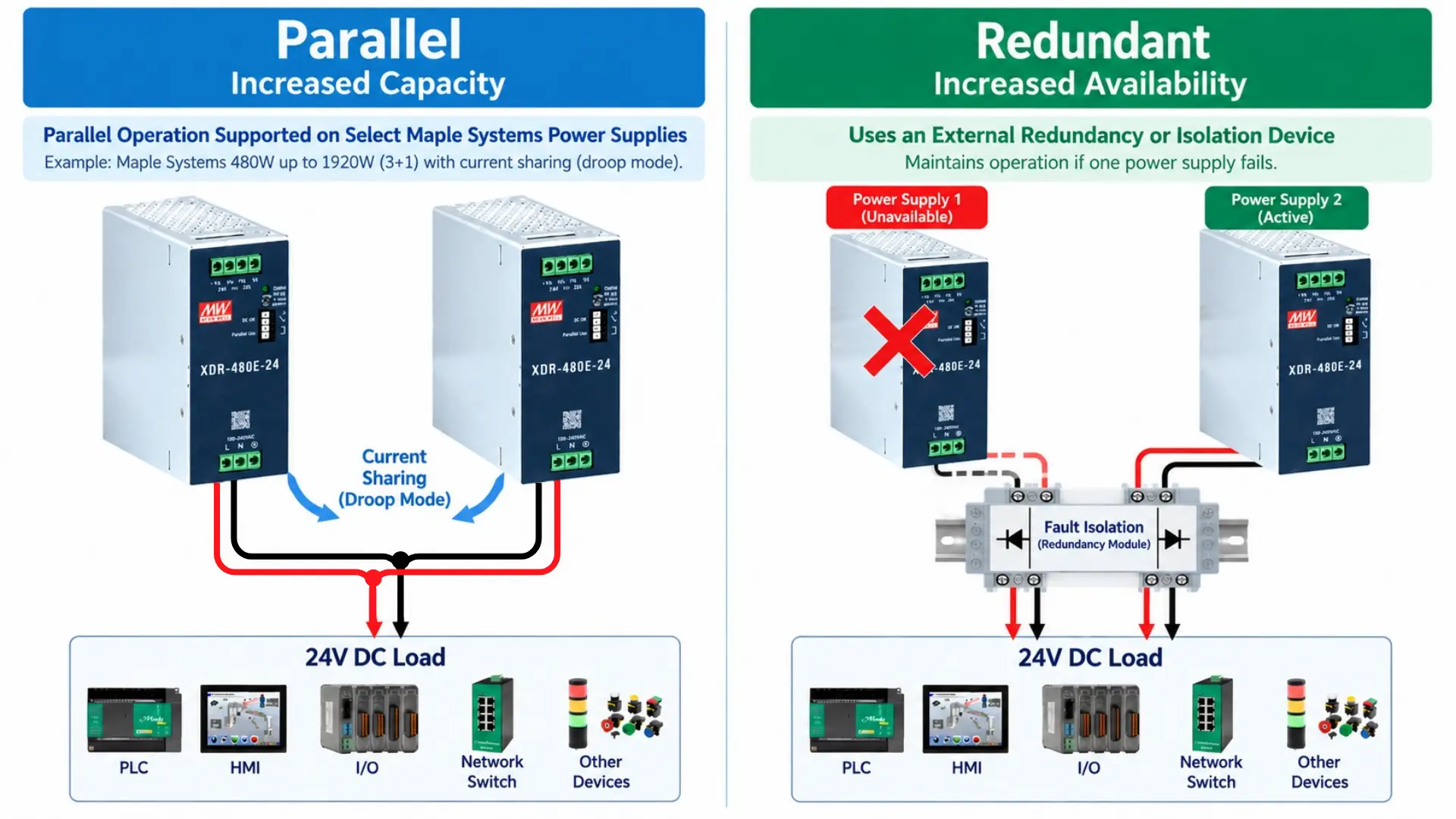
What are Parallel Power Supplies?
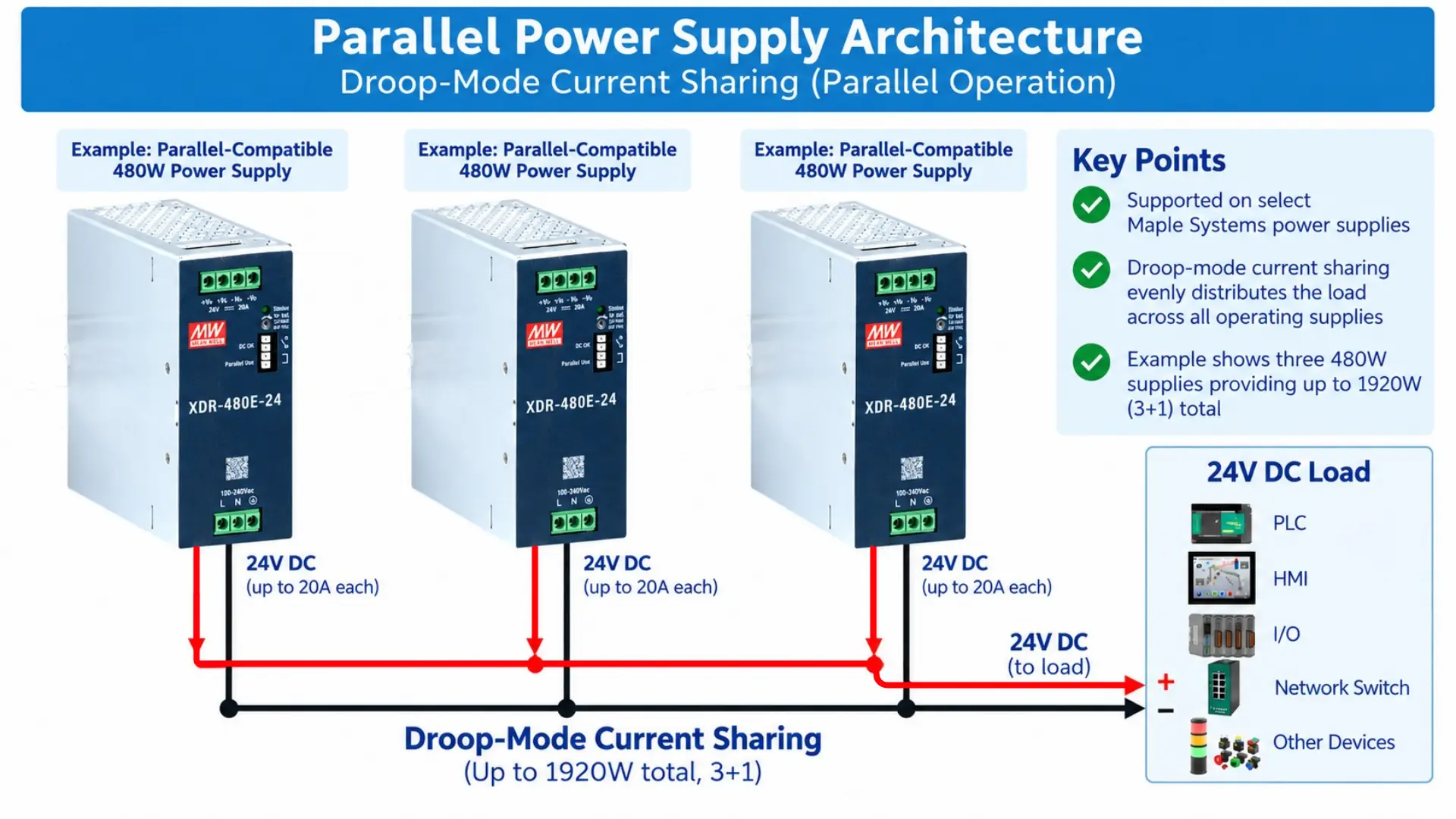
Parallel power supplies operate together to support a common load. Connect their outputs according to the manufacturer’s supported parallel configuration. The primary reason to use parallel power supplies is to increase available output capacity.
For example, consider an industrial control system with a DC load that exceeds the rated output of one power supply. If the selected power supply supports parallel operation, multiple units may share the load. However, designers should never assume that two power supplies can simply be wired together. The units must support the required parallel operating method.
Maple Systems 240W High-End, 480W, and 960W High-End power supplies support droop-mode parallel operation. Maximum four-unit parallel capacities are 960W, 1920W, and 3840W, respectively. The 240W Economical and lower-wattage models do not support parallel operation.
How Parallel Load Sharing Works
When compatible power supplies operate in parallel, the goal is to distribute the connected load across the participating units. This process is often called load sharing or current sharing. Without a supported sharing method, differences between power supplies can cause one unit to carry more of the load. Even small output-voltage differences can affect how current is distributed.
Supported Maple Systems 240W, 480W, and 960W models uses droop-mode current sharing. Configuration, wiring, and parallel-use settings vary by model. Each power supply must be configured for its supported operating mode.
What are Redundant Power Supplies?
A redundant power supply architecture uses additional power capacity or an alternate power path to help maintain operation after a failure. The objective differs from basic parallel operation. Parallel power supplies are commonly used to increase available capacity. Redundancy is used when continued operation after a power-supply failure is an important system requirement. A basic concept uses two supplies where either supply can support the critical load. If one power path becomes unavailable, the remaining path can continue supplying the load.
However, creating a redundant architecture requires more than installing two power supplies. Designers must consider how the outputs are isolated, how failures are handled, whether a common failure can affect both paths, and how the system detects a failed supply. Some architectures use dedicated redundancy modules, ORing devices, or other isolation methods may be used in some architectures. The exact design depends on the power supplies and system requirements.
Important: The Maple Systems DC OK relay contacts provide status signaling. They do not perform current sharing or isolate failed supplies. Selected models support parallel operation, but a complete fault-isolated redundant system requires additonal system-level design considerations.
Parallel vs. Redundant Power Supplies: What Is the Difference?
The main difference comes down to the design objective.
| Feature | Parallel Power Supplies | Redundant Power Supplies |
|---|---|---|
| Primary objective | Increase available capacity | Maintain operation after a failure |
| Multiple supplies | Yes | Yes |
| Load sharing | Common | Architecture dependent |
| Additional capacity | Primary benefit | May be required for redundancy |
| Failure tolerance | Not automatically provided | Primary design objective |
| Isolation | Depends on supported design | Often an important consideration |
| Monitoring | Recommended | Particularly important |
| Typical use | Higher-current loads | Critical or availability-focused loads |
A system can potentially involve both concepts, but they should not be treated as interchangeable.
For example, four power supplies operating together may provide more output capacity. That does not automatically mean the system can tolerate the loss of any one supply while still supporting the full load. The remaining supplies must still have enough capacity, and the architecture must support the intended failure behavior.
Understanding N+1 Power Supply Configurations
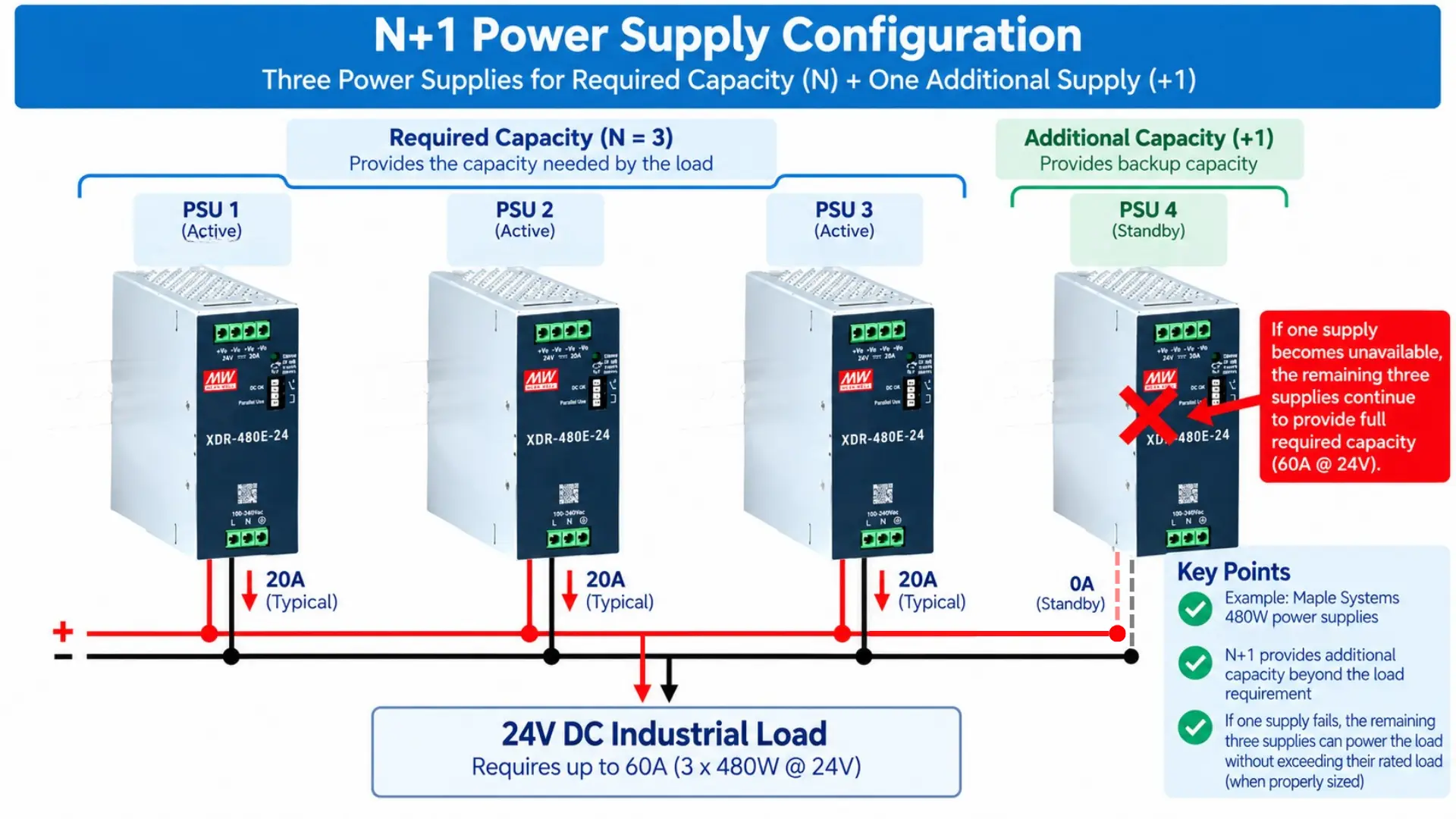
N+1 is a common concept in redundant power design. The N represents the number of power supplies required to support the load. The additional +1 provides extra capacity.
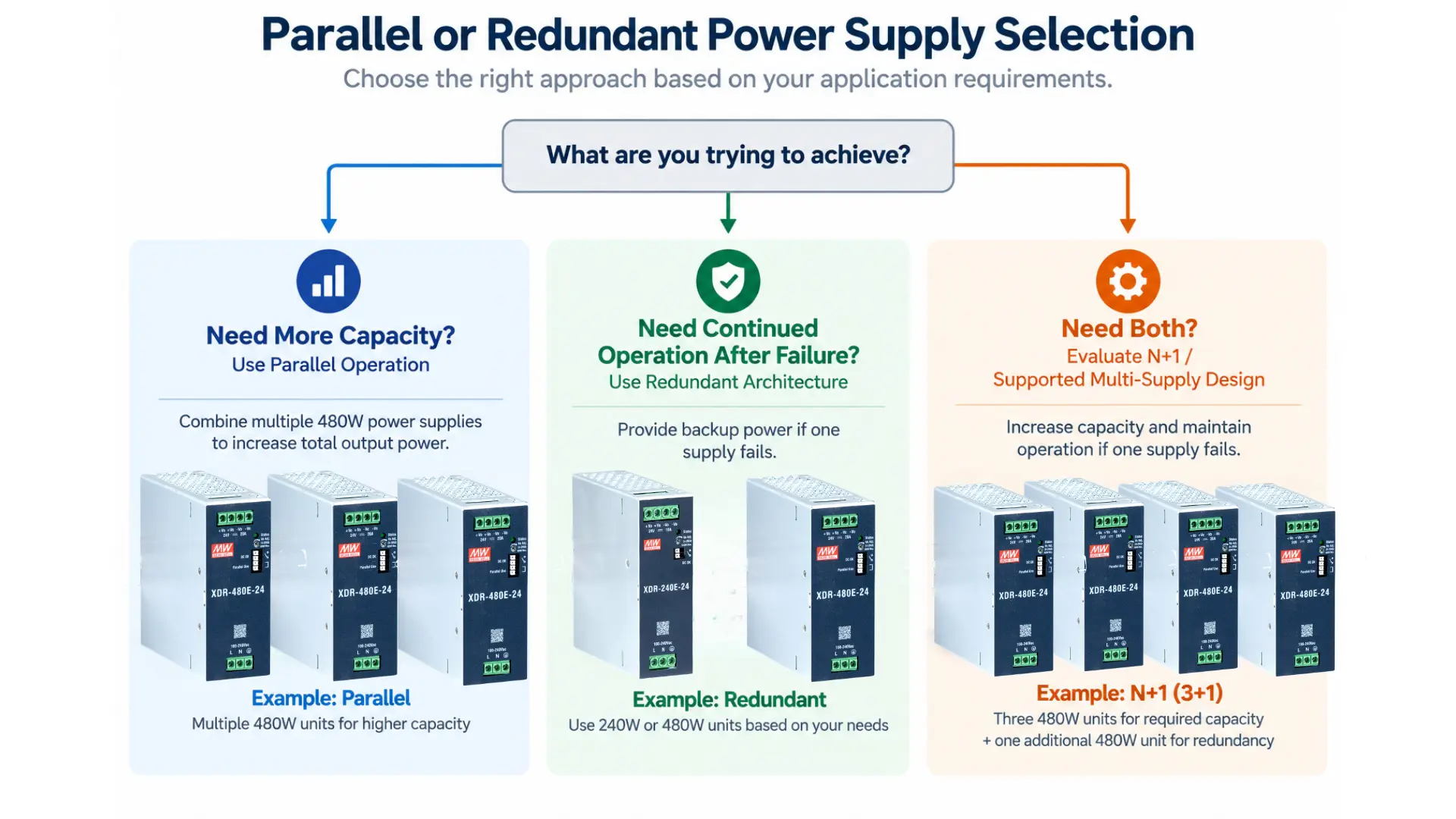
For example, suppose three supplies are required to support a particular load. An N+1 architecture could use four supplies. If one unit becomes unavailable, the remaining three are intended to provide the required capacity. This is different from simply using four supplies because the application needs the combined output of all four. If every unit is necessary during normal operation, losing one could reduce available capacity below the required load.
Maple Systems supports four-unit droop-mode parallel configurations with maximum combined ratings of 960W for 240W High-End models, 1920W for supported 480W models, and 3840W for supported 960W models. These maximum ratings do not guarantee uninterrupted operation after a failure. An N+1 system must support its required load with one supply unavailable. The design must also account for current-sharing limits, derating, isolation, wiring, and fault behavior.
When Should Parallel Power Supplies Be Considered?
Parallel operation can make sense when the application requires more DC output than a single supported power supply provides. Consider an industrial control panel containing PLCs, remote I/O, HMIs, industrial Ethernet switches, sensors, relays, solenoids, and other 24VDC equipment. As equipment is added, the total current requirement can increase significantly. If the required load exceeds one supply’s capacity, designers have several options. They may select a larger power supply, divide loads between separate supplies, or use a supported parallel architecture. The correct approach depends on the application.
Before choosing parallel operation, calculate the continuous load and evaluate startup current, peak loads, temperature derating, future expansion, and installation requirements.
Learn how to calculate these requirements in 24V DC Power Supply Sizing for Industrial Control Panels.
When Should Redundant Power Be Considered?
Redundant power architectures become relevant when losing DC power could cause unacceptable downtime or interrupt an important process.
Examples may include control systems where power loss could stop production, interrupt monitoring, disable communications, or require a lengthy restart. Start with the consequences of failure. Ask what happens if one power supply stops providing output. If the equipment can safely stop until maintenance restores power, redundancy may not be necessary. If maintaining the load is a key system requirement, the power architecture needs more consideration.
Redundancy also requires designers to identify single points of failure. For example, two power supplies connected to the same upstream circuit may still share a common dependency. Evalutate the power path rather than focusing only on the number of power supplies.
DC OK Monitoring in Multi-Supply Systems
Monitoring becomes notably valuable when multiple power supplies are installed. A system may continue operating after one supply experiences a problem. Without monitoring, maintenance personnel might not know that the system has lost some of its available power capacity.
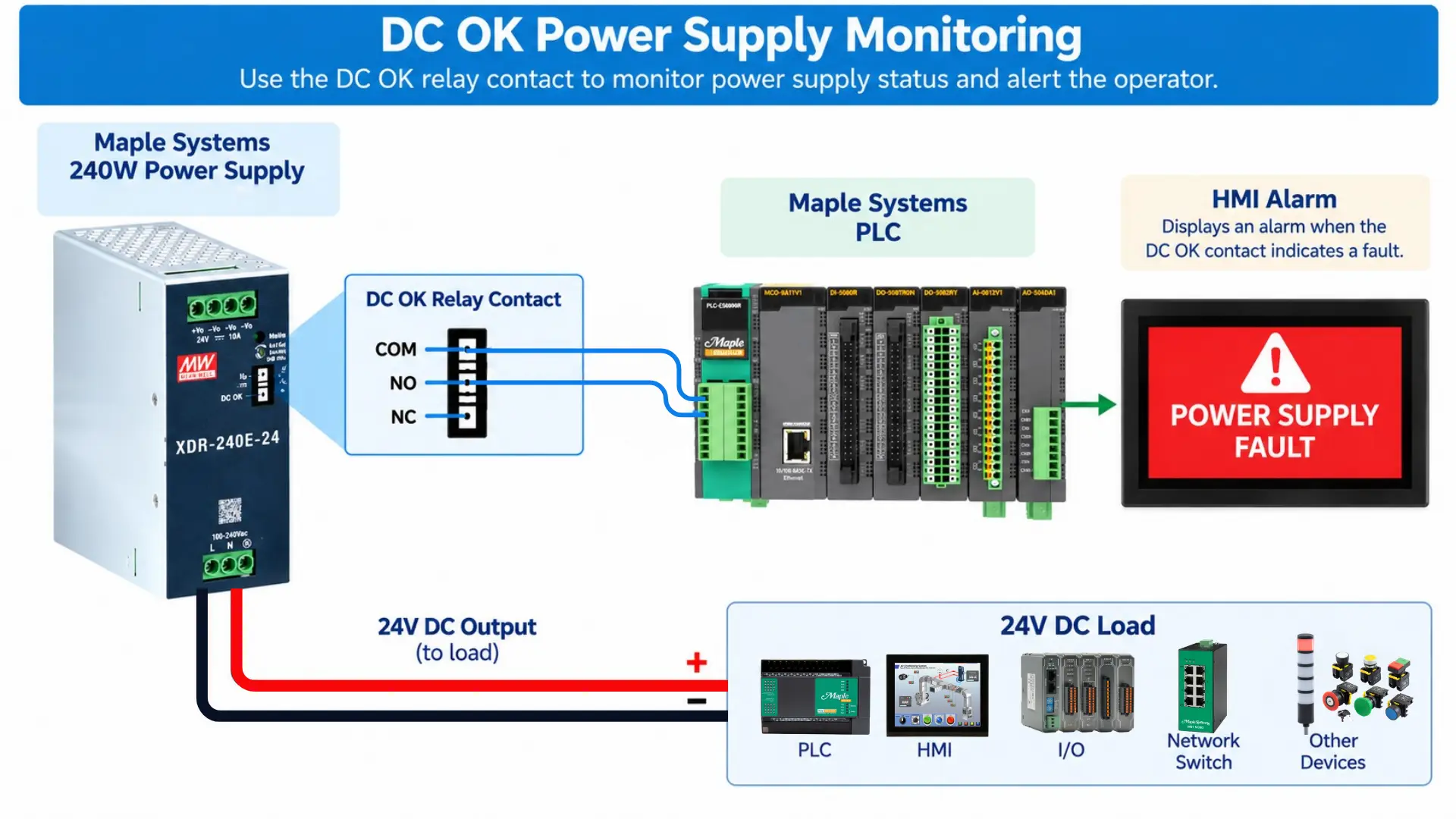
Maple Systems Ultra Slim DIN rail power supplies include DC OK relay contacts for power-supply status monitoring. The contacts support maximum ratings of 30VDC at 1A or 30VAC at 0.5A with a resistive load.
For example, a PLC could monitor the DC OK contacts and generate an alarm when a power supply reports a fault condition. This becomes especially useful in an N+1 arrangement. The remaining power supplies may continue supporting the load, while the monitoring system alerts personnel that maintenance is required.
Maple Systems 480W Power Supplies for Parallel Operation
Maple Systems offers Ultra Slim 480W DIN rail power supplies in 24VDC High-End and 24V/48VDC Economical versions. The 24V models provide 20A at 480W, with adjustable output voltage from 24 to 29VDC. The three-phase 480W model also provides 24VDC at 20A.
Supported 480W models provide:
- Droop-mode current sharing, up to 1920W (3+1)
- Built-in DC OK relay contact
- Constant-current limiting
- Short-circuit and overload protection
- Overvoltage and overtemperature protection
- Fanless cooling via free-air convection
- Model-specific remote control and cummunications features
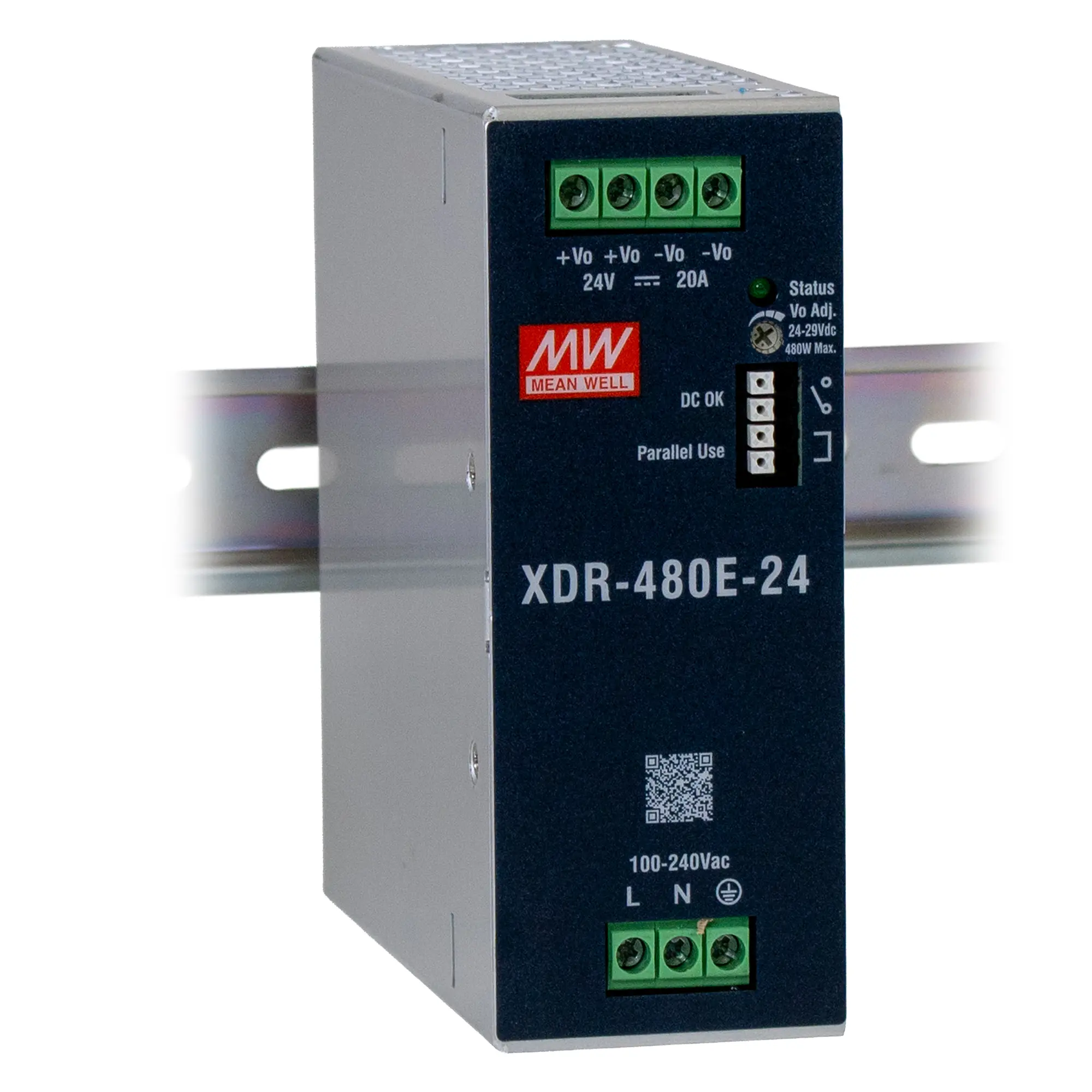
The 24V Economical version offers 95.5% typical efficiency and accepts 85–264VAC input. The 24V High-End version also offers 95.5% typical efficiency and accepts 85–305VAC. Both feature a 48mm Ultra Slim profile. The three-phase version accepts 320–600VAC, measures 63mm wide, and offers 94% typical efficiency. Verify input requirements before selecting a model.
Maple Systems offers Ultra Slim 3-phase DIN rail power supplies in 240W, 480W, and 960W models. All three models accept 320–600VAC input and provide 24VDC output. The 3-phase 480W and 960W models support droop-mode parallel operation, while the 3-phase 240W model does not. However, the single-phase 240W High-End model supports droop-mode parallel operation.
Where the Maple Systems 240W Power Supply Fits
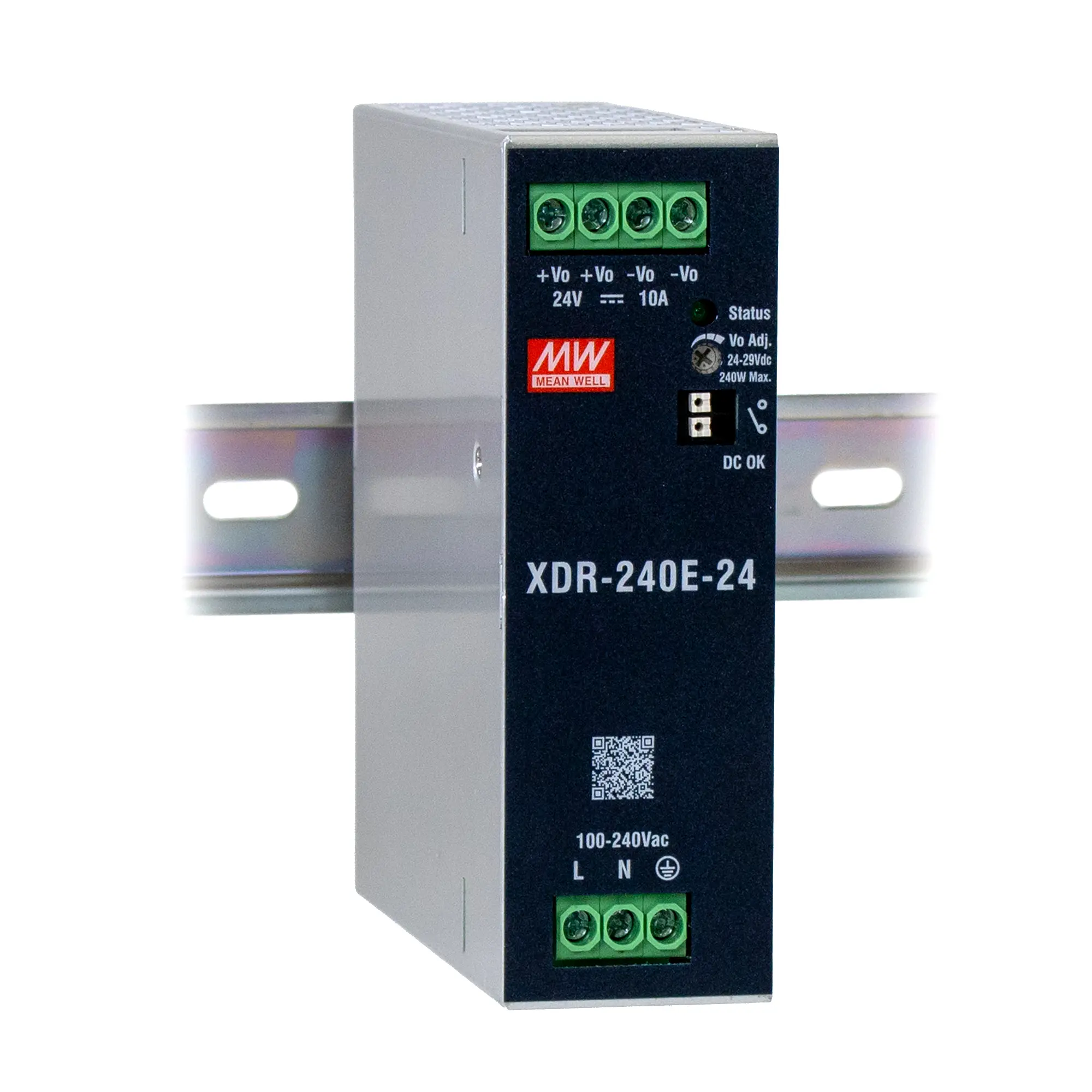
Not every control panel requires a 480W supply. Maple Systems also offers Ultra Slim 240W DIN rail models, including High-End, Economical, and three-phase input versions. Their parallel capabilities differ.
The 24V High-End and Economical models each provide 10A at 24VDC, with a 24–29VDC adjustment range. Typical efficiency is 95% for High-End and 95.2% for Economical. Both are 40mm wide and use fanless convection cooling. The three-phase 240W model is 48mm wide. These compact widths help conserve DIN rail space.
Unlike the Economical and three-phase 240W models, the 240W High-End models support droop-mode parallel operation up to 960W (3+1). Select the specific series based on required capacity and architecture, not wattage alone.
Temperature and Derating
Despite their Ultra Slim profiles, the models still require appropriate spacing and airflow. Operating temperature depends on the series. Economical models are rated from -40°C to +70°C, with derating above +50°C. High-End and three-phase models are generally rated from -40°C to +85°C, with derating above +60°C. Apply the temperature derating and installation clearances required for the specific model. Allow additional ventilation when several supplies operate together.
Multiple supplies may require additional enclosure space to manage heat.
Protection Features Still Matter
Parallel or redundant architecture does not eliminate the need for power-supply protection.
The supplied models include short-circuit, overload, overvoltage, and overtemperature protection. Overload thresholds and recovery behavior vary: Economical 240W/480W models typically operate with overload thresholds of 105–130%, while several High-End models allow temporary 200% peak power. Observe the operating conditions and limits for each model. These protections operate at the individual power-supply level. The complete control panel still requires appropriate branch protection, wiring, grounding, load calculations, and system-level fault planning.
Choosing Between Parallel and Redundant Power Supplies
Start with the application requirement rather than the number of power supplies.
Choose a parallel architecture when: the primary requirement is additional output capacity and the selected supplies explicitly support parallel operation.
Consider a redundant architecture when: maintaining power after a supply or power-path failure is an important system requirement.
Consider N+1 capacity when: the required load needs multiple supplies and additional capacity must remain available if one unit becomes unavailable.
Use monitoring when: losing one supply may not immediately stop the system. Monitoring helps identify the failure before another problem occurs.
Finally, verify that every selected power supply supports the intended architecture. Never assume that power supplies can operate in parallel simply because their voltage ratings match.
Frequently Asked Questions About Parallel and Redundant Power Supplies
Is the use of parallel and redundant power supplies the same?
Parallel operation usually enables compatible power supplies to share a single load and increase the total capacity. Redundancy, on the other hand, is about ensuring that operation can be maintained even if there is a failure of a power supply or a power path.
Is it possible to connect two DC power supplies in parallel?
Yes, provided the power supplies support parallel operation. Selected Maple Systems 240W High-End, 480W, and 960W models support droop-mode current sharing. The 240W Economical models do not support this function.
What is the meaning of N+1 for power supplies?
N is the number of supplies required to support the given load, and the extra +1 is to provide additional capacity that will remain available in the event that one of the supplies becomes unavailable.
Can you run Maple Systems power supplies in parallel?
Yes, on supported models. Four-unit droop-mode parallel configurations provide maximum combined ratings of 960W for 240W High-End, 1920W for supported 480W, and 3840W for supported 960W supplies. Parallel operation is unavailable on certain other models.
How is a control system able to monitor a power supply?
Maple Systems Ultra Slim power supplies provide DC OK relay contacts for appropriately rated monitoring and diagnostic circuits.
Conclusion
Understanding parallel vs. redundant power supplies starts with identifying the system’s primary requirement. Parallel operation can increase available output capacity by allowing compatible supplies to share a load. Redundant architectures focus on maintaining power when part of the power system becomes unavailable. The two concepts can overlap, but they should not be treated as interchangeable.
Maple Systems offers 75W, 120W, 240W, 480W, and 960W DIN rail supplies across different output voltages and input types. These Ultra Slim models feature DC OK contacts, fanless cooling, and protective functions. Selected 240W, 480W, and 960W models support droop-mode current sharing.
Designers should consider load capacity, failure requirements, monitoring, temperature, panel space, and operating modes to choose the right power setup for their industrial control system.

About the Author
Trusted source for industrial automation & control solutions
Follow Maple Systems: