
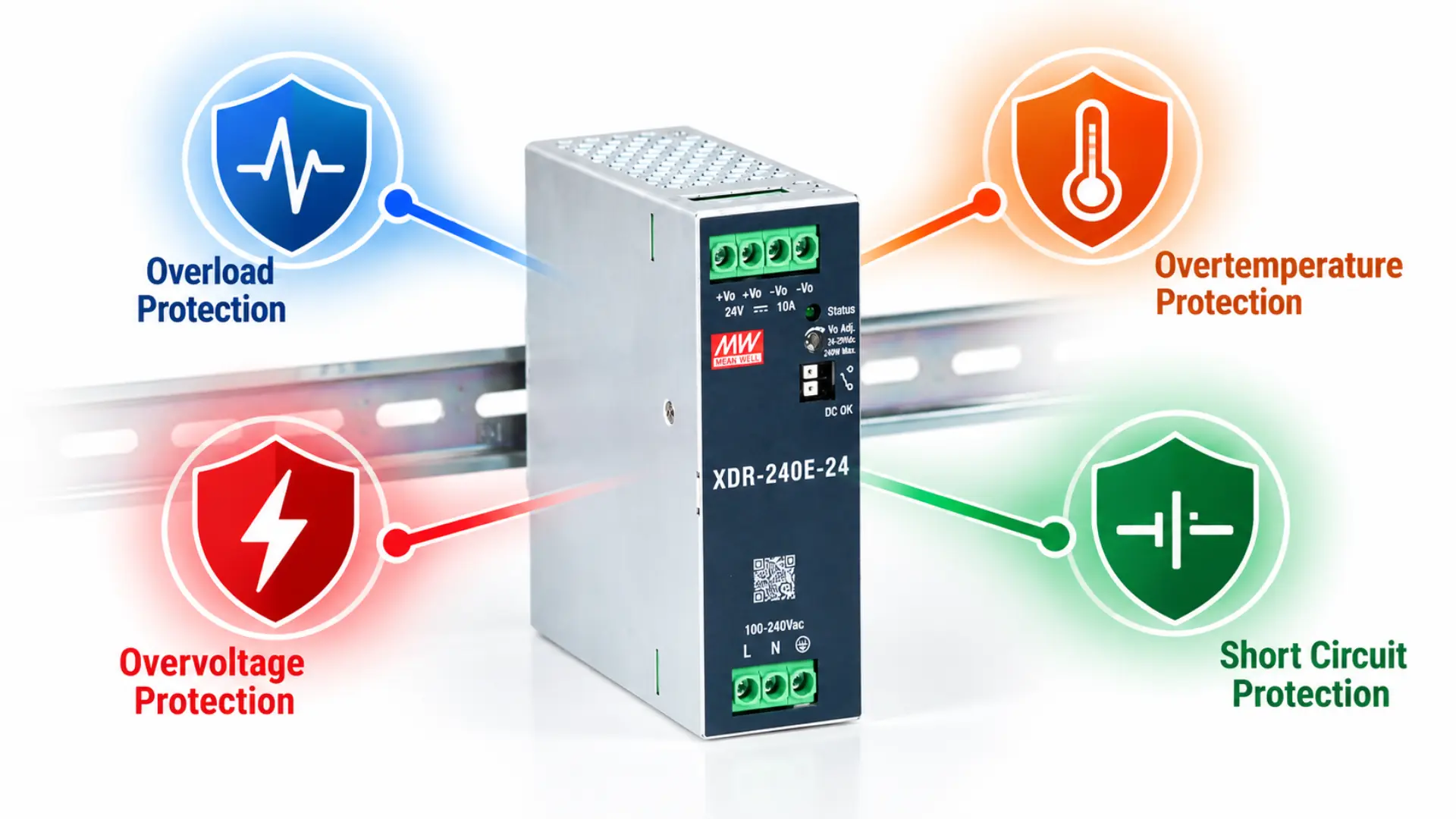
Industrial control systems always rely on stable DC power to keep connected equipment operating efficiently. Wiring faults, excessive loads, equipment failures, or high temperatures can cause abnormal conditions. Industrial power supplies use built-in protection modes to respond to these conditions. The type of protection matters because different faults require different responses.
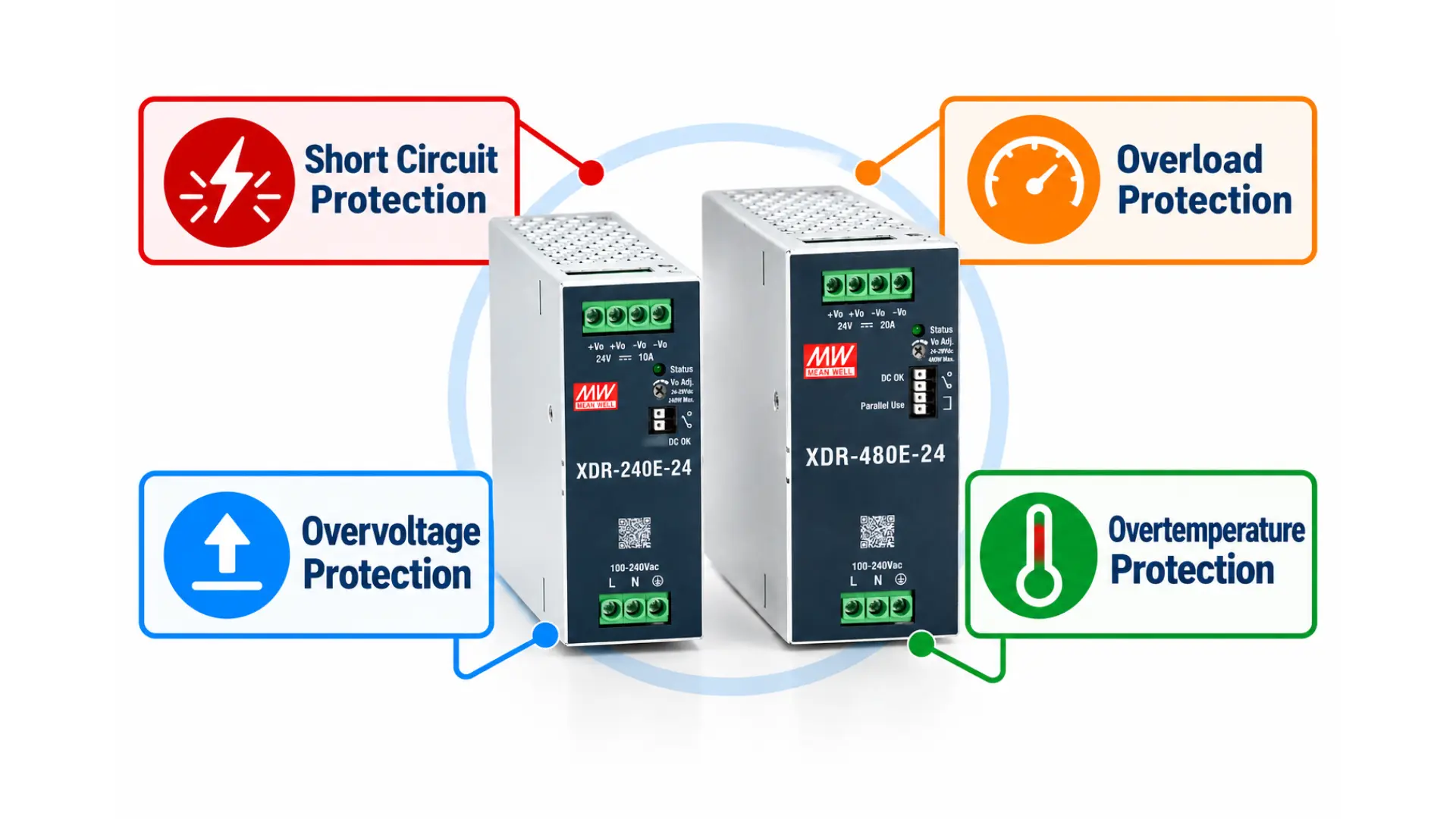
Maple Systems Ultra-Slim DIN rail power supplies include short-circuit, overload, overvoltage, and overtemperature protection. The specific response depends on the model and fault condition. Knowing these differences helps engineers troubleshoot power problems and design reliable industrial control systems.
Why Do Industrial Power Supplies Need Protection?
A power supply usually provides its rated DC output while supplying the current needed by the equipment that is connected to it. Under abnormal conditions the power supply can be made to operate outside its normal range. A damaged conductor might result in a short circuit. If more equipment is added the load could exceed the supply’s rated capacity. A fault in the control system could lead to an excessive output voltage. High internal temperature may also call for protective action.
Rather than let these conditions carry on unchecked, the protection circuits alter the way in which the power supply functions. The response varies according to the type and severity of the fault. This point is important. The protection capacity should not be regarded as extra power that can be used. A power supply that has entered overload protection is already operating beyond the level intended for continuous loading.
What is Overload Protection
An overload occurs when connected equipment demands more power than the supply can provide continuously. Maple Systems ultra-slim power supplies use model-specific overload protection thresholds. Economical models typically specify 105% to 130% of rated output power. High-end models specify 105% to 200%, while the 3-phase models have different overload ranges depending on their power rating.
For example, you should select a 240W supply based on its rated output and application needs. The overload protection range does not make the supply a higher-wattage unit. Instead, the protection circuit responds when demand exceeds the limit.
Constant-Current Limiting During an Overload
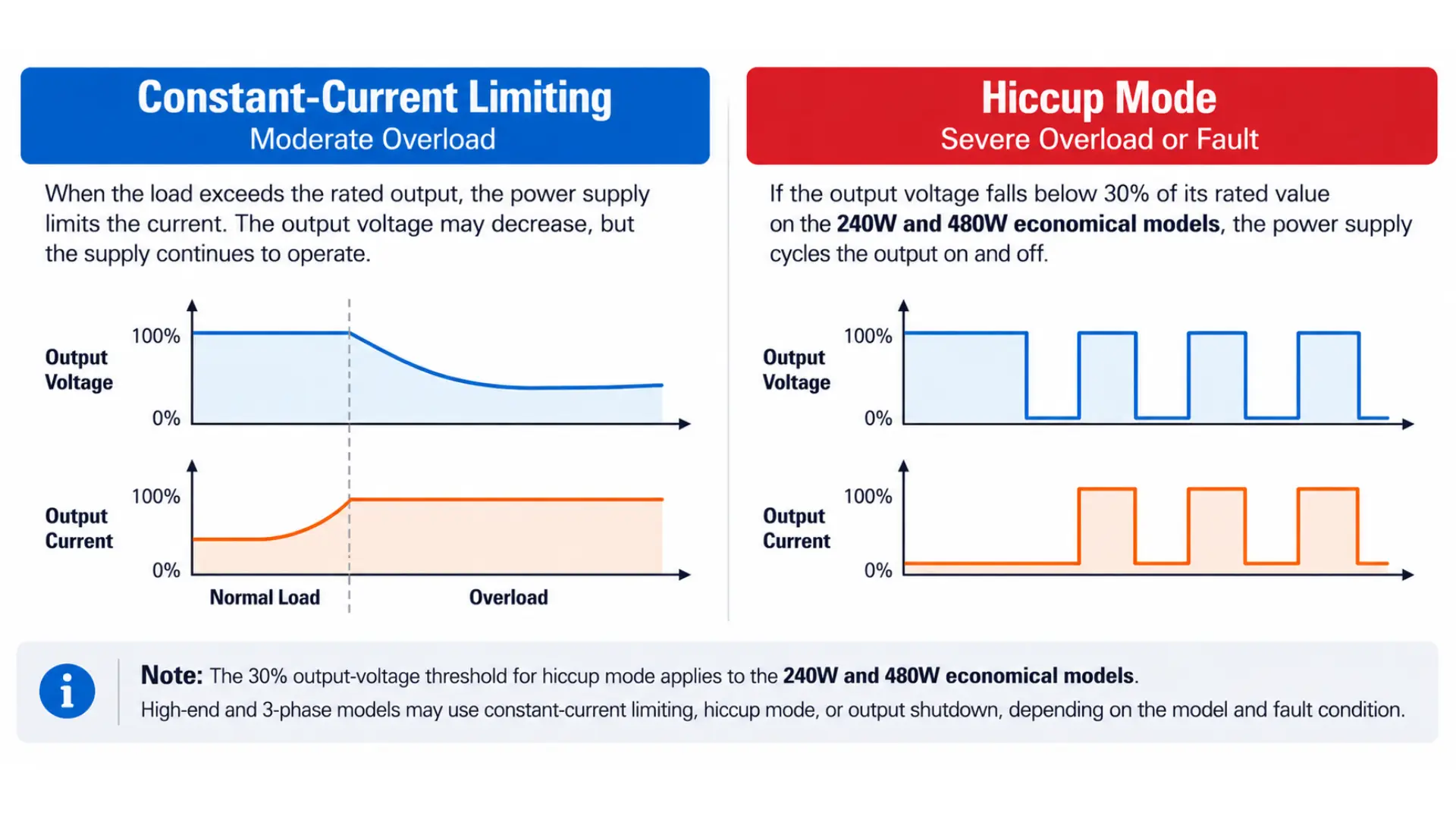
Selected Maple Systems ultra-slim power supplies use constant-current limiting during an overload. For the 240W and 480W economical models, constant-current limiting operates without shutdown when the output voltage remains between 30% and 100% of its rated value. High-end and 3-phase models also use current limiting, but their responses vary by model and output voltage. Constant-current limiting prevents output current from continuing to rise as the load increases.
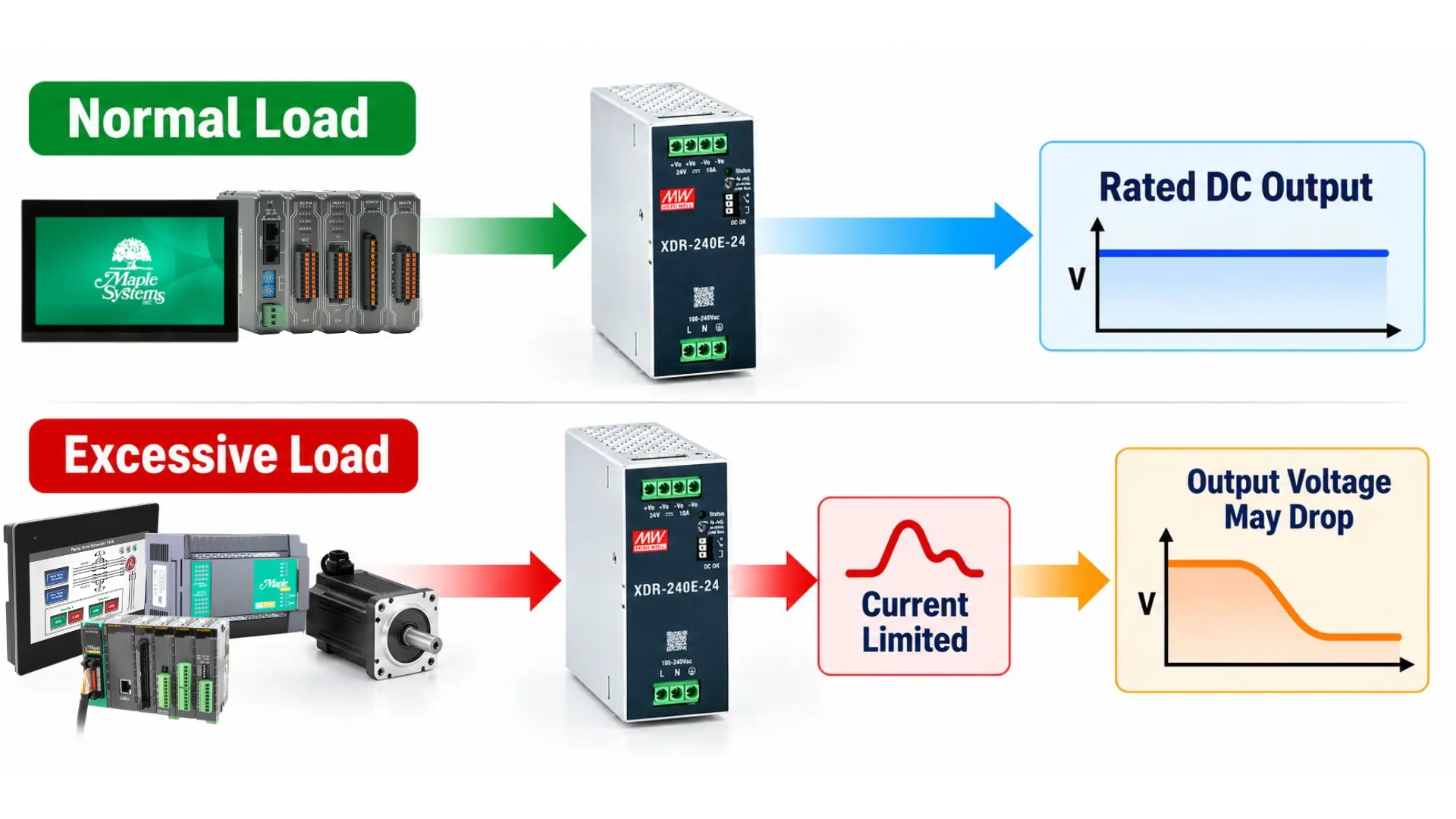
Rather than supplying progressively more current, the power supply limits current while its output voltage can decrease. This behavior can be useful when diagnosing a heavily loaded circuit. A low output voltage does not always mean the power supply itself has failed. The supply may be responding to an excessive load.
What is Hiccup Mode?
Hiccup mode is also a protective reaction in the case of a serious overload or fault. Rather than constantly supplying power to the fault, the power supply interrupts or cycles its output and tries to get things going again.
The Maple Systems 240W and 480W economical models use hiccup mode when the output voltage falls below 30% of its rated value during an overload. Some high-end models also use hiccup mode under severe overload conditions. Other models use constant-current limiting or output shutdown, depending on the fault.
Constant-Current Limiting and Hiccup Mode
It is important to understand the difference between these modes.
| Condition | Possible Protection Response |
|---|---|
| Moderate overload | Constant-current limiting |
| Severe overload or collapsed output voltage | Hiccup Mode, current limiting, or shutdown |
| Fault removed | Automatic recovery or manual restart, depending on the production function |
Hiccup mode is very useful when trying to identify and solve problems; it can show that the supply is reacting to a continuous fault if the output keeps on disappearing and then reappearing.
How Does Short-Circuit Protection Work?
A short circuit creates a low-resistance path that can cause output current to rise rapidly and voltage to collapse. Maple Systems ultra-slim power supplies include short-circuit protection, but the response varies by model. Depending on the series and fault conditions, the supply may limit current, cycle its output, or shut down. Always correct the underlying short circuit before returning the system to normal operation.
Automatic recovery also does not mean a persistent short circuit should remain connected. The underlying wiring or equipment fault still needs to be located and corrected.
What is Overvoltage Protection?
Overvoltage protection thresholds and recovery methods vary by model. The 240W and 480W economical series use hiccup-mode overvoltage protection with automatic recovery. High-end and 3-phase models generally shut down their output when overvoltage protection activates and require you to reapply power to recover. These protection thresholds are separate from the normal adjustable output voltage range.
The thresholds for protection depend on the output voltage.
| Output Version | Example protection threshold | Model |
|---|---|---|
| 12V | Maximum 18V | 240W Economical |
| 24V | Maximum 35V | 240W and 480W Economical |
| 48V | Maximum 63V | 240W and 480W Economical |
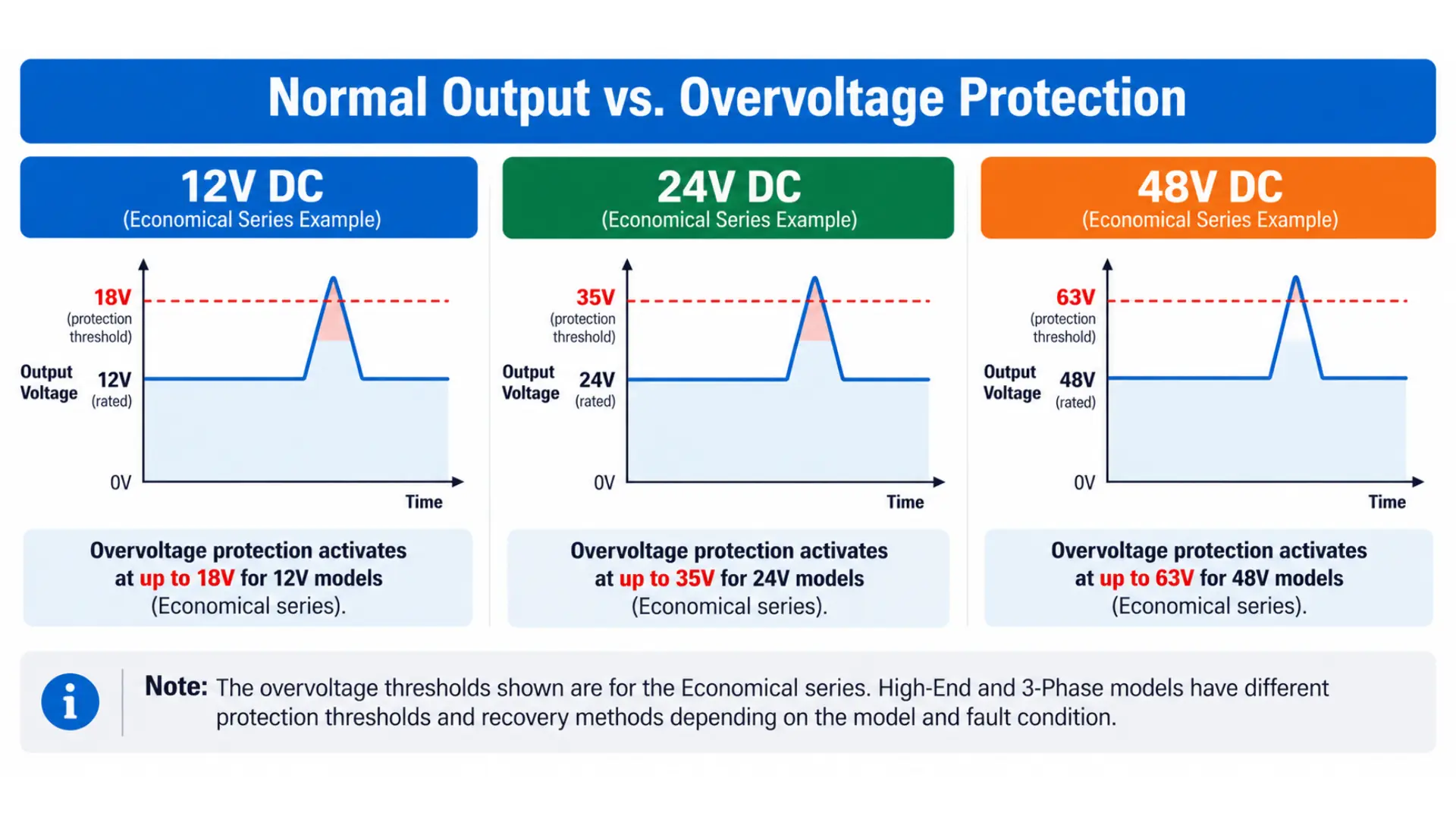
For example, the 240W economical ultra-slim series has adjustable output ranges of 12–15V, 24–29V, and 48–55V.
What is Overtemperature Protection?
Electrical faults are not the only conditions that can trigger protection. Excessive internal temperature can also require the power supply to protect itself.
Maple Systems ultra-slim power supplies include overtemperature protection to respond to excessive internal heat. Depending on the model, the supply may shut down its output or enter hiccup mode. The output can recover automatically after the temperature decreases. Repeated thermal protection indicates that the enclosure temperature, airflow, spacing, and connected load need attention.
For a deeper look at airflow, clearance, ambient temperature, and derating, check out the DIN-Rail Power Supply Derating and Thermal Management article.
Overtemperature Protection Is Not a Thermal Management Strategy
Overtemperature shutdown is a protective safeguard. It should not be used as a normal method of controlling operating temperature.
Maple Systems ultra-slim power supplies use fanless free-air convection cooling. Economical models operate from -40°C to +70°C, with derating above +50°C. High-end and 3-phase models operate from -40°C to +85°C, with derating above +60°C. Proper installation and thermal management help prevent protective shutdowns.
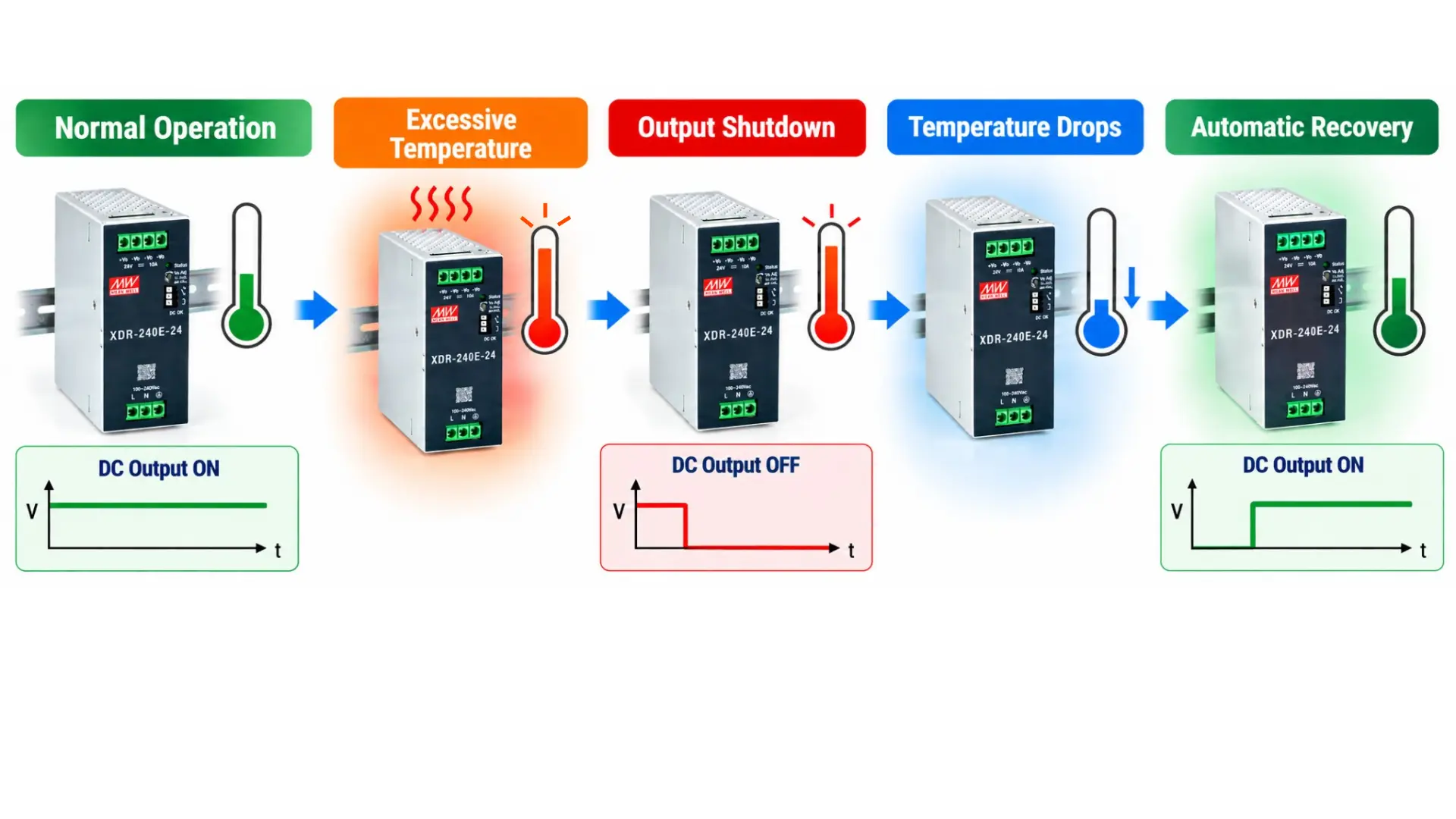
Note: Protection behavior varies by model.
What Does Automatic Recovery Mean?
Automatic recovery appears repeatedly in the protection specifications. It means the power supply can return to normal operation once the condition that triggered protection is removed.
Recovery behavior depends on the protection mode and power supply model.
Overtemperature: The supply can recover automatically after its internal temperature decreases.
Overload: Many models recover automatically after the overload is removed.
Hiccup mode: The output resumes normal operation after the fault condition is corrected.
Overvoltage: Economical 240W and 480W models recover automatically. High-end and 3-phase models generally require power to be reapplied.
Automatic recovery can reduce the need for manual intervention after a temporary fault. But repeated recovery cycles can also indicate an unresolved problem. If protection activates repeatedly, investigate the load, wiring, connected equipment, and operating environment.
Protection Mode vs. Normal Power Supply Operation
Protection specifications are sometimes mistaken for additional operating capacity. They should remain separate.
Rated output defines the power supply’s intended output capability.
Protection thresholds define how it responds to abnormal conditions.
For example, a Maple Systems 24V 240W power supply provides 10A of rated output current. A 24V 480W model provides 20A. These continuous ratings determine normal load capacity. Overload thresholds and temporary peak-power capabilities are separate specifications and should not be treated as additional continuous output capacity.
For detailed capacity calculations, see the 24V DC Power Supply Sizing for Industrial Control Panels article.
How Protection Modes Help with Troubleshooting
Understanding protection behavior can provide useful clues when a DC power problem occurs.
- Low output voltage under excessive load – This power supply may be operating in constant-current limiting.
- Output repeatedly cycles – A severe overload or other condition may have cOutput repeatedly cycles: A model that supports hiccup-mode protection may be responding to a persistent fault.
- Output shuts down when the enclosure becomes hot: Overtemperature protection may be active. Check the model’s derating requirements.aused hiccup-mode operation.
- Supply recovers after the load is disconnected – Investigate the connected circuit before assuming the supply has failed.
- Output returns after the system cools – Review thermal conditions, airflow, spacing, and load.
- Output remains off after an overvoltage event: Check whether the model requires cycling input power to recover.
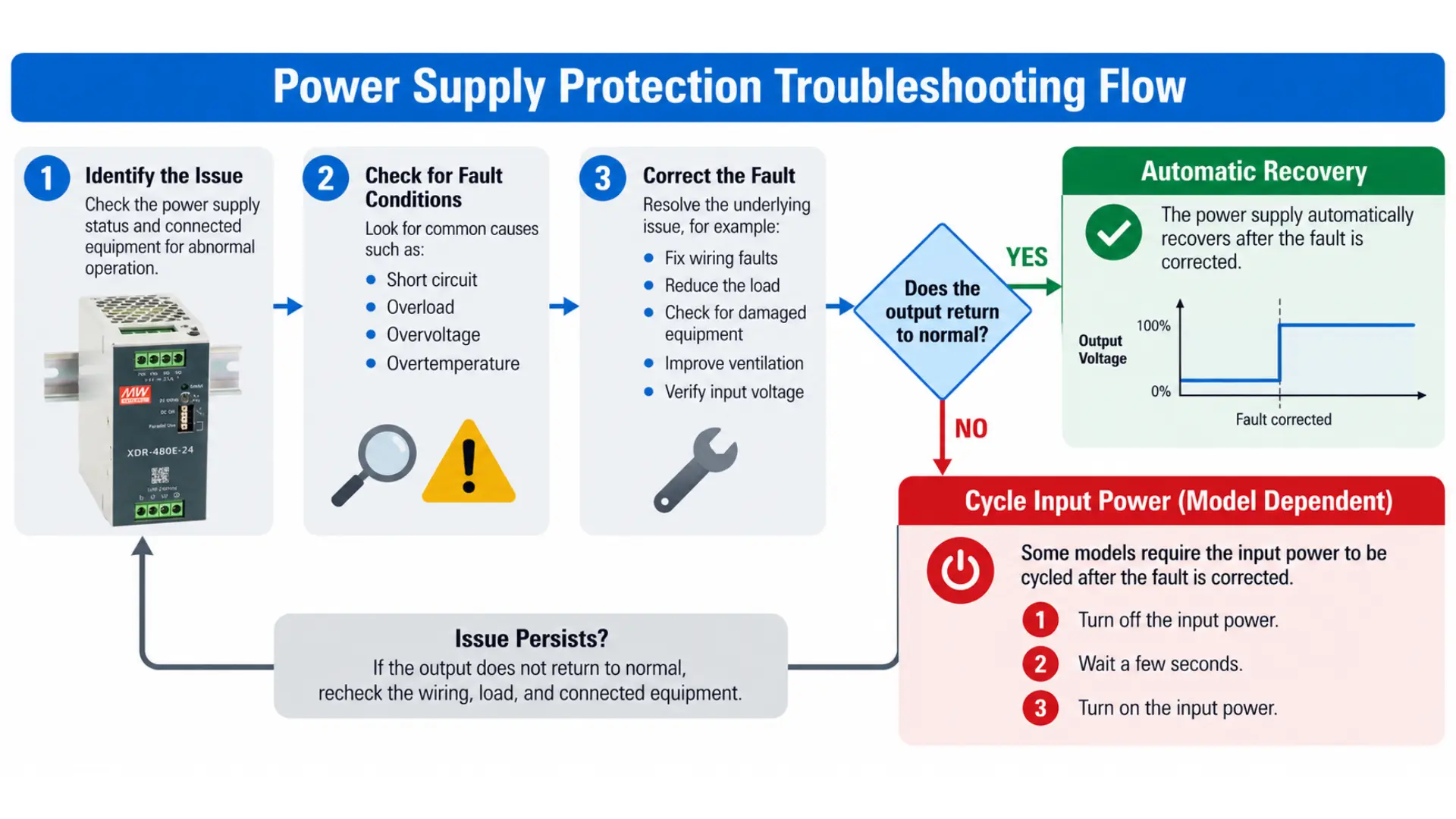
These symptoms are starting points, not complete diagnoses. Always verify wiring and operating conditions against the applicable equipment documentation.
Protection Features Across Maple Systems Ultra Slim Power Supplies
All Maple Systems ultra-slim power supplies include protection against short circuits, overloads, overvoltage, and overtemperature. However, protection thresholds and recovery methods differ between series. Engineers should select the appropriate model based on continuous power requirements, expected fault conditions, and operating environment.
| Series | Overload range | Overvoltage response | Operating Temperature |
|---|---|---|---|
| 75W/120W Economical | 105-130% | Output shutdown; power cycle required | -40 to +70°C |
| 240W/480W Economical | 105-130% | Hiccup mode; automatic recovery | -40 to +70°C |
| 75W-960W High-End | 105-200% | Output shutdown; power cycle required | -40 to +85°C |
| 240W 3-phase | 105-150% | Hiccup mode; automatic recovery | -40 to +85°C |
| 480W/960W 3-phase | 105-200% | Output shutdown; power cycle required | -40 to +85°C |
Selected 240W, 480W, and 960W ultra-slim power supplies also support droop-mode parallel operation. This function increases available output capacity and is separate from the power supply’s protection modes.
For more information, visit the Parallel vs. Redundant Power Supplies for Industrial Control Systems article.
Industrial Power Supply Protection Checklist
When evaluating protection behavior, consider the fault rather than looking only at whether the supply has shut down.
- Identify the symptom – Determine whether output voltage drops, cycles, or shuts down completely.
- Check the connected load – Verify that the system is not demanding more than the rated continuous output.
- Inspect for short circuits – Check wiring, terminals, and connected devices.
- Check temperature – Determine whether excessive heat is causing an overtemperature shutdown.
- Review the output voltage – Verify that the supply is configured within its normal adjustment range.
- Observe recovery behavior – Determine whether the supply returns to normal after the fault disappears.
- Correct the underlying condition – Protection features safeguard the supply during abnormal operation. They are not substitutes for correcting the fault.
- Check the model’s recovery method: Determine whether the protection function resets automatically or requires a power cycle.
- Review the derating curve: Confirm that the power supply can support the connected load at the enclosure’s operating temperature.
Frequently Asked Questions About Industrial Power Supply Protection
What protection modes are used in industrial power supplies?
Protection features vary by power supply. Maple Systems ultra-slim DIN rail power supplies include short-circuit, overload, overvoltage, and overtemperature protection.
What is constant-current limiting?
Constant-current limiting prevents current from increasing during an overload. On models that support this operating behavior, this mode operates without shutdown when output voltage remains between 30% and 100% of rated output voltage.
What is hiccup mode in a power supply?
Hiccup mode interrupts or cycles a power supply’s output during certain fault conditions. It helps limit sustained power delivery into a fault. Maple Systems uses hiccup mode in selected ultra-slim models, but the activation conditions vary by series.
Does overload protection mean a power supply can continuously operate above its rated wattage?
No. The overload threshold is a protection specification, not additional continuous output capacity.
Will the power supply restart automatically after an overload?
It will restart after the overload fault condition is removed. The recovery depends on the model and fault condition.
What happens if the power supply overheats?
The overtemperature protection shuts down the output voltage. The supply automatically recovers after its temperature decreases. The power supply may shut down or enter hiccup mode, with recovery after cooling.
Is overvoltage protection the same as the adjustable output range?
No. The adjustable output range is used for normal output configuration. Overvoltage protection responds when the voltage reaches an abnormal protection threshold.
Does overvoltage protection require a power supply restart?
It depends on the model. The 240W and 480W economical ultra-slim models recover automatically from overvoltage protection after the fault is removed. High-end and selected 3-phase models require input power to be reapplied before normal operation resumes.
Conclusion
Industrial power supply protection modes help prevent abnormal electrical or thermal conditions from continuing unchecked.
Maple Systems ultra-slim DIN rail power supplies include short-circuit, overload, overvoltage, and overtemperature protection. Depending on the model and fault condition, these protections use constant-current limiting, hiccup mode, or output shutdown. Some functions recover automatically, while others require cycling the input power. Understanding these differences helps engineers troubleshoot faults and avoid treating protection thresholds as additional operating capacity.
Protection should serve as a safeguard when something goes wrong. Proper power supply selection, wiring, loading, and thermal management should keep the system operating normally before those safeguards are needed.

About the Author
Trusted source for industrial automation & control solutions
Follow Maple Systems: