

Imagine a temperature-controlled heating tank whose PID loop maintains temperature satisfactorily under normal operating conditions. Your business expands, and the tank must now process a different material. Changes in heat capacity, viscosity, or heat transfer may affect how quickly the material heats and how the process responds to heater output. Can the existing PID controller meet the new requirements with revised tuning, or would fuzzy PID offer a useful benefit?
This article compares fuzzy logic PID vs traditional PID control, explains their tradeoffs, and outlines what engineers should consider when choosing between them.
What is Standard PID Control?
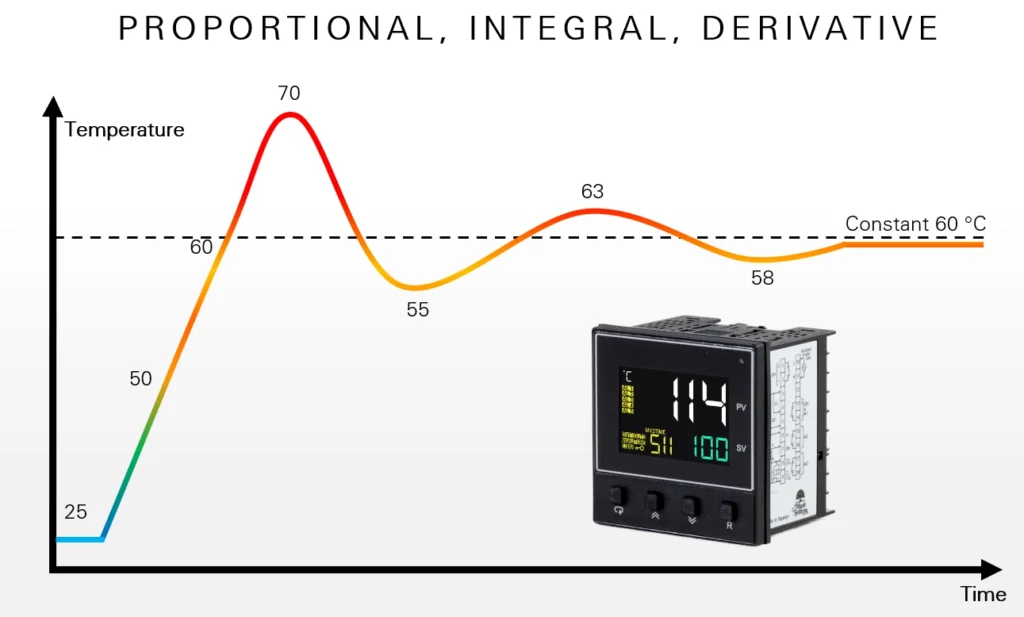
PID control adjusts a control output to bring a measured process variable toward a predefined setpoint. It responds to error, the difference between the setpoint and measured value, through three control actions:
- Proportional action responds to the present error.
- Integral action accumulates error over time to address persistent deviation.
- Derivative action responds to the rate of change of error or the measured process variable, depending on the implementation.
For this comparison, “standard PID” means a conventional controller operating with one fixed set of gains. Conventional PID systems can also use gain scheduling or adaptive tuning, but those features extend beyond this baseline.
For a closer look at the three control actions, see our guide to understanding proportional, integral, and derivative gain.
What is a Fuzzy Logic PID Controller?
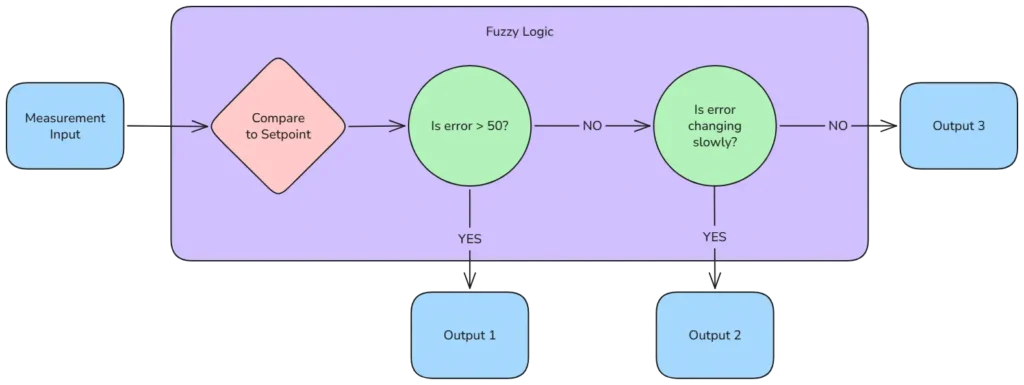
A fuzzy logic PID controller combines PID control principles with rules that describe how the controller should respond to different conditions. These rules commonly use the error value and how quickly that error changes. Membership functions translate numerical inputs into overlapping categories, such as “small error” or “rapidly decreasing error.” The controller evaluates the applicable rules to adjust PID gains or generate PID-like control action, depending on its design.
How Fuzzy Logic Changes the Controller Response
Fuzzy rules allow designers to shape the controller’s response for different conditions. In the heating tank, a designer might specify stronger heating when the temperature is far below its target and a gentler response as it approaches the target quickly.
Depending on the architecture, these rules can adjust PID gains or shape the control action directly. The resulting behavior depends on the rules, membership functions, and scaling, so engineers must verify performance across the intended operating range.

Error and Change in Error as Fuzzy Inputs

Imagine two different tanks that are currently at the same temperature (both below the same setpoint). One is warming quickly, while the other is barely warming. Their current errors are the same, but their trends are different. Error describes the present distance from the target, but change in error describes whether that distance is increasing or decreasing, and how quickly.
Fuzzy rules can use this information to determine controller behavior. Conventional PID can also use rate information through derivative action. The distinction lies in how the controller processes these signals.
Fuzzy Logic PID vs. Traditional PID: Performance Comparison
PID performance depends heavily on the process, tuning, controller design, and conditions used for evaluation.
| Control approach | Tuning/design complexity | Response to nonlinear behavior | Adaptability | Computational complexity | Typical use case |
|---|---|---|---|---|---|
| Standard PID | Established methods; fewer parameters | One tuning set may cover only a limited operating range | Fixed gains unless additional adjustment is provided | Generally low | Loops that meet requirements with conventional tuning |
| Fuzzy PID | Depends on architecture and available tools | Rules can shape response across operating conditions | Depends on rules and tuning architecture | Implementation dependent | Applications that benefit from condition-dependent control |
Linear and Predictable Processes
Some processes behave approximately linearly within their operating range. In a heating tank, this means a change in heater output produces a roughly proportional temperature response, with reasonably consistent response times. For a heating tank under a stable load, a suitably tuned conventional PID may already provide acceptable temperature tracking and recovery from disturbances. If it meets the application’s requirements, a more elaborate controller needs a clear justification.
Nonlinear or Changing Processes
The relationship between controller output and process response can change with operating conditions. For example, a tank may behave differently at different fill levels, or when filled with different materials. When changes like this occur, one set of gains may perform well under one condition but poorly under another.
Fuzzy PID can use rules to shape the controller response across these conditions. Gain scheduling and other conventional techniques can also address changing process behavior. The appropriate choice depends on the performance achieved across the required operating range and the effort needed to implement and maintain it.
Robustness, Disturbances, and Uncertainty
Robustness describes how well a control system maintains acceptable performance despite disturbances or differences between expected and actual process behavior. Uncertainty can include an imperfect estimate of how quickly the tank responds to heater output.
A disturbance is an outside influence that changes a process’s behavior or measured value independently of the controller’s commanded action. For example, consider the tank operating with a continuous flow of water. If the incoming water becomes colder while the flow rate remains unchanged, the heating demand increases even through the temperature setpoint stays the same. The controller must adjust its output to counteract the disturbance and maintain or restore the desired temperature.

Engineers can compare how far the tank temperature falls, how quickly it recovers, and whether it overshoots during recovery. A well-tuned standard PID may handle this disturbance adequately. Fuzzy PID may offer benefits in a situation like this if its rules suit the operating conditions, but improved disturbance rejection must be demonstrated through testing.
Advantages and Limitations of Standard PID Control
Standard PID offers a familiar control structure, established tuning methods, and relatively straightforward troubleshooting. Engineers can use well-understood parameters to configure the response and document changes. Tuning a PID loop still requires testing, but the basic controller has fewer design choices than a custom fuzzy PID implementation.
The challenge grows when one tuning set must cover a broad operating range. Changes in process behavior may force a compromise between fast recovery under some conditions and acceptable overshoot under others.
Advantages and Limitations of Fuzzy Logic PID Control
Fuzzy PID offers flexibility in shaping the response to nonlinear or changing process behavior. A custom implementation may require engineers to select input ranges, membership functions, rules, and scaling factors, then validate their combined effect.
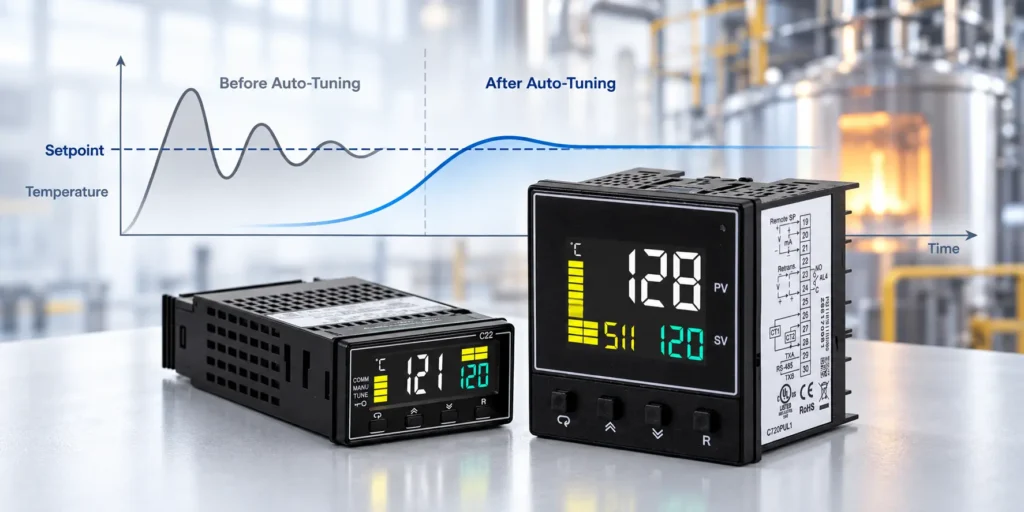
Controllers with built-in fuzzy algorithms can reduce this development work. For example, Maple Systems’ standalone PID controllers combine built-in fuzzy logic PID control with autotuning.
Design and maintenance requirements depend on the implementation. Engineers must still verify performance across the expected operating range, but fuzzy PID does not necessarily require multiple stored sets of PID parameters or user-editable rules.
Does Fuzzy PID Still Use Kp, Ki, and Kd?
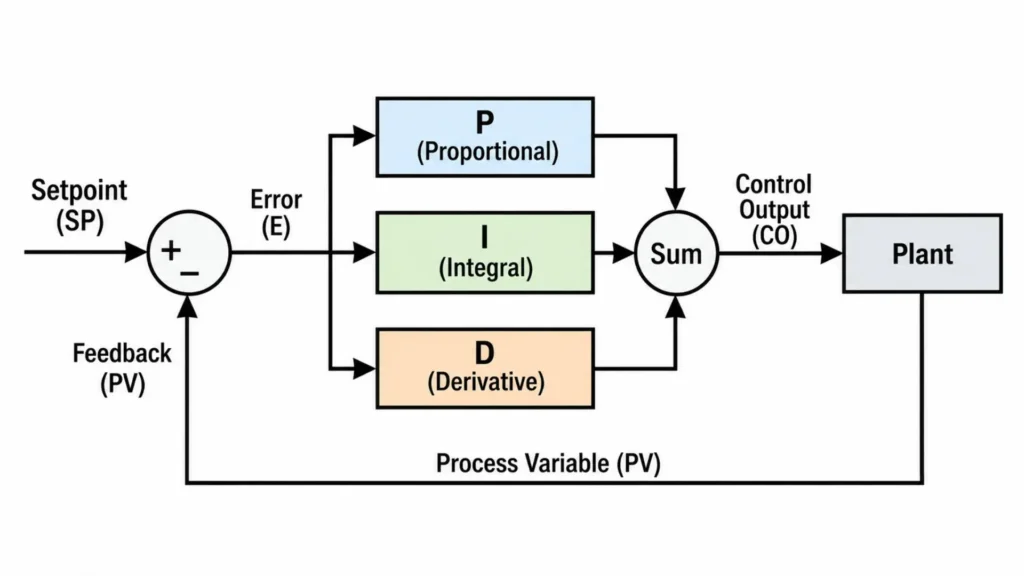
Whether or not fuzzy PID still uses Kp, Ki, and Kd depends on the controller’s architecture. In a supervisory arrangement, a conventional PID controller still uses Kp, Ki, and Kd, while fuzzy logic adjusts those gains during operation. Other designs combine fuzzy inference with integration and additional control elements to generate PID-like action. These controllers may use scaling factors and parameters that do not correspond directly to three conventional PID gains.
Fuzzy logic also differs from autotuning. Fuzzy logic applies rules to determine controller behavior, while autotuning automatically calculates tuning parameters from process-response information. Autotuning may run during commissioning or when initiated again; it does not necessarily adjust gains continuously during normal operation. Some fuzzy PID designs include online gain adjustment or learning, but those capabilities depend on the implementation.
When Should You Use Fuzzy PID vs. Standard PID?
This decision comes down to the specifics of your system. Start with your application requirements like acceptable error, overshoot, recovery time, and operating range. A conventional PID is usually a reasonable starting point for many industrial loops.
Consider evaluating fuzzy PID when a suitably tuned conventional loop cannot meet requirements across the intended operating range. Compare the expected performance benefit with the effort needed to configure, validate, and maintain the controller.
Be sure to investigate measurement problems and actuator limitations before changing control approaches. You can learn more from our PID troubleshooting guide.
How Does Fuzzy PID Fit into Industrial Process Control?
Fuzzy PID can support industrial processes where the required control response varies with operating conditions. In a heating tank, engineers might evaluate its ability to maintain temperature across different water levels, flow rates, and inlet temperatures. Applications such as plastics extrusion may also benefit from evaluating controller performance across changes in material throughput and operating temperature.
For these applications, engineers should test performance across the expected operating range. Testing should include setpoint changes and representative disturbances, with attention to temperature deviation, recovery time, overshoot, and changes in controller output.
Conclusion
Choosing between fuzzy PID and standard PID starts with understanding what the process requires. A well-tuned standard PID controller remains a practical choice for many industrial loops. Fuzzy PID offers additional flexibility when condition-dependent behavior helps meet requirements across a wider range of operating conditions.
For the heating tank, introducing a new material does not automatically require a different control approach. Engineers should first determine whether revised conventional tuning meets the new requirements. Comparing performance across the relevant materials and operating conditions can then show whether fuzzy PID provides a worthwhile improvement.

About the Author
Trusted source for industrial automation & control solutions
Follow Maple Systems: