
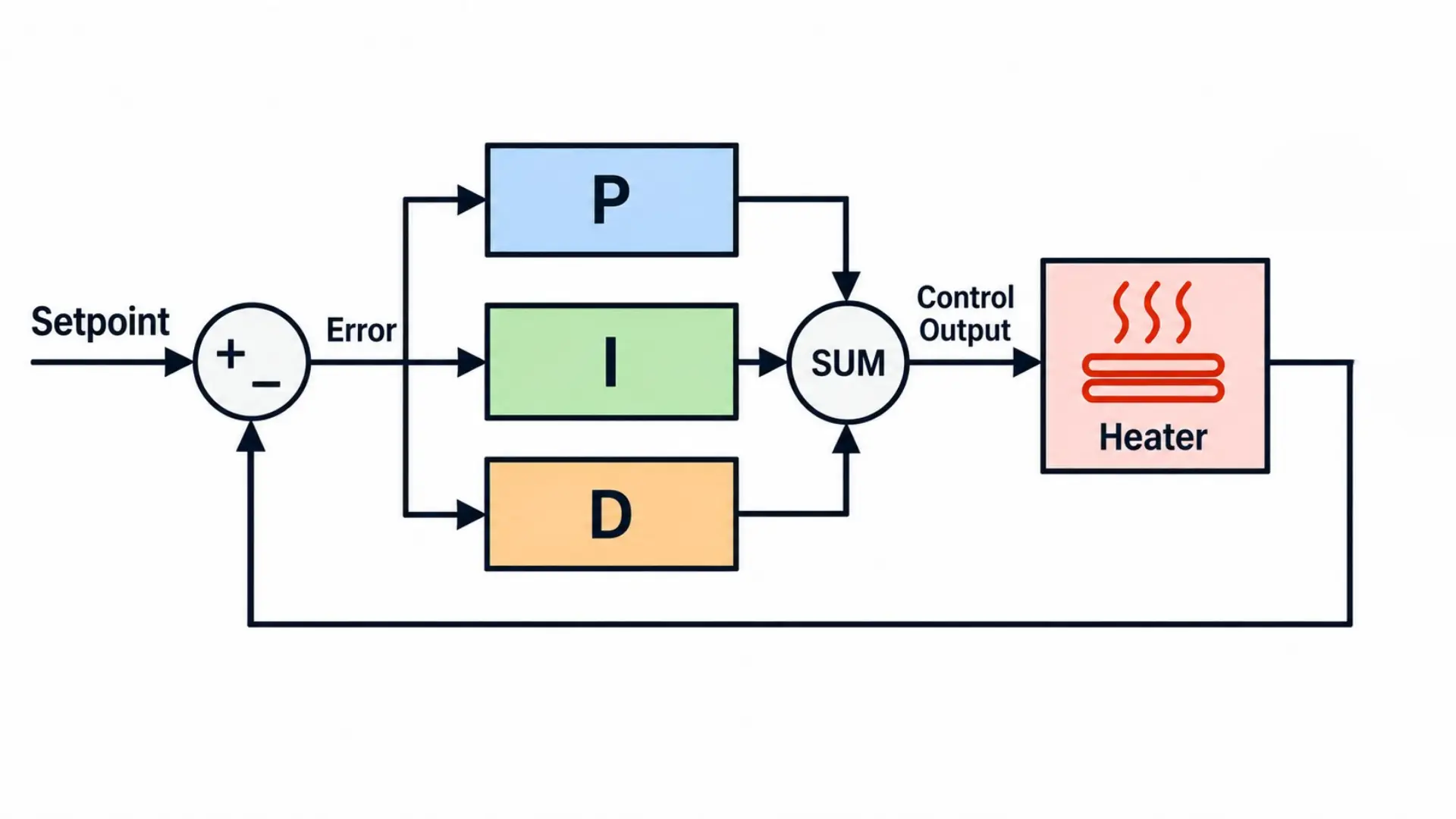
Proportional gain (Kp), integral gain (Ki), and derivative gain (Kd) determine how a PID controller responds to process errors. Each parameter affects response speed, accuracy, and stability.
Knowing these three terms helps engineers configure a proportional-integral-derivative (PID controller to control temperature, pressure, flow, and other industrial process variables.
What Are PID Gains?
PID gains are tuning parameters that control how a PID controller responds to differences between a desired setpoint and a measured process variable.
A PID control loop uses three primary values:
- Setpoint (SP): The desired process value.
- Process Variable (PV): The actual measured value.
- Error: The difference between the setpoint and process variable.
For example, a temperature controller maintaining 200°F detects an error when the measured temperature falls to 190°F.
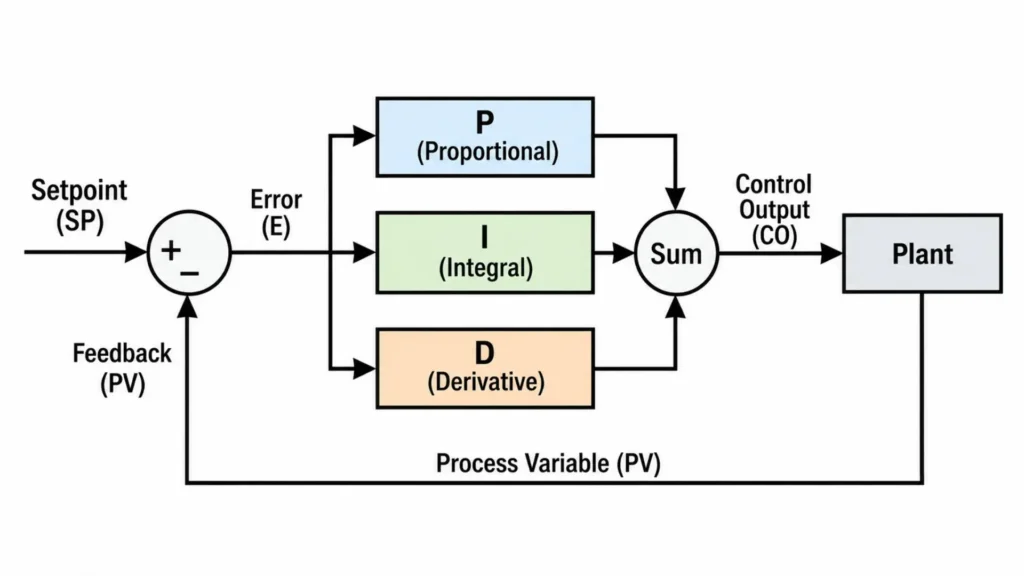
The controller calculates a corrective output using three control actions:
- Proportional (Kp): Responds to the current error.
- Integral (Ki): Responds to accumulated error over time.
- Derivative (Kd): Responds to the rate of change.
A common parallel-form PID equation is:
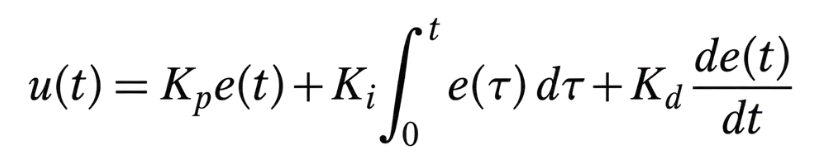
The u(t) represents the controller output, and e(t) represents the error over time. This equation illustrates the three control items. Actual controllers may use different PID algorithms and parameters.
Understanding Proportional Gain (Kp) in PID Loops
Proportional gain determines how strongly a controller responds to the current error between the setpoint and process variable. Increasing Kp generally produces a stronger corrective response, while decreasing Kp reduces the controller’s reaction.
How Proportional Gain Responds to Error
Proportional control adjusts the output in proportion to the error. Consider a temperature controller maintaining a setpoint of 200°F. If the temperature falls to 190°F, the controller detects a 10°F error. A higher proportional gain produces a larger output correction for that error. A lower gain produces a smaller correction. As the temperature approaches the setpoint, the proportional correction decreases.
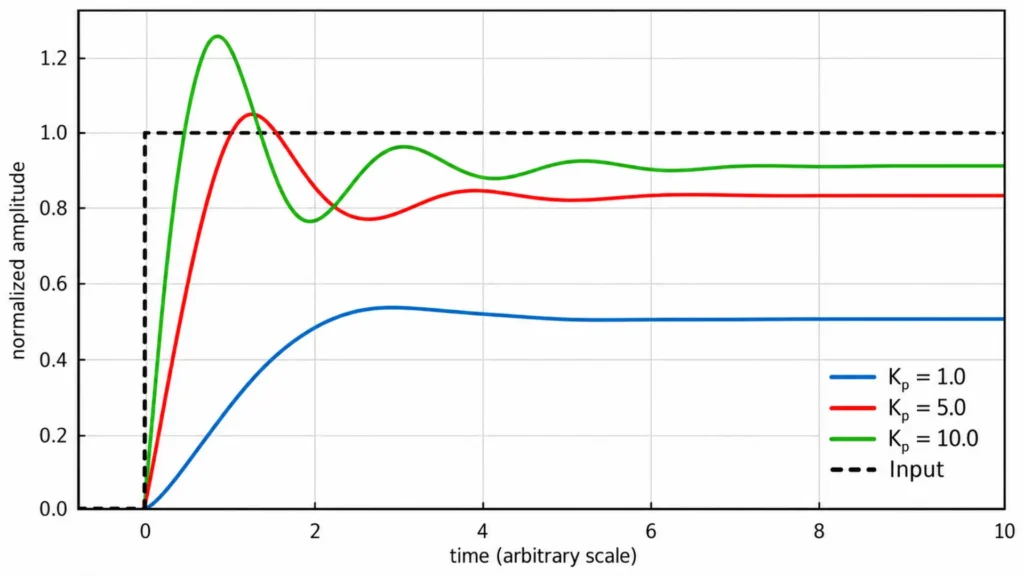
But proportional-only control may leave a steady-state error because maintaining the required output can depend on a remaining difference from the setpoint.
What Happens When Kp Is Too High or Too Low?
Incorrect proportional gain can affect response speed and stability.
- Kp too low: The process responds slowly and may maintain a steady-state error.
- Kp properly tuned: The controller responds quickly while maintaining acceptable stability.
- Kp too high: The process may overshoot, oscillate, or become unstable.
For temperature applications, excessive proportional gain may cause repeated heating adjustments around the setpoint. The objective is to provide sufficient corrective action without creating excessive oscillation.
Understanding Integral Gain (Ki) and Reset Time in PID Loops
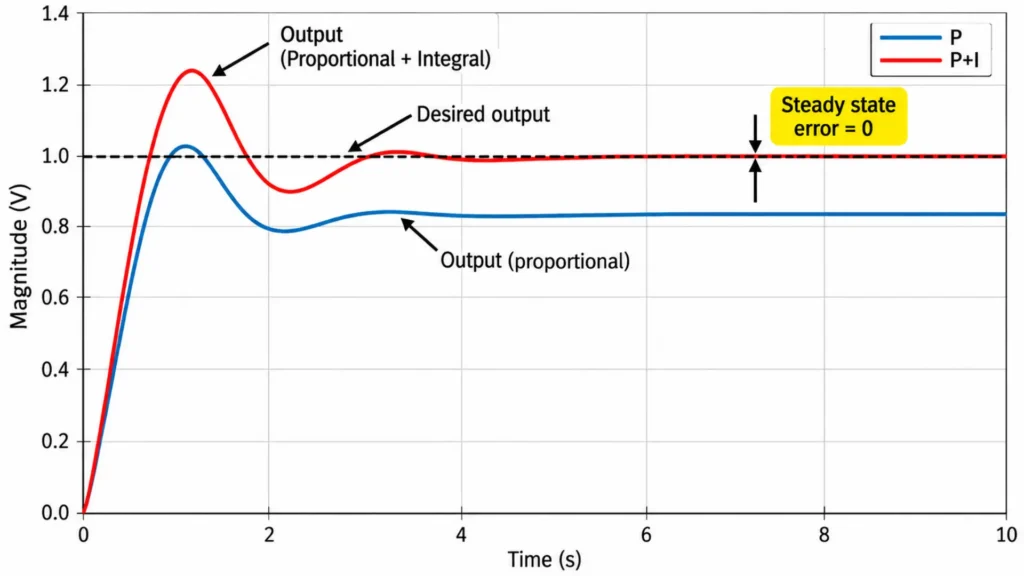
Integral gain deals with the error that is left over after the proportional action has taken place. Rather than just reacting to the present error, integral action takes into account the cumulative error over time.
How Integral Gain Eliminates Steady-State Error
Integral action ramps the controller output up or down as long as there is an error.
For instance a temp controller could be sitting at 195°F even though the setpoint is 200°F. Proportional control could maintain this condition as the residual error would give the required output to balance the heat loss. Integral action will keep on adjusting the output until the residual error is effectively zero (assuming the system has the requisite capacity). Increasing the integral gain will generally get rid of the steady state error quicker. The downside of too much integral action is that it can lead to overshoot and oscillation.
Integral Gain vs. Reset Time
Integral gain and reset time are two settings which describe quite similar control behaviour but are not in any way interchangeable. Integral gain (Ki) is essentially the amount of integral action. Reset time (also known as integral time (Ti)) is a measure of how fast the integral action builds up in comparison to the proportional action.
In a common dependent PID formulation:
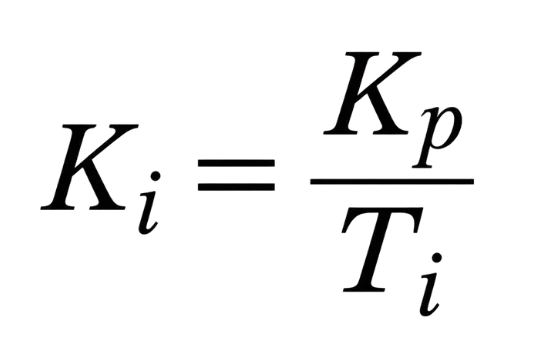
Under that convention decreasing integral time increases integral action.
Maple Systems PID controllers have integral time settings ranging from 0 to 3600 seconds. You should stick to their parameter conventions rather than entering the equivalent Ki values. The exact relationship between integral gain and reset time is dependent upon the PID algorithm being used.
Integral Windup
Integral windup occurs when the accumulated error is continuing to increase whilst the controller is unable to generate any more corrective output.
For instance the heater could be running at full output and the actual temperature still be below the setpoint. The integral term would then keep on accumulating. When the temperature does eventually rise the accumulated correction can result in a large overshoot. This is one of the situations where proper tuning, output limits and supported anti-windup will make all the difference.
Understanding Derivative (Kd) and Rate Time in PID Loops
Derivative gain responds to how quickly the process error changes. Unlike proportional control, which reacts to the current error, derivative control considers the rate of change. This action can improve stability and reduce overshoot.
How Derivative Gain Responds to Rate of Change
Derivative control evaluates how quickly the error or process variable is changing, depending on the controller algorithm.
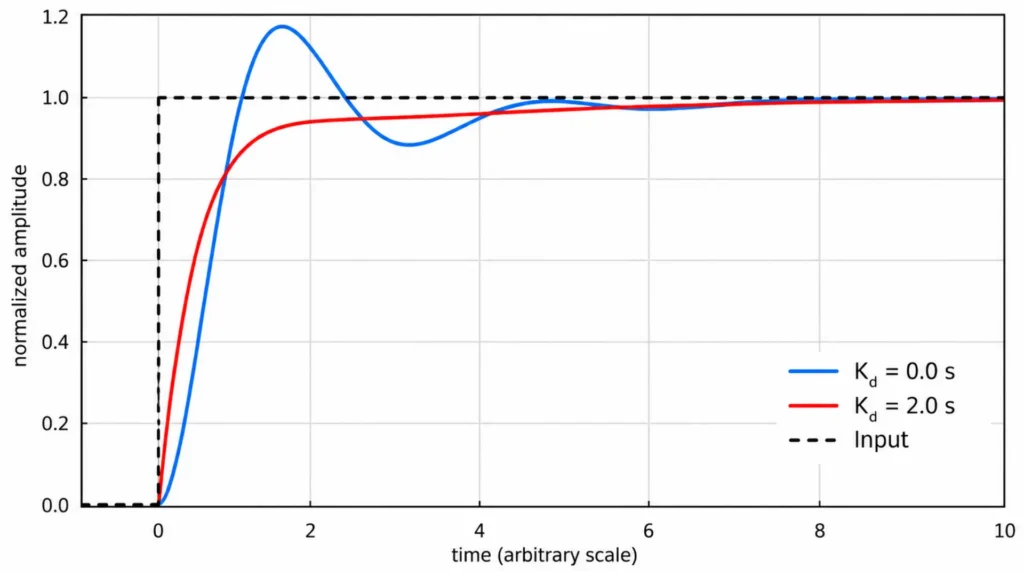
For instance a heating process might go right to its 200°F setpoint. Derivative action can then be used to reduce the controller’s corrective output as the temperature nears the setpoint thus helping to prevent excessive overshoot. The more derivative gain you have the greater the damping effect. Of course derivative action on its own will not eliminate the steady state error as its contribution goes to zero when the measured value is no longer changing.
Derivative Gain vs. Rate Time
Derivative gain and rate time are two ways of describing essentially the same behaviour, just using different parameterisations. Derivative gain (Kd) is the gain of the derivative action in a parallel form PID equation. Rate time (also known as derivative time Td) is the derivative contribution relative to the proportional action.
In a common dependent PID formulation:
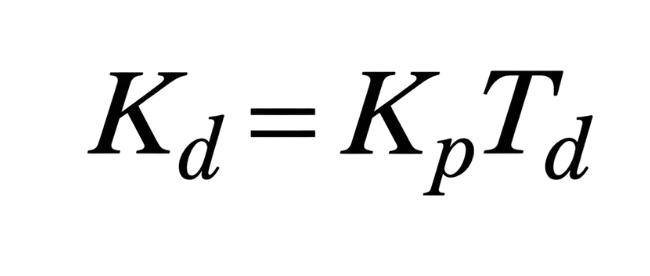
Under this convention, increasing derivative time strengthens derivative action.
Maple Systems PID controllers have derivative time settings ranging from 0 to 360.0 seconds. The relationships are controller specific and should not be considered as general conversion factors.
Why Derivative Action Is Sensitive to Noise
Derivative control responds to rapid changes in the measured signal. Electrical interference, sensor interference, and measurement fluctuations can create sudden changes that produce unnecessary derivative corrections. Excessive derivative action may cause rapid output fluctuations, even when the actual process remains relatively stable.
A sudden setpoint change can also lead to a large derivative response in controllers that calculate their derivative action from error (ex: derivative on error). This is known as derivative kick. Derivative-on-measurement implementations can avoid derivative kick due to setpoint changes. Filtering can reduce noise sensitivity, though too much filtering can delay the response.
How Kp, Ki, and Kd Work Together in a PID Controller
Proportional, integral, and derivative actions work together to correct process errors. Each term contributes differently to the controller’s output.
| PID Term | What it responds to | Main effect | When too aggressive |
|---|---|---|---|
| Proportional (Kp) | Current error | Increases corrective response | Overshoot and oscillation |
| Integral (Ki) | Accumulated error | Eliminates steady-state error | Windup and instability |
| Derivative (Kd) | Rate of change | Improves damping and reduces overshoot | Noise sensitivity and output fluctuations |
Consider a temperature controller maintaining a 200°F setpoint. When the measured temperature drops, proportional action increases heater output based on the current error. If the temperature stays below the setpoint, integral action keeps increasing the correction. As the temperature nears the setpoint, derivative action helps reduce overshoot by responding to the rate of temperature change. The controller continuously combines these actions to regulate the process.
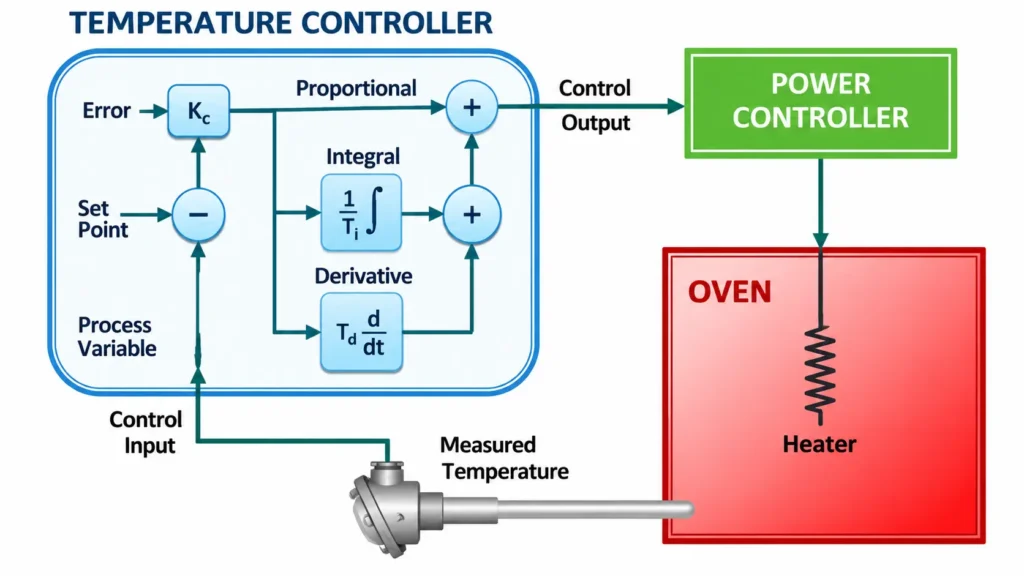
Not every application requires all three terms. Some processes operate effectively using proportional-integral (PI) control without derivative action.
How PID Gains Affect System Response
PID gains determine how quickly a process responds, how far it will go beyond the setpoint and how accurately it will track the setpoint. These are all factors which an engineer will want to consider when assessing the quality of tuning.
Response Speed and Rise Time
Rise time describes how quickly a process moves toward its target following a setpoint change. Increasing proportional gain often reduces rise time by producing a stronger corrective response. Integral action can also speed the response by increasing output when an error persists.
But faster response does not always produce better control. Aggressive tuning may introduce overshoot or oscillation.
Overshoot and Oscillation
Overshoot occurs when the process variable exceeds its intended setpoint. Oscillation occurs when the process repeatedly moves above and below the setpoint. Excessive proportional or integral action can contribute to these conditions. Derivative action can improve damping, but excessive derivative settings may introduce noise-related output fluctuations.
A properly tuned PID controller balances response speed with acceptable overshoot and settling behavior.
Steady-State Error and Stability
Steady-state error is the remaining difference between the setpoint and process variable after the process settles. Proportional-only control may maintain a steady-state error under constant load conditions. Integral action helps eliminate this remaining error.
But excessive integral action can reduce stability and increase settling time. Stable PID control requires the appropriate combination of proportional, integral, and derivative action for the process.
How are PID Gains Tuned?
PID tuning adjusts controller parameters to balance response speed, overshoot, and stability. Common approaches include manual tuning, established methods, and automatic tuning.
Manual tuning adjusts control parameters while observing the process response. Engineers evaluate changes in rise time, oscillation, and steady-state error. Ziegler-Nichols and Tyreus-Luyben methods use measured process characteristics or sustained oscillation data to estimate initial PID settings. These methods provide starting values that may need further adjustment.
Auto-tuning allows a controller to evaluate process behavior and determine suitable initial parameters.
Maple Systems PID controllers support fuzzy logic modified PID control and cold-start and warm-start auto-tuning. They also support thermocouple, RTD, current, and voltage inputs, with 200 ms input sampling. These features support industrial temperature and process control applications. However, evaluate auto-tuning results under normal operating conditions.
For additional guidance, see the Maple Systems heater temperature control example.
Conclusion
Proportional, integral and derivative gain determine how the controller responds to the process error. Kp is the gain which determines the immediate response to the error, Ki is the gain which eliminates the accumulated error (i.e. the steady state error), and Kd is the gain which helps to reduce overshoot by responding to the rate of change of the error. The correct tuning of the three gains is required to achieve a stable, accurate and responsive control action.
Maple Systems PID controllers provide configurable proportional band, integral time, and derivative time settings, along with auto-tuning capabilities. Understanding these parameters helps engineers select appropriate settings and maintain reliable industrial process control.
For more details see the Maple Systems PID Controllers and What Is a PID Controller?.

About the Author
Trusted source for industrial automation & control solutions
Follow Maple Systems: