
Industrial control systems have to respond to process changes without continually adjusting their output. Small signal variations can lead to unnecessary switching, actuator movement and equipment wear.
Understanding hysteresis and deadband in the context of industrial PID control is key to achieving the right balance between stability, responsiveness and accuracy. Both can reduce output chatter, though if taken too far they can also result in a delay in the correction of a process variable. Mechanical hysteresis can also be a factor in preventing the equipment from responding in a consistent manner.
This article explains how hysteresis and deadband work, how they differ, and how to apply them efficiently.
What Are Hysteresis and Deadband in PID Control?
Hysteresis and deadband have an effect on how the controller (or final control element) reacts to a changing signal.
Hysteresis is a response that depends on the direction of change or the system’s previous state. In the case of switching control it defines different thresholds for turning the output on and off.
Deadband is a range where small variations in the signal or control error will have no effect at all. Its behavior is depends on where you actually apply the deadband.
Both concepts can prevent unnecessary control activity, but they are not interchangeable.
For instance, a temperature controller might be using hysteresis to stop the heater from cycling all the time. Another control system might be using deadband to ignore the small deviations that would occur right around the setpoint. Some controllers will also use the term deadband to describe the separation or overlap between the heating and cooling outputs. This is different from simply suppressing small PID errors. Understanding the difference matters because it can prevent incorrect configuration and avoid some unexpected behavior.
What is Hysteresis in Industrial Control?
Hysteresis is when the system behaves differently depending on whether the input is rising or falling. In an industrial context, it can be deliberately configured or result from the system’s mechanical behavior. Configured hysteresis will give you a very predictable set of switching thresholds. Mechanical hysteresis can of course lead to some unanticipated delays or inconsistencies in the actuator movement.
Hysteresis in On/Off Control
ON-OFF control with hysteresis is a commonly used form of control in temperature control and other applications where you just want simple on/off switching. Without hysteresis you could have a heater cycling on and off as the process variable (PV) fluctuates around the setpoint. Take a heating system with a 100°C setpoint as an example.
An illustrative hysteresis configuration might operate as follows:
- The heater switches on at 98°C.
- The heater stays on as the temperature rises.
- The heater switches off at 102°C.
- The heater stays off until the temperature has dropped back down to 98°C.
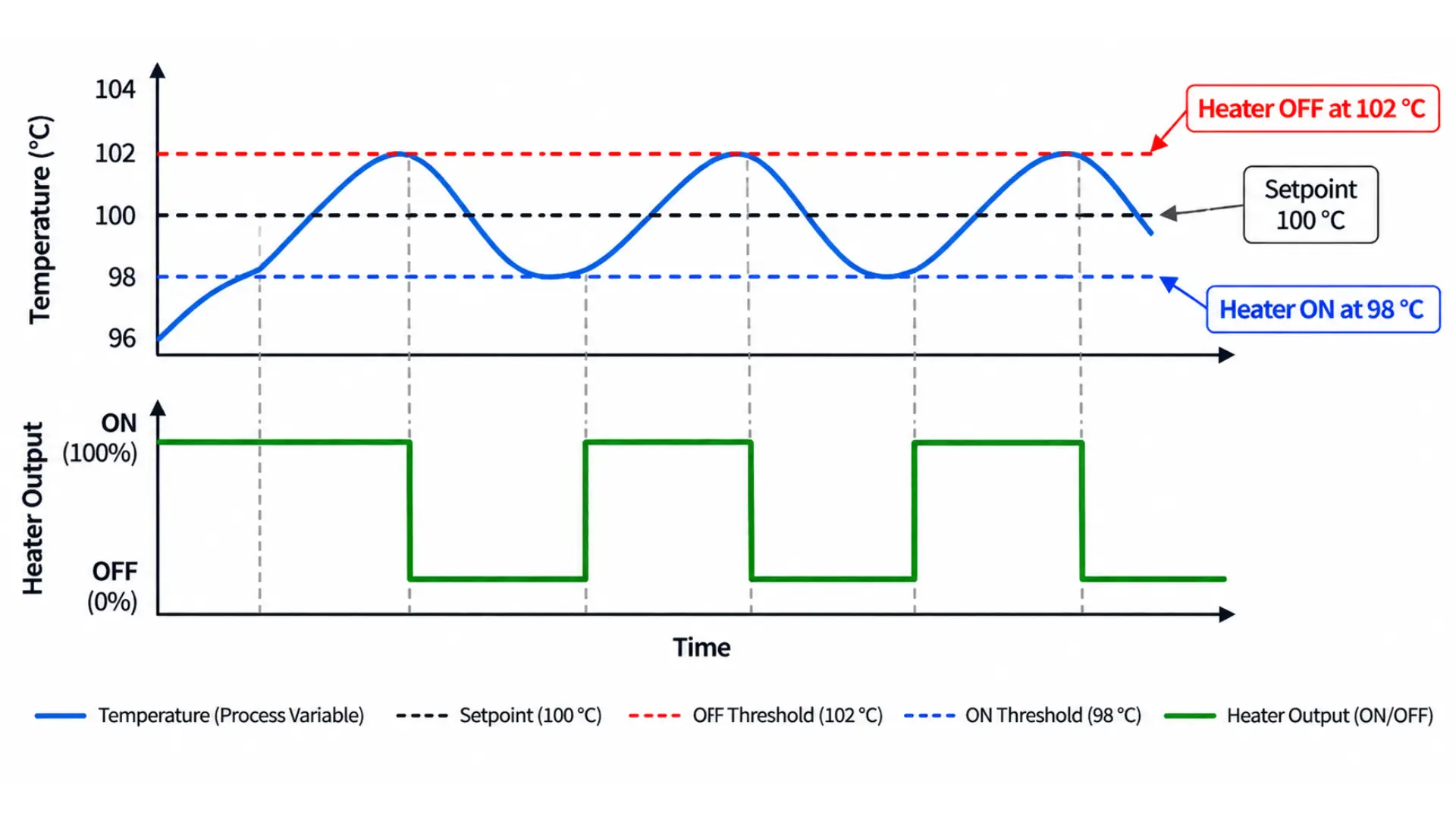
The four-degree switching differential prevents rapid cycling right at the setpoint. The exact threshold arrangement is controller-dependent.
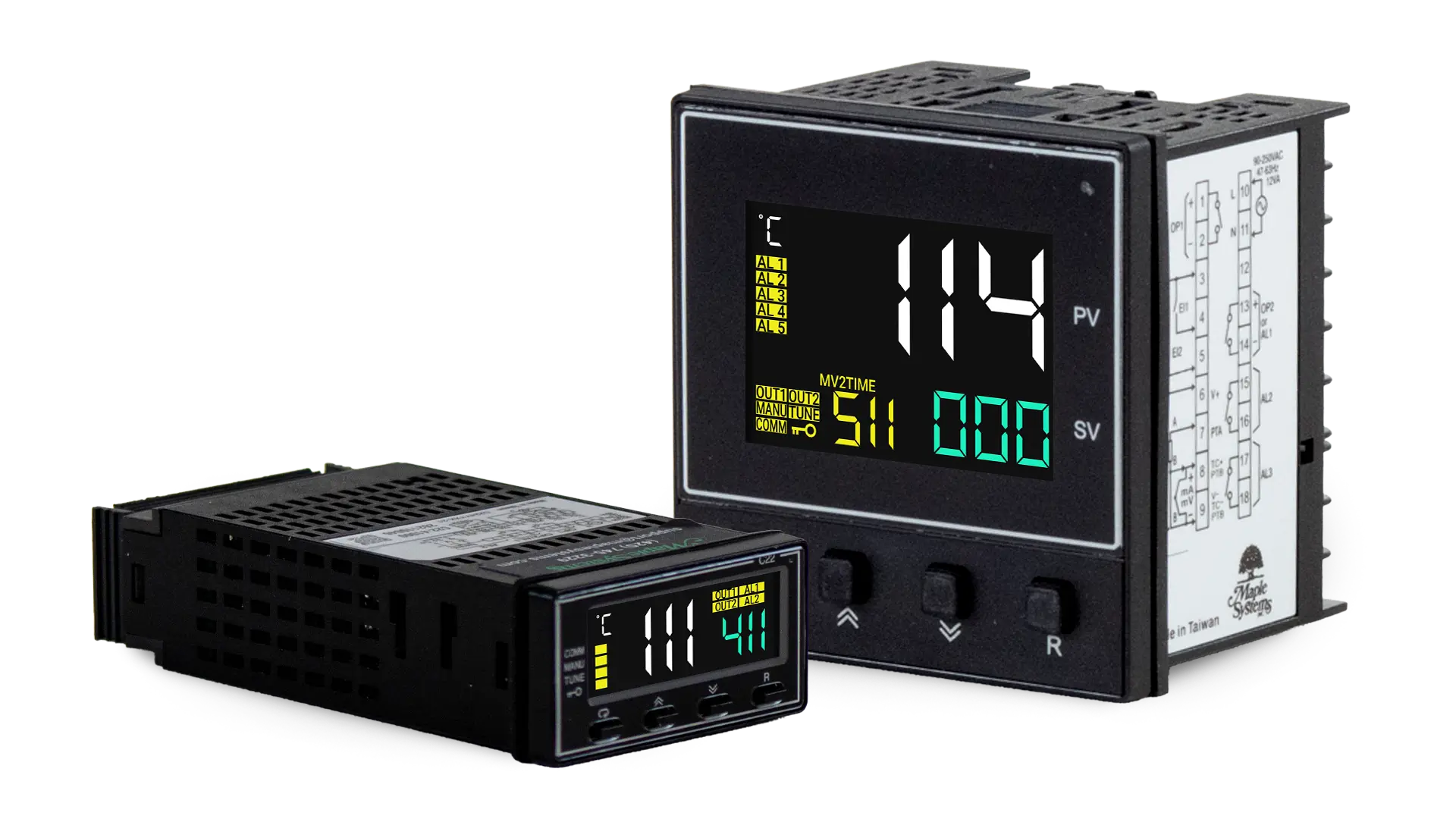
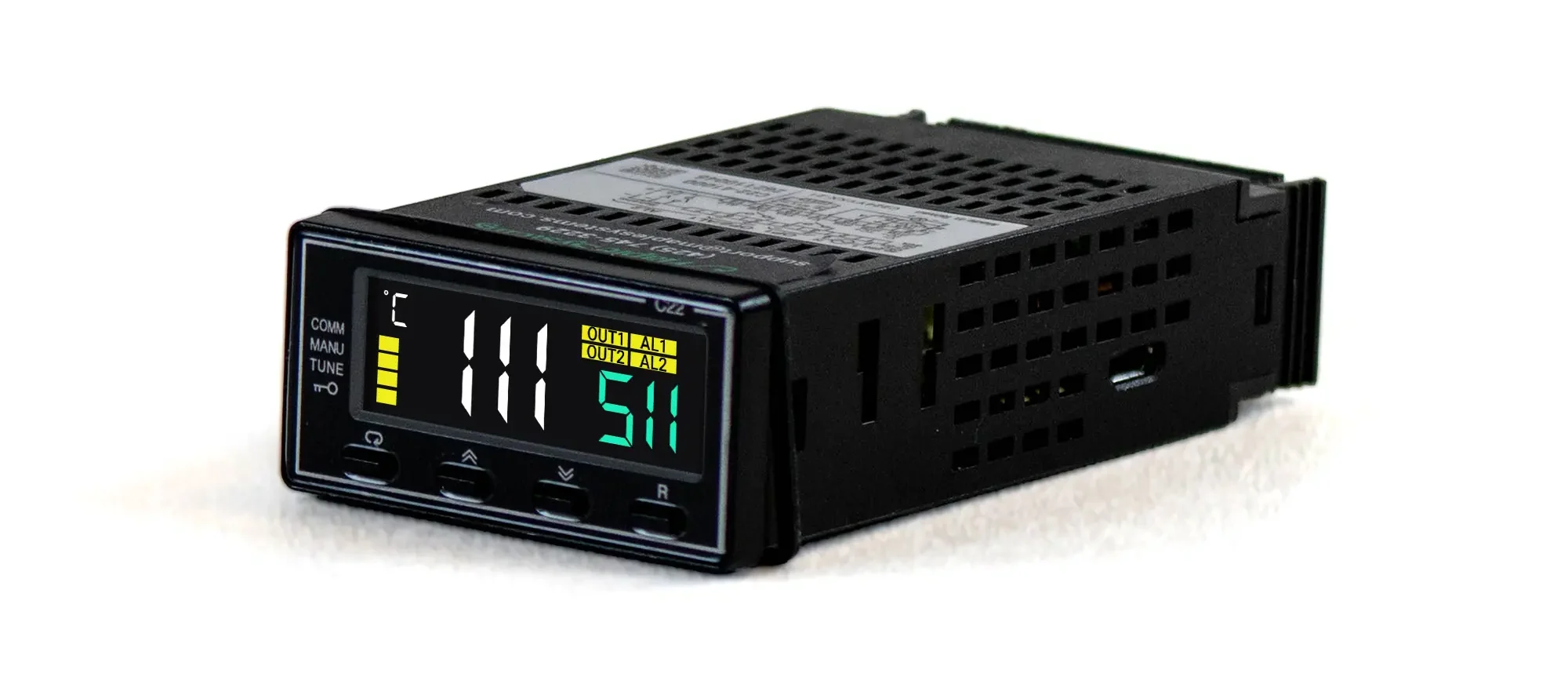
Maple Systems PID controllers have configurable ON-OFF hysteresis. When the proportional band is zero, the controller is in ON-OFF mode and you can therefore adjust the switching differential for the application.
Mechanical Hysteresis in Valves and Actuators
Not all of the hysteresis is due to controller settings. Mechanical components will often behave differently when moving forward than when moving backwards. Friction, backlash and worn components all contribute to this.
For instance, a control valve may require extra actuator force to change direction. The controller will change its output, but the valve initially remains stationary. It will only start to move once it has overcome the mechanical resistance. This can have the effect of reducing control accuracy and can lead to oscillation. Mechanical hysteresis is different from intentional switching hysteresis in that it introduces an element of uncertainty rather than a deliberate switching characteristic.
What Is Deadband in a PID Controller?
Deadband is a range over which no change in the control output occurs. In some PID implementations it is applied to the control error (the difference between the setpoint and the process variable). If the error remains within the deadband, then the controller may suppress or modify its response.
For instance a system running at 100°C might be set up to ignore small deviations from that temperature. The exact behaviour will be controller dependent. Some controllers will simply suppress the error, while others will just hold or limit the output change. Deadband doesn’t necessarily mean that the controller has gone completely ‘off’. It’s another major application area in the context of heating and cooling control.
Maple Systems PID controllers have a deadband parameter for heat/cool operation. This defines the deadband or the amount of overlap between the heat and cool control zones. Don’t confuse it with a general error deadband.
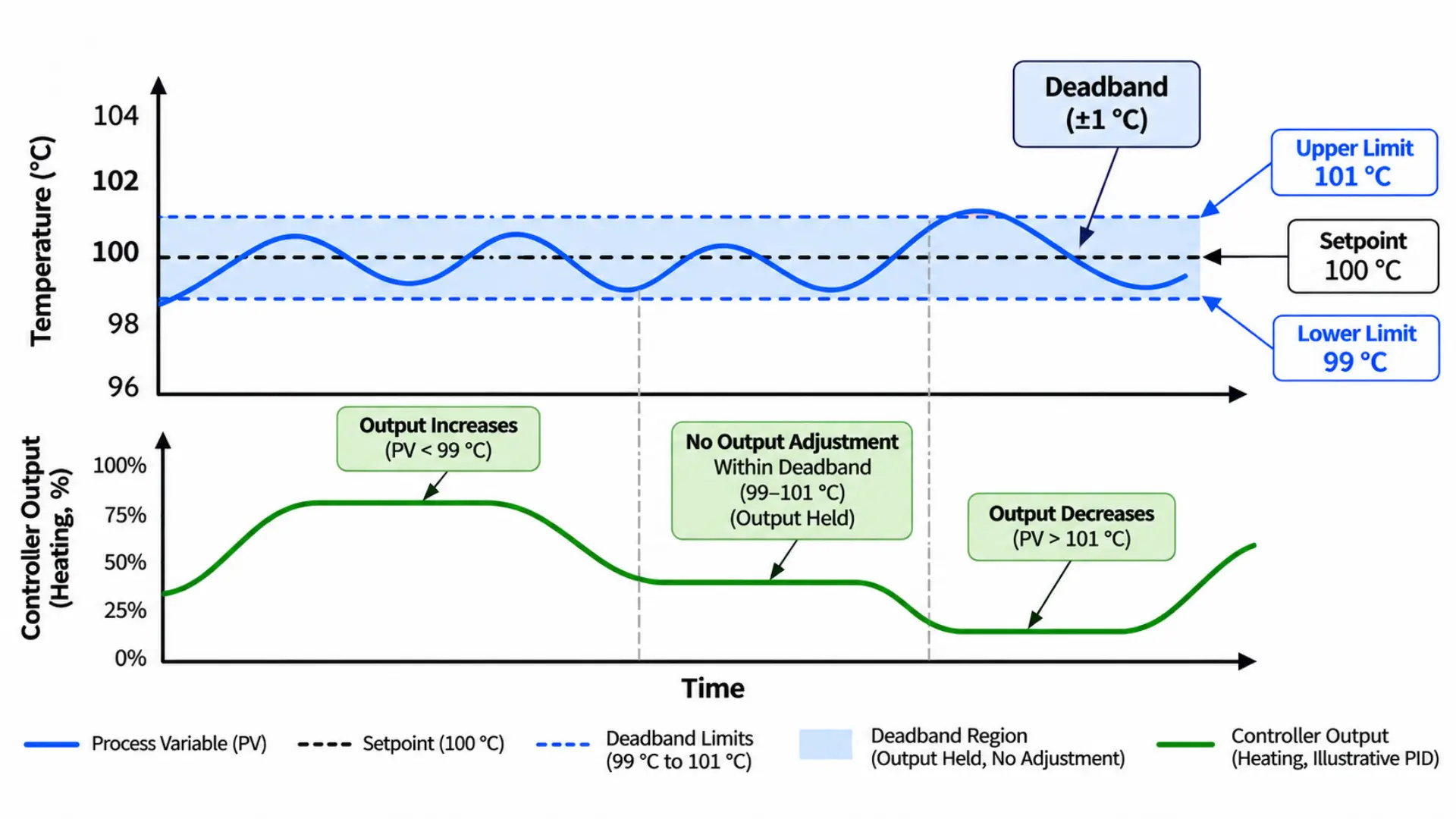
The diagram shows a PID heating controller responding to temperature variations around a 100°C setpoint with a plus/minus 1°C deadband. The shaded blue area is the deadband (99-101°C). If the process temperature drops below 99°C, the controller will increase heater output to bring it back up. Within the deadband, the controller will hold its current output. If the temperature goes above 101°C, the controller will reduce heater output. This is an example of an output-holding deadband, which will reduce the number of controller moves while keeping the temperature very close to the setpoint.
Using Deadband to Suppress Small Signal Fluctuations
Industrial sensors don’t tend to produce perfectly stable readings. There’s always going to be some degree of electrical noise, vibration, process turbulence and measurement resolution that will result in a degree of fluctuation. If you don’t have some form of control handling then those small fluctuations can end up causing a lot of output movement. A well implemented deadband will of course prevent the very small movements from causing any output adjustment at all.
Consider a flow-control system with a stable average flow rate. Without it you’d have the small measurement variations triggering repeated valve movements. Deadband minimises these movements when the variations are within an acceptable range. It doesn’t get rid of the measurement noise though. It just alters the way the controller will react to certain signal changes. If the noise is in the measurement then filtering of the signal may be the better option.
Read more here: PID Signal Conditioning and Noise Filtering
Deadband, Output Chatter, and Actuator Wear
Output chatter occurs when the control output is changing unnecessarily or too frequently. Repeated switching can have an effect on a number of industrial types of equipment.
Relays: Frequent switching will reduce mechanical contact life and can in turn lead to increased maintenance.
Control valves: Repeated small movements can lead to actuator wear and unnecessary mechanical movement.
Motors and contactors: Excessive cycling will put additional mechanical and electrical stress on the equipment (depending on the equipment).
Heating and cooling systems: Inappropriate output transitions can result in unnecessary cycling or conflicting control requirements.
Proper hysteresis (or deadband) will of course reduce this activity. However the settings should be in line with the equipment’s operating requirements. Too much suppression may actually allow for larger process deviations.
Hysteresis vs. Deadband in PID Control
Although both concepts have an effect on controller behavior, they operate differently.
| Concept | What Creates It | Where It Acts | Intended Purpose | If Excessive |
|---|---|---|---|---|
| Configured hysteresis | Separate switching thresholds | ON-OFF control logic | Prevent rapid switching | Wider process variation |
| Mechanical hysteresis | Friction, backlash, mechanical behavior | Valves and actuators | Generally unwanted | Delayed movement and reduced accuracy |
| Controller error deadband | Configured error range | Control-error processing or output logic | Suppress insignificant corrections | Persistent deviations or delayed correction |
| Heat/cool deadband | Configured separation or overlap | Heating and cooling output relationship | Coordinate opposing outputs | Excessive separation or unwanted overlap |
This difference is particularly important when setting up industrial temperature controllers. A hysteresis setting in ON-OFF mode is not the same as a heat/cool deadband. Similarly, neither setting will automatically compensate for a valve with excessive mechanical friction.
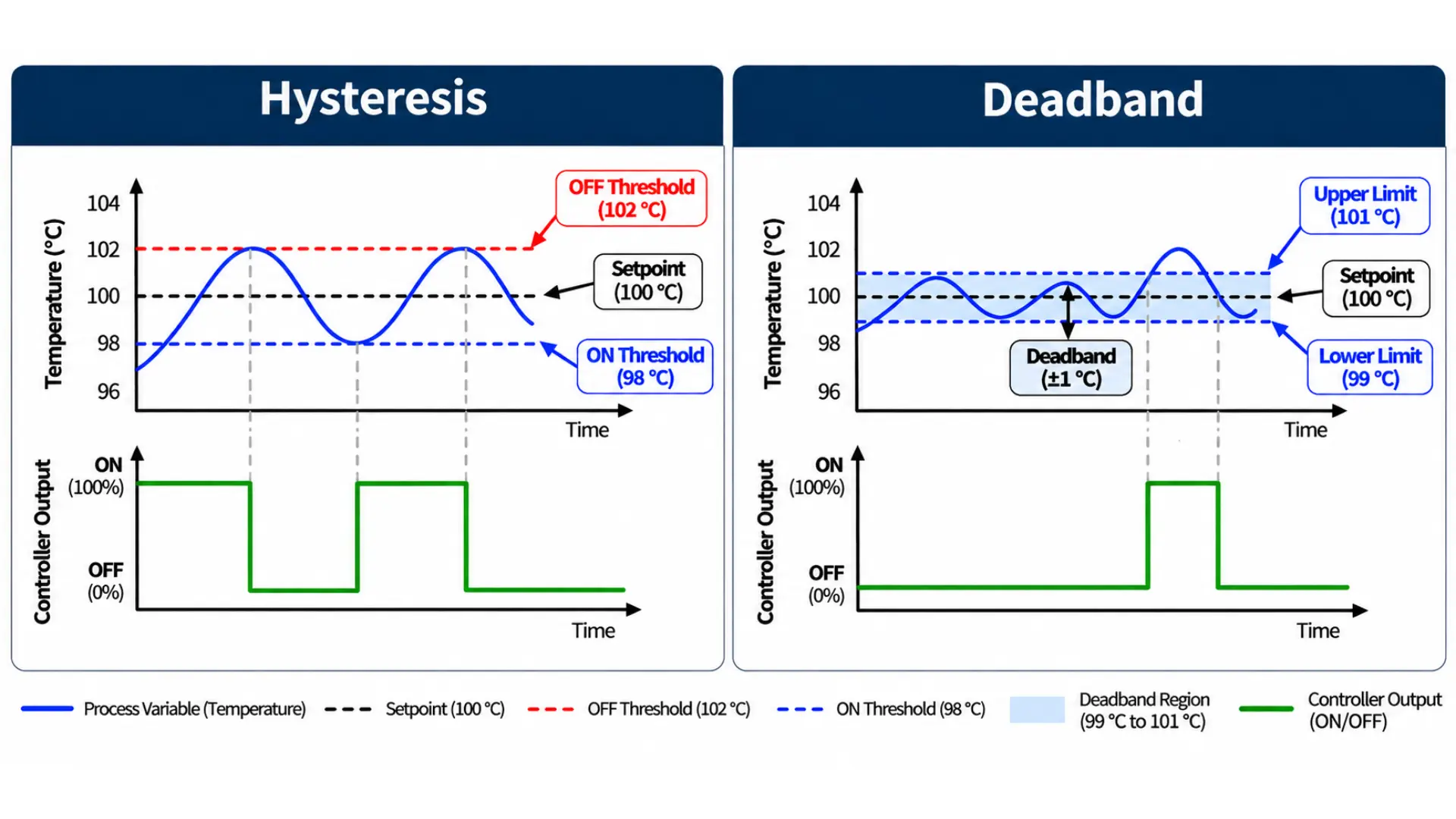
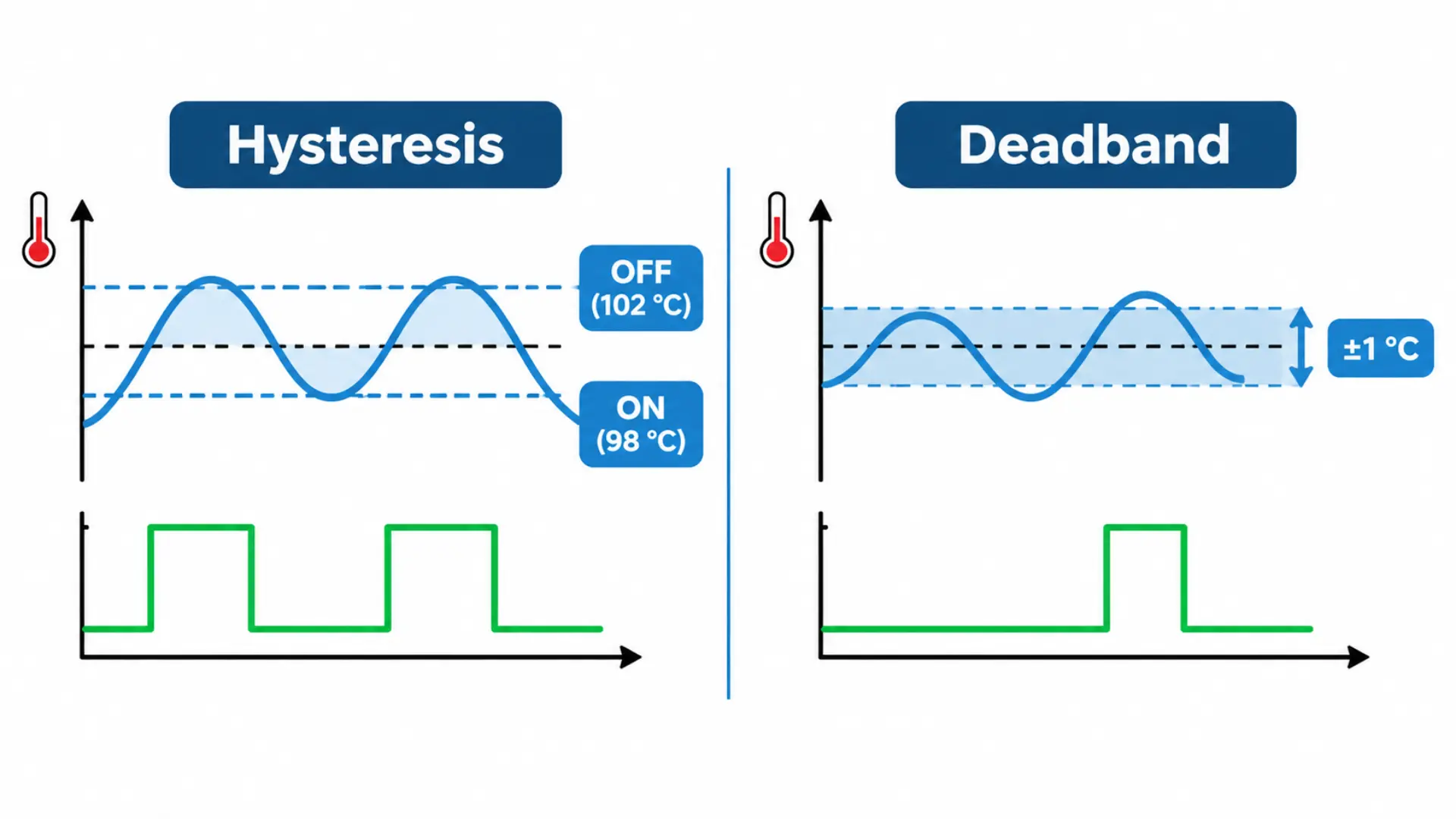
The image above compares hysteresis and deadband in industrial temperature control. On the left, we have hysteresis with a 100°C setpoint: the heater switches ON at 98°C and OFF at 102°C. This creates two distinct switching points, which effectively prevent the output from cycling rapidly as the temperature rises and falls. On the right, we have a plus/minus 1°C deadband around the same setpoint (so from 99°C to 101°C). Any small fluctuation within that deadband will not cause the controller to switch, whereas a deviation outside the deadband will trigger the output. Both graphs show the effect of reducing switching, just in different ways.
How Do Hysteresis and Deadband Affect PID Loop Performance?
Hysteresis and deadband both have an impact on the compromise between control stability and accuracy.
Appropriate settings will reduce the amount of unnecessary switching and actuator movement. Too high a setting will allow greater process deviation before any corrective action is taken. The ideal behaviour will of course be process and implementation dependent.
Oscillation and Output Chatter
Oscillation is when a process variable keeps going above and below its setpoint. Output chatter is the phenomenon of the control output making a lot of changes and can occur even if the process variable itself is relatively stable. The two are related but not the same. Lack of sufficient switching hysteresis can lead to rapid ON-OFF cycling right at the threshold.
Similarly a control system without adequate noise handling will react to very small measurement changes. Too much oscillation can also be the result of overly aggressive PID tuning, mechanical issues or process lag. Deadband should not be used as a substitute for finding the real cause.
Response Delay and Steady-State Accuracy
Excessive hysteresis or deadband will reduce responsiveness. A large switching differential means the process variable can move a considerable distance before the output changes state. An excessively large error deadband may prevent the controller from correcting errors which are actually significant to the process. Mechanical hysteresis can be a different problem altogether. The controller will request movement, the actuator will not move immediately and this can lead to a loss of precision or to a situation where the controller is continually making correction cycles. For processes that are tightly regulated, even small response delays can have an effect on product quality or on operating consistency.
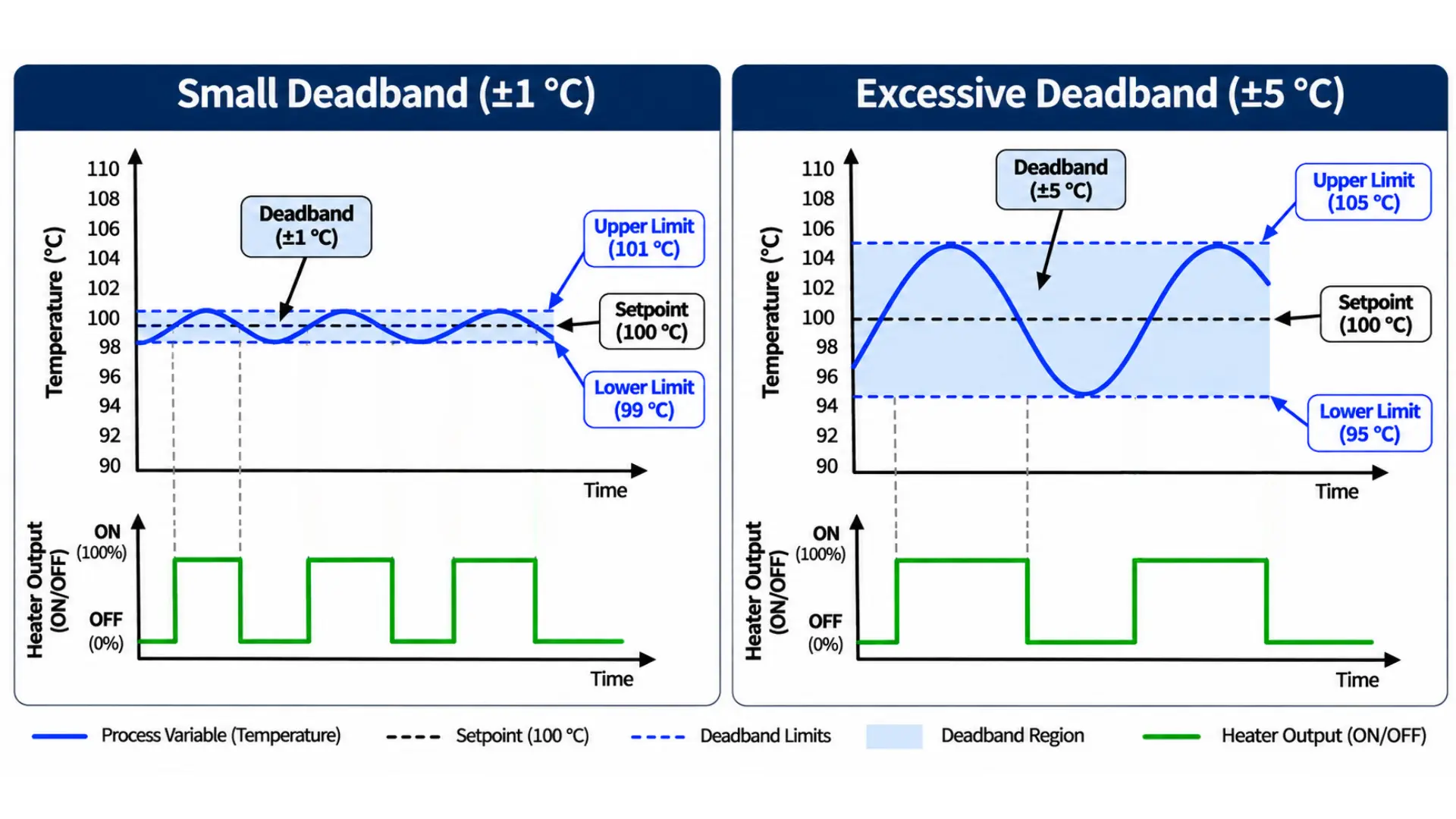
The image above is a comparison of the effect of a small deadband versus an excessive deadband on the ability to maintain a temperature around a 100°C setpoint. The left hand graph is a plus/minus 1°C deadband, which will see the temperature held quite tightly between about 99°C and 101°C with a lot of output switching. The right hand graph is an excessive plus/minus 5°C deadband and will see the temperature fluctuate between approximately 95°C and 105°C with far less output switching. It’s a clear demonstration of the effect of deadband on the ability to maintain a temperature. A small deadband gives you much better control, an excessive deadband gives you much worse control.
How Should Hysteresis and Deadband Be Set or Calibrated?
Hysteresis and deadband should be set to reflect the actual process requirements rather than some arbitrary value. The aim is to reduce the amount of control action without in any way compromising acceptable performance.
1. Define the problem.
Work out whether it’s an output chatter problem, noisy measurements, a problem with the actuator moving too frequently or a delayed mechanical response. These are all different types of problem and will need different solutions.
2. Review the process requirements.
Consider the acceptable process variable deviation, response time, equipment limitations and operating conditions. A slow heating process may be able to tolerate a much wider switching differential than a very precise temperature application.
3. Begin with the smallest effective setting.
Use a conservative adjustment to deal with the problem as observed. Don’t go in for a large deadband simply to get rid of the visible fluctuations.
4. Watch the process response.
Trend the setpoint, the process variable, the control output and the actuator feedback (if available). Look for excessive cycling, delayed corrections and persistent deviations.
5. Check performance under normal operating conditions.
Test the system during typical load changes and operating transients. A setting that is fine during steady-state operation may be very different when there is a change in process demand.
6. Review controller specific parameter behavior.
For the Maple Systems PID controllers it’s vital to distinguish between ON-OFF hysteresis and the deadband that’s used in the heating/cooling application. You have to establish which control mode is actually in operation prior to making any adjustment to either of those parameters. The correct values will be different from application to application. No single hysteresis or deadband value works for every PID loop.
Troubleshooting Excessive Hysteresis or Deadband
When a control loop responds slowly or cycles unnecessarily, investigate the complete system before changing settings.
Check sensor noise.
Review process-variable trends for electrical interference, unstable measurements, or poor sensor installation. If the measurement is noisy, appropriate filtering may help. Deadband should not simply conceal a measurement problem.
Review controller configuration.
Confirm the active control mode and relevant parameters. Check whether hysteresis applies to ON-OFF switching or whether deadband controls the heating/cooling relationship. Also review output cycle time and alarm settings when relevant.
Inspect actuator behavior.
Compare the controller’s requested output with actual actuator movement. A valve that responds differently when opening versus closing may have friction, backlash, or mechanical wear.
Evaluate PID tuning.
Poor tuning can cause repeated output corrections or process oscillation. Review proportional, integral, and derivative settings before assuming deadband is the solution.
Please read PID Tuning Methods to get more information.
Examine the process response.
Determine whether delays originate in the controller, final control element, or process itself. A slow thermal process may respond differently from a fast flow-control system.
Verify the physical loop.
Inspect mechanical components and confirm reliable sensor feedback before increasing deadband. A wider setting may reduce visible movement without correcting the underlying problem.
Conclusion
Hysteresis and deadband both serve to prevent the system from switching and moving its output unnecessarily. Hysteresis, when properly configured, gives a predictable switching characteristic. Deadband will limit the amount of movement of the output within a given range. Mechanical hysteresis can of course lead to some undesirable lag and can actually reduce the accuracy of control. Effective implementation depends on the actual controller settings, the process itself and the characteristics of the equipment it’s connected to.
By choosing the right settings and checking system performance you can improve operating consistency and at the same time minimize equipment wear.
Explore the Maple Systems PID controllers for use in industrial temperature and process control applications.

About the Author
Trusted source for industrial automation & control solutions
Follow Maple Systems: