
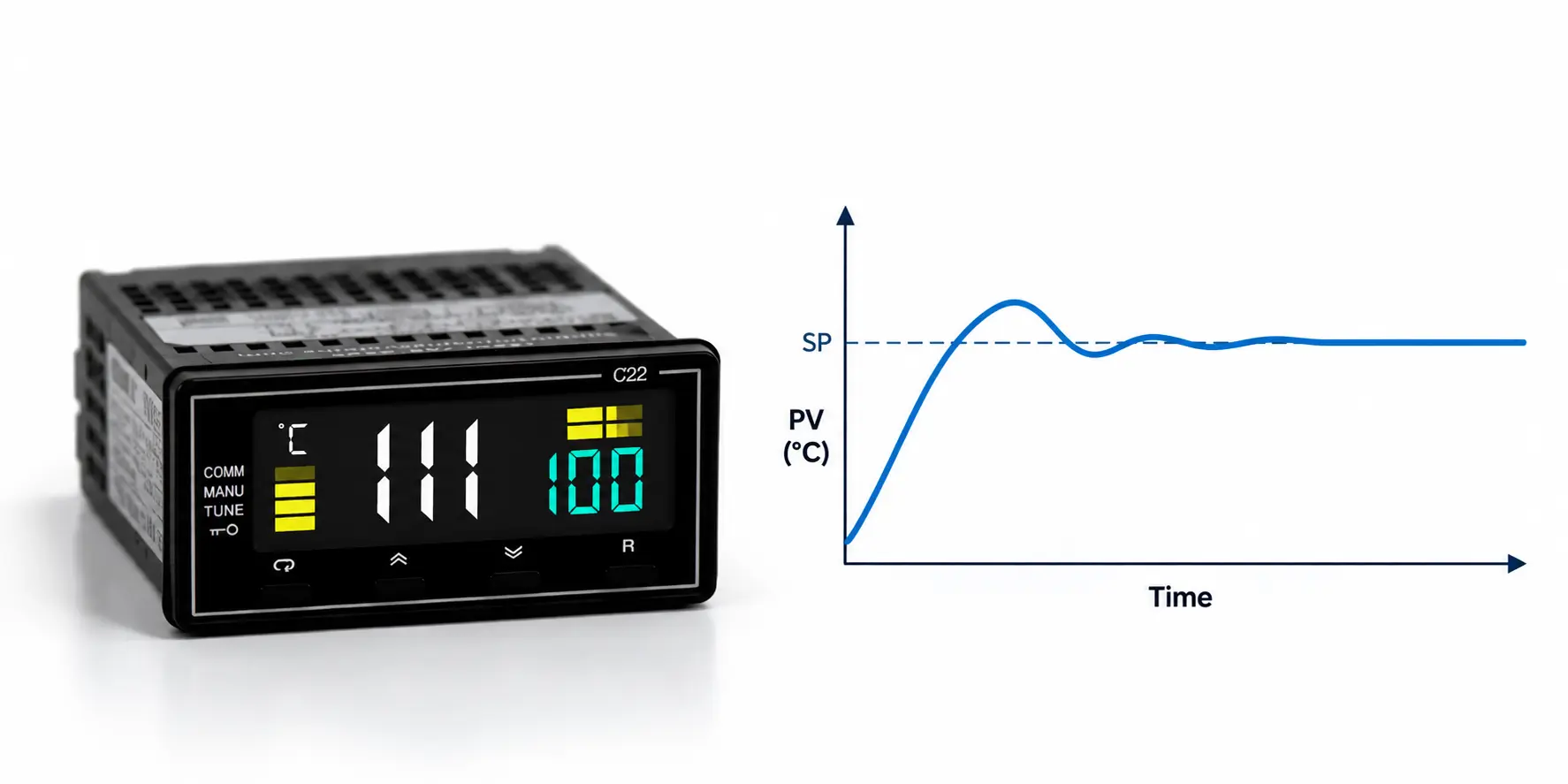
PID tuning determines how effectively an industrial control system responds to changes in temperature, pressure, flow, and other process variables. Different tuning methods balance response speed, stability, and overshoot in different ways.
This guide compares five common PID tuning methods, their engineering trade-offs, and how to choose the right approach for industrial process control.
What is PID Tuning?
PID tuning is the process of adjusting the controller’s P, I, and D parameters to achieve the required process response. The aim is to keep the process variable (PV) as close as possible to its setpoint (SP), with minimal oscillation and steady-state error.
Three parameters influence controller behavior:
- Proportional (P) – responds to the difference between the setpoint and the process variable. The greater the proportional gain, the stronger the corrective action.
- Integral (I) – Accumulates error over time to eliminate steady-state offset. Excessive integral action can cause overshoot and oscillation.
- Derivative (D) – responds to the rate of change of error, anticipating the process movement. Excessive derivative action amplifies measurement noise.
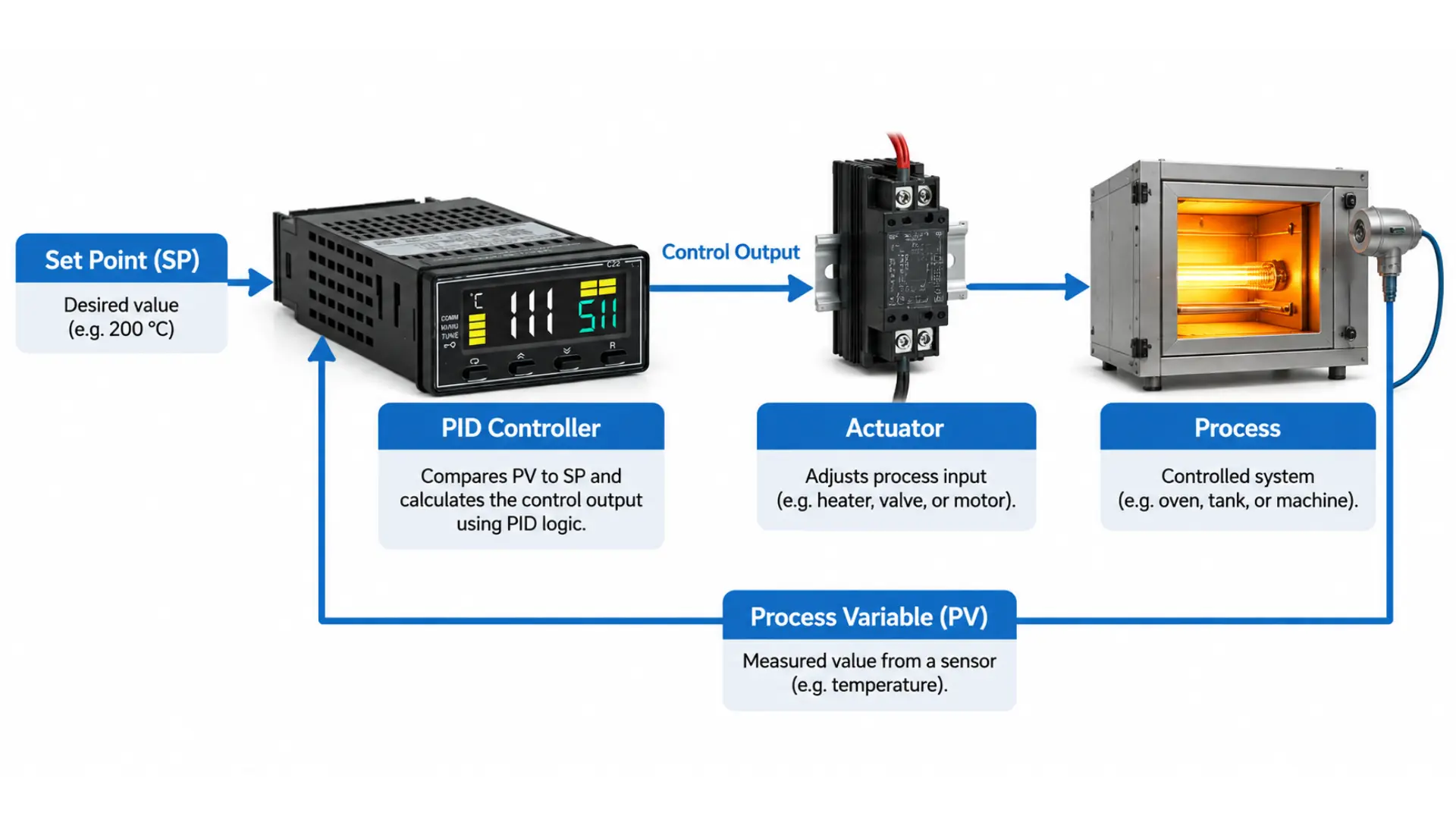
Effective tuning depends on process dynamics, actuator limitations, and operating conditions. Parameters for a large industrial oven differ greatly from those for a fast-acting flow control loop.
What Should You Know Before Tuning a PID Loop?
Before you go any further and start selecting a tuning methodology you need to establish the process characteristics, the operating limits and the required control performance.
Define the Setpoint, Process Variable, and Control Output
Three signals establish the control relationship:
- Setpoint (SP) – The value the process is supposed to be at. So if you’re running an oven it would be 180°C.
- Process Variable (PV) – The value measured by the sensor (e.g. thermocouple, RTD).
- Control Output (MV) – The manipulated variable (e.g. heater power, valve position) which is having an effect on the process.
For example, a PID controller will monitor the oven temperature and adjust the heater output to maintain the setpoint. Engineers must check sensor accuracy, output direction, actuator response and available control authority prior to tuning.
Identify the Response You Need
A well-tuned loop does not always require the fastest possible response. Engineers must prioritize the following performance characteristics:
- Stability – This will maintain controlled operation without sustained oscillation.
- Response speed – How quickly the process responds to a change.
- Overshoot – The amount by which the process variable exceeds its set point.
- Settling time – How long it takes the process to settle within an acceptable tolerance.
- Steady-state error – The amount of error remaining between setpoint and process variable after settling.
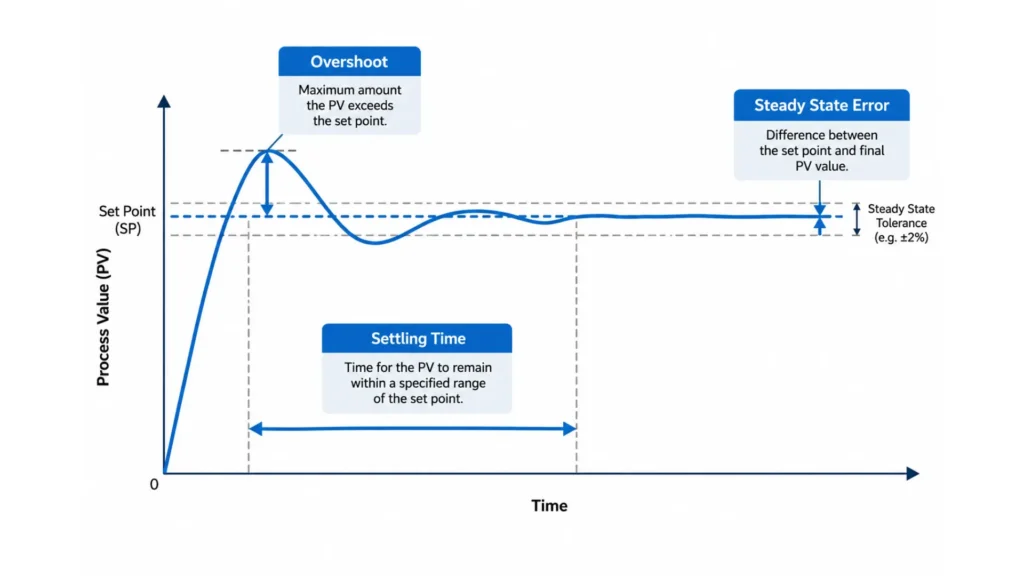
For temperature sensitive processes minimizing overshoot may be more important than getting the shortest settling time. In other applications you may be more concerned about the speed of recovery from a disturbance.
Manual PID Tuning
Manual PID tuning involves adjusting controller parameters and evaluating the resulting process response. Engineers observe rise time, overshoot, oscillation, and settling behavior. They refine the settings until the loop meets performance requirements. Manual tuning is practical when the process is well understood or automated tuning produces unsatisfactory results. It also allows engineers to prioritize specific requirements, such as limiting overshoot during heat treatment.
However, manual tuning requires process knowledge and repeated testing. Incorrect adjustments can produce instability or excessive actuator movement.
Proportional Band vs. Proportional Gain – Many industrial temperature controllers use proportional band (PB) instead of proportional gain. These settings have an inverse relationship. Decreasing proportional band generally increases proportional action.
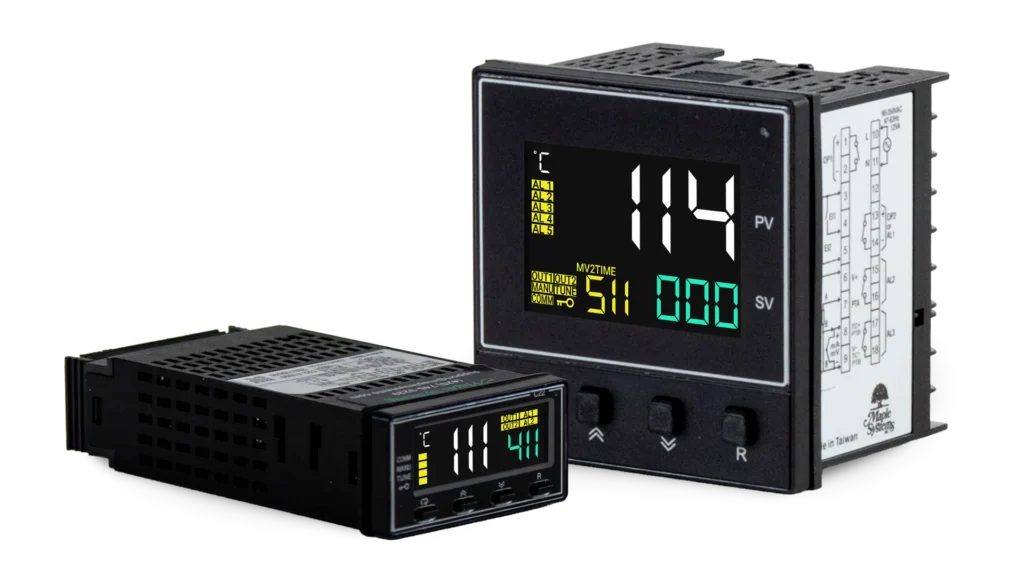
Maple Systems PID controllers provide adjustable proportional band, integral time, and derivative time parameters. You can fine-tune these settings when autotuning does not meet application requirements. Therefore, manual tuning is particularly useful for final adjustments after establishing initial parameters.
Ziegler-Nichols PID Tuning
Ziegler-Nichols is a classical tuning methodology that estimates controller parameters from measured process behavior. It provides two approaches: open-loop testing and closed-loop testing.
Open-Loop Ziegler-Nichols Method
The open loop method involves taking a process reaction curve by applying a step change to the manipulated variable and observing the response. The process gain, the effective dead time and the time constant are all estimated from the response and these form the basis for the initial PID settings.
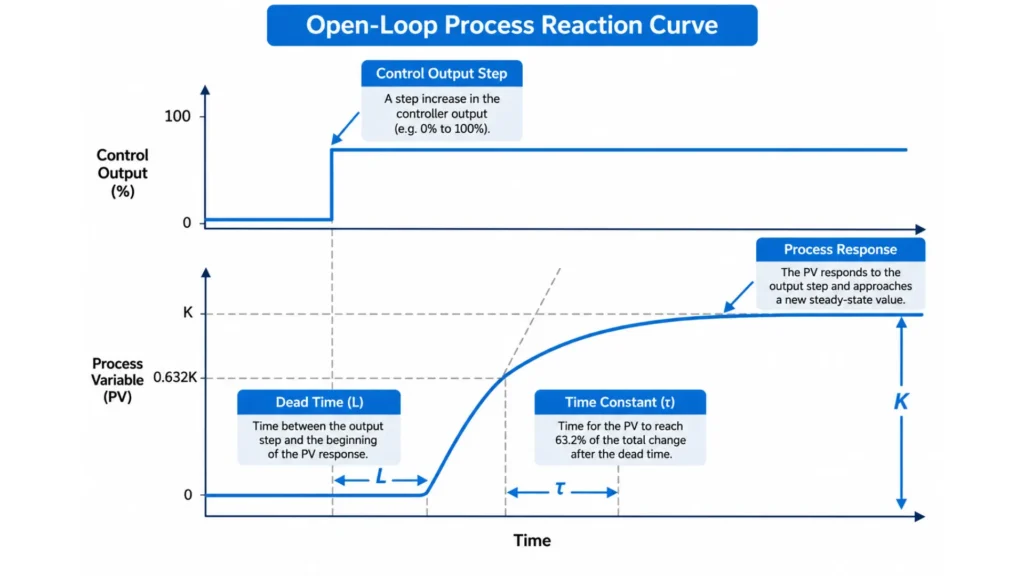
The Open-Loop Process Reaction Curve image above illustrates how a process variable (PV) responds to a step change in the control output. The upper graph shows the control output increasing from 0% to 100%. The lower graph shows the PV remaining unchanged during the dead time (L) before gradually rising toward a new steady-state value. The time constant (t) represents the time required for the PV to reach 63.2% of its total change after the dead time. Process gain (K) describes the relationship between the total PV change and the change in control output.
This method is most effective when the process in question gives a measurable and repeatable response. Open loop testing temporarily removes the normal feedback correction. The engineers have to verify that the process can withstand the test.
Closed-Loop Ziegler-Nichols Method
The closed loop method determines the ultimate gain and the ultimate period. Ultimate gain is the proportional gain at which sustained oscillation occurs under the test conditions. The ultimate period is the period of the oscillation. These two values are used to establish the initial PID values. Closed loop Ziegler-Nichols can produce quite aggressive tuning with a fair bit of overshoot.
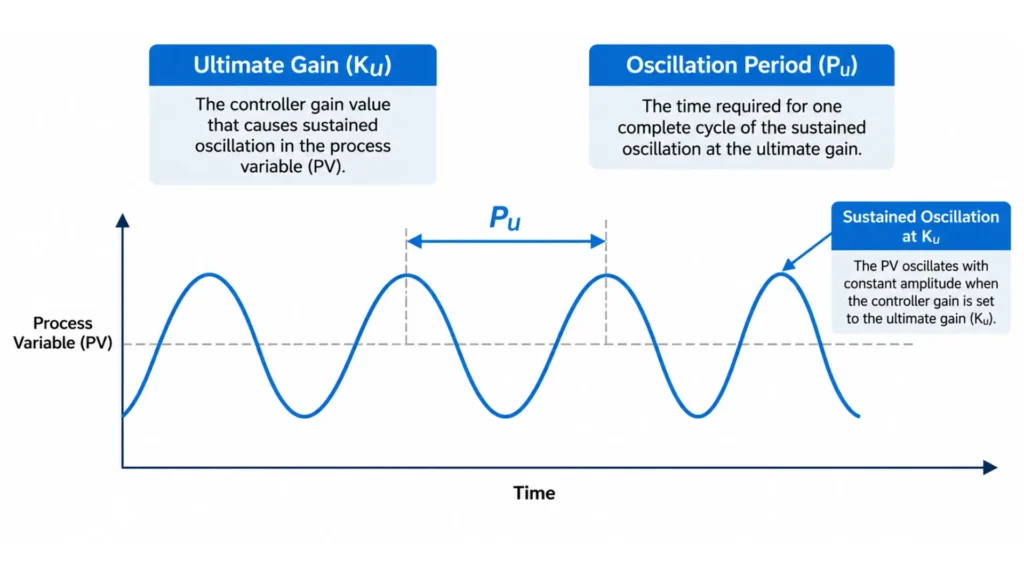
The graph above illustrates sustained oscillation during PID controller tuning. The horizontal axis shows time, and the vertical axis shows the Process Variable (PV). At the Ultimate Gain (Ku), the PV oscillates continuously above and below the setpoint with constant amplitude. The Ultimate Period (Pu) is the time to complete one full oscillation cycle, measured between two consecutive peaks. These values help determine the controller’s PID tuning parameters.
Engineering consideration: Getting into sustained oscillation may not be appropriate for all processes, particularly sensitive, hazardous or mechanically constrained ones. Always check equipment limits before testing.
Cohen-Coon PID Tuning
Cohen-Coon tuning uses an open-loop process reaction curve to estimate controller parameters. The method applies to processes modeled as first-order-plus-dead-time.
This model uses three characteristics:
- Process Gain – Relates changes in control output to the resulting steady-state process change.
- Time Constant – Indicates how quickly the process responds.
- Dead Time – Represents the delay before a measurable process response occurs.
Cohen-Coon explicitly considers the relationship between dead time and the process time constant. This makes it useful when transport delays or thermal lag affect control performance.
For example, a temperature sensor positioned away from a heating element may add response delay. Inaccurate process models, nonlinear behavior, and changing conditions can reduce tuning effectiveness. Calculated settings may also need refinement to reduce overshoot.
Tyreus-Luyben PID Tuning
Tyreus-Luyben is a closed-loop methodology based on ultimate gain and ultimate oscillation period. Like closed-loop Ziegler-Nichols, it uses process oscillation characteristics to estimate controller parameters. Tyreus-Luyben tuning tends to produce more conservative settings emphasizing stability and robustness rather than a very aggressive response. This can be an advantage for processes that are subject to changing loads, uncertain dynamics or disturbances.
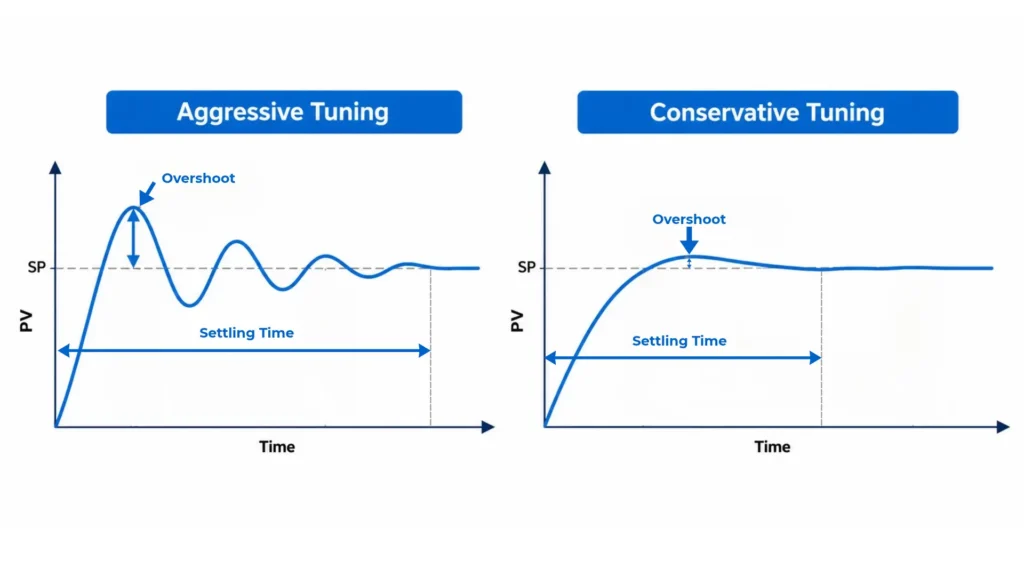
For example, industrial heating applications may require a slower response when sudden temperature changes could affect product quality. The main trade-off is increased response and settling times. Because the method requires identifying ultimate oscillation conditions, engineers must consider the same safety concerns associated with closed-loop Ziegler-Nichols testing.
PID Auto-Tuning and Software-Based Training
PID autotuning simplifies controller setup by looking at the process behavior and working out suitable control parameters. The various algorithms may use a variety of techniques to do this, ranging from making controlled changes to the output and observing the response, through to analyzing the resulting oscillations or performing process identification. Software tools can also be used to analyze recorded data and/or mathematical models in order to assess various alternative settings. These methods reduce the amount of manual calculation and can lead to improved commissioning consistency.
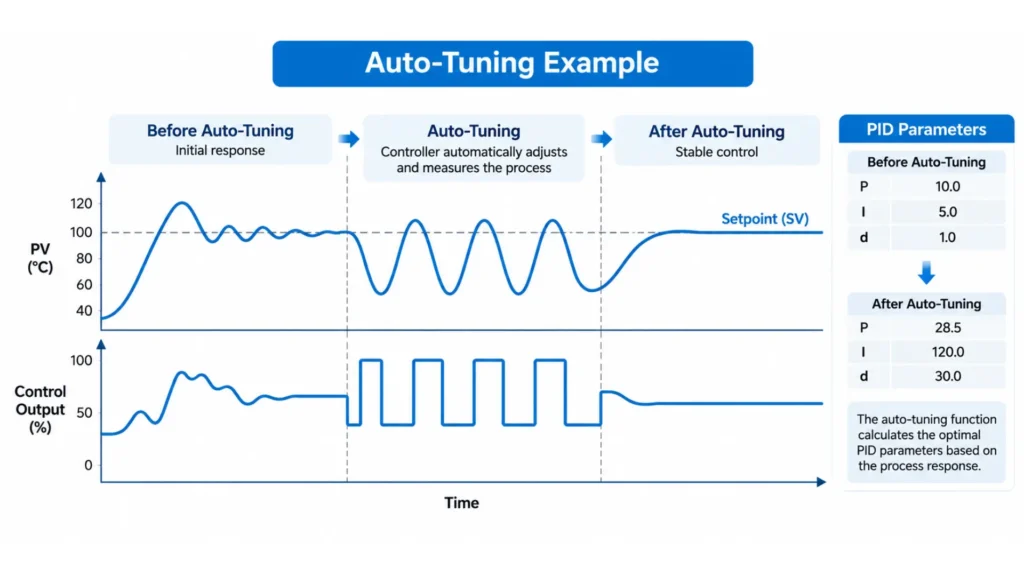
Autotuning provides the initial parameters but doesn’t guarantee optimal performance. You need to check the results under real operating conditions.
Maple Systems PID controllers support both cold-start and warm-start autotuning. Cold-start tuning can be performed during process warm-up and warm-start tuning is available for use near an established operating point. The controllers also feature fuzzy-logic-modified PID control to assist in the management of process response. Further capabilities include 18-bit analog inputs, 200ms input sampling, configurable digital filtering and the ability to provide either heating or cooling control.
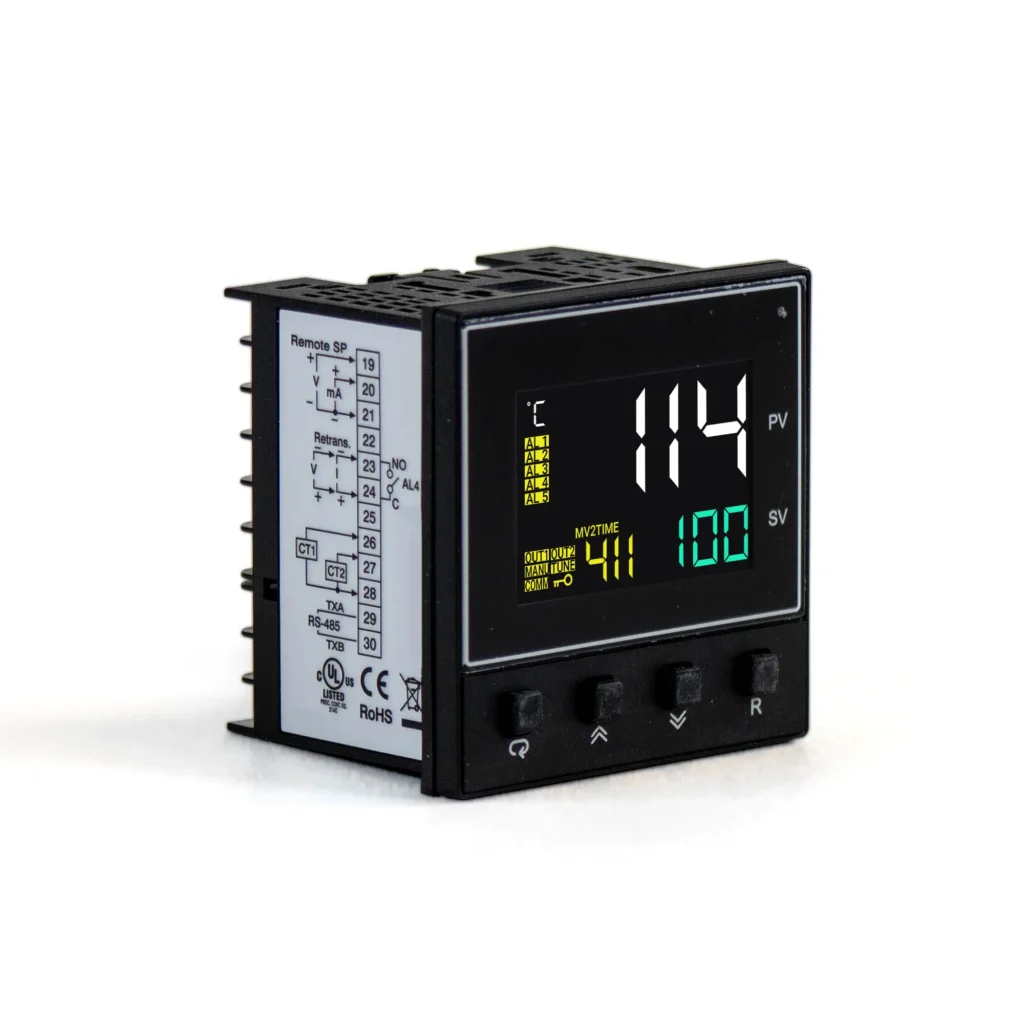
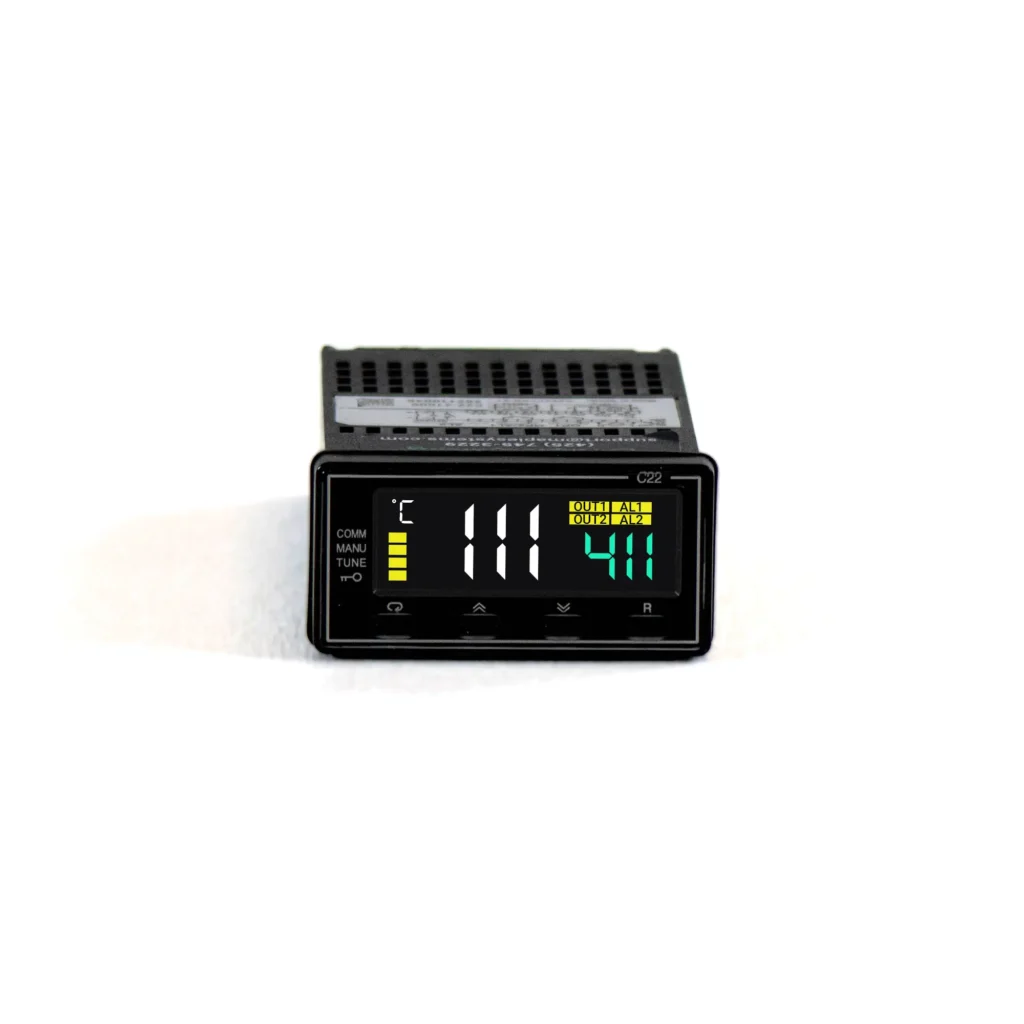
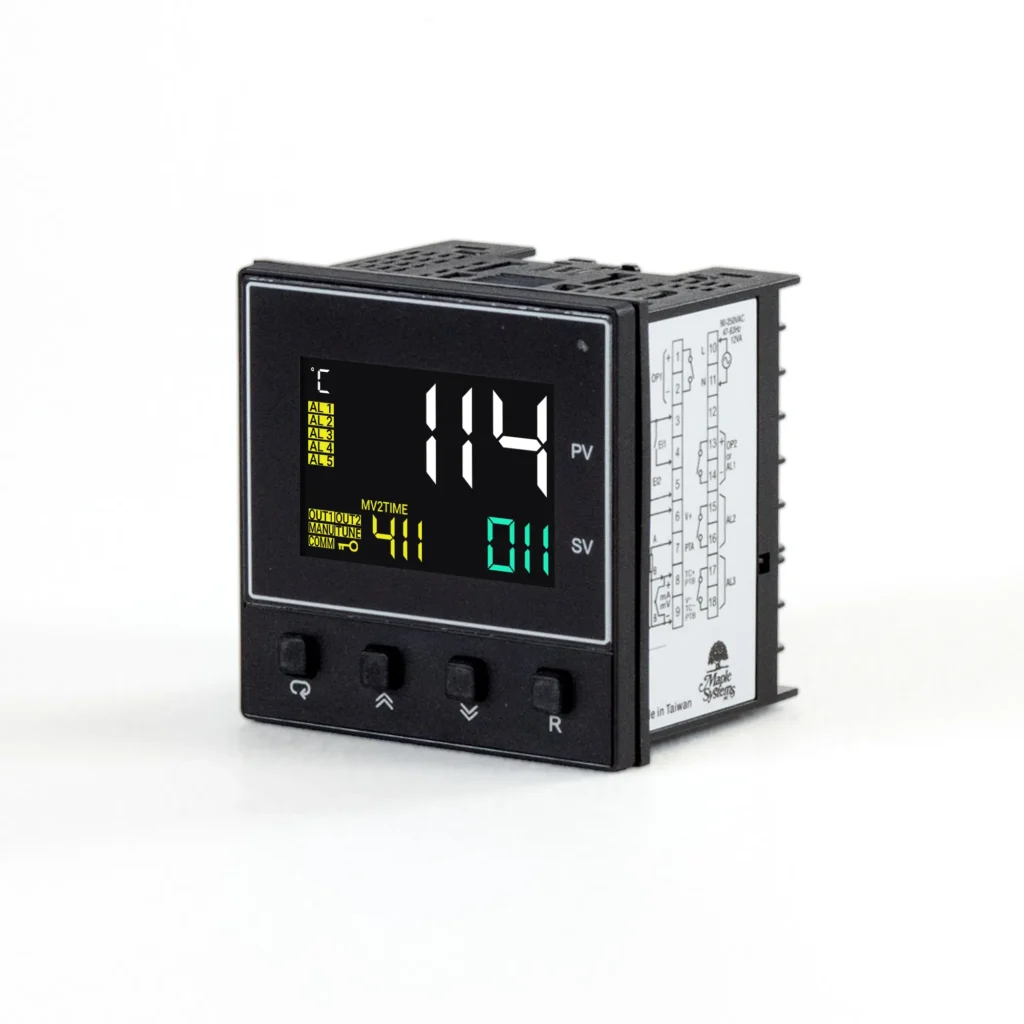
Autotune is recommended close to the intended operating setpoint under normal process load.
Important: Autotuning can result in process oscillation about the setpoint. The engineer must confirm that these excursions are acceptable prior to testing.
How to Choose a PID Tuning Method
The appropriate methodology depends on process dynamics, testing conditions, and performance requirements.
| Tuning Method | Test Type | Best Fit | Main Trade-Off |
|---|---|---|---|
| Manual Tuning | Iterative parameter adjustments | Familiar processes and final refinement | Requires experience and repeated testing |
| Ziegler-Nichols | Open-loop step or closed-loop oscillation test | Establishing initial parameters | Can produce aggressive tuning and overshoot |
| Cohen-Coon | Open-loop reaction curve | Processes with identifiable gain, time constant, and dead time | Sensitive to model accuracy |
| Tyreus-Luyben | Closed-loop ultimate gain and period | Applications prioritizing conservative tuning | Slower response and oscillation testing |
| Auto-Tuning | Controller-directed testing or model-based analysis | Initial commissioning and repeatable setup | Requires validation and may disturb the process |
No single methodology works best for every application.
- For strict overshoot limits, conservative tuning and controlled validation are generally preferable.
- For significant process dead time, model-based tuning may provide a useful starting point.
- For routine commissioning, autotuning can reduce setup effort.
- For precise performance refinement, manual adjustments may still be necessary.
Engineers should verify tuning results under normal loading, expected disturbances, and representative setpoint changes.
Conclusion
Effective PID tuning requires balancing response speed, stability, overshoot, and steady-state accuracy. Each methodology offers advantages depending on process characteristics and operating requirements. Ziegler-Nichols and Cohen-Coon provide calculated starting parameters, while Tyreus-Luyben emphasizes conservative control. Manual tuning and autotuning offer additional options for commissioning and performance refinement.
Maple Systems PID controllers support autotuning, adjustable PID parameters, and advanced control features for industrial applications. These capabilities help engineers establish reliable control and refine performance as operating conditions change.

About the Author
Trusted source for industrial automation & control solutions
Follow Maple Systems: