
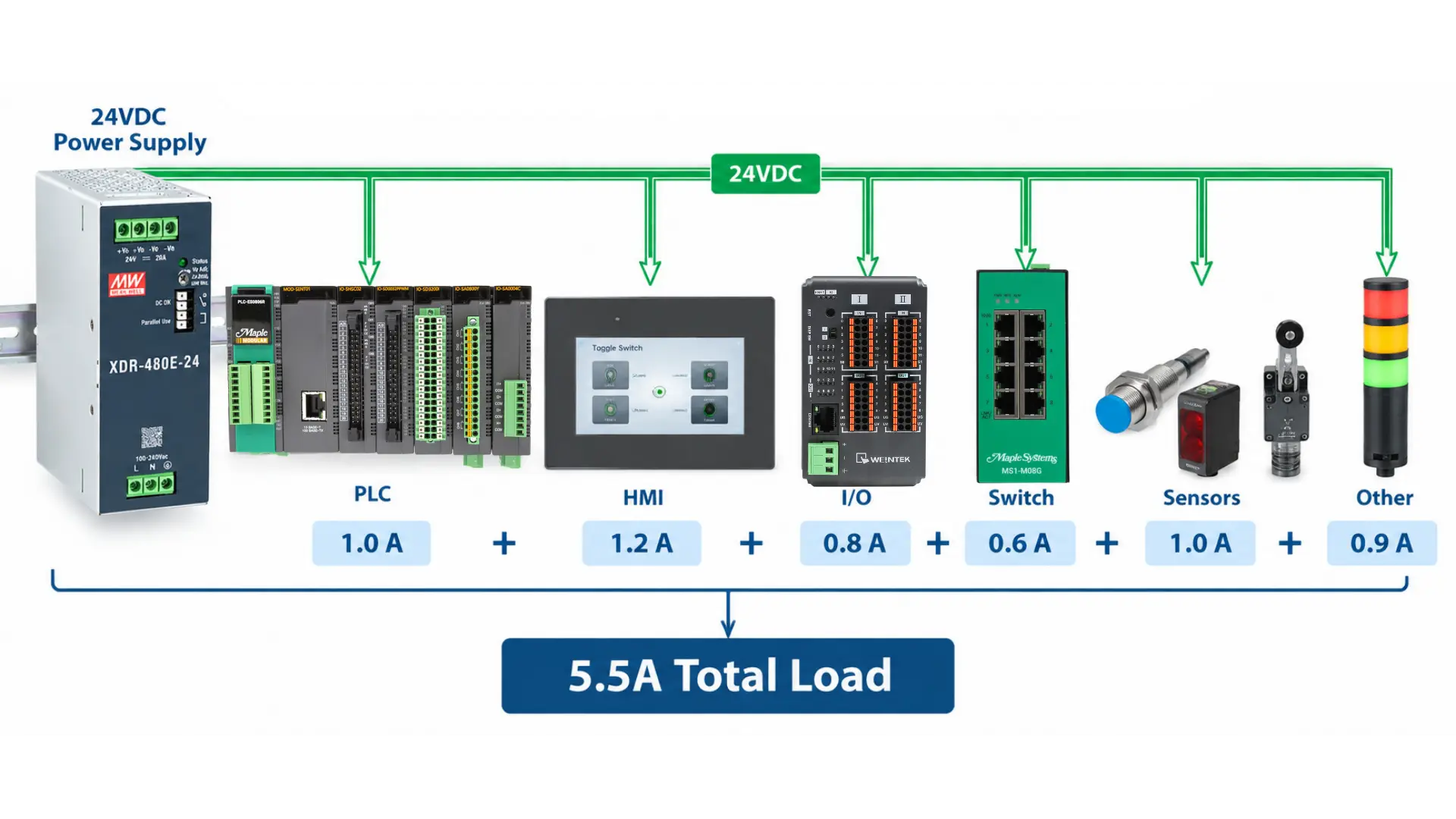
A 24V DC power supply provides operating power for many devices inside an industrial control panel. PLCs, HMIs, sensors, relays, communication devices, and other control components often depend on the same 24VDC power source. Choosing a power supply requires more than adding the wattage printed on several device labels. A properly sized supply must support the total connected load under actual operating conditions. Designers should also consider startup current, future expansion, ambient temperature, derating, efficiency, and available panel space. An undersized power supply may experience overload conditions or leave too little capacity for changing loads. Oversizing without considering the application can increase cost and use valuable DIN rail space.
This guide explains 24V DC power supply sizing for industrial control panels. It covers current wattage calculations, design margin, derating, startup loads, and other important selection factors.
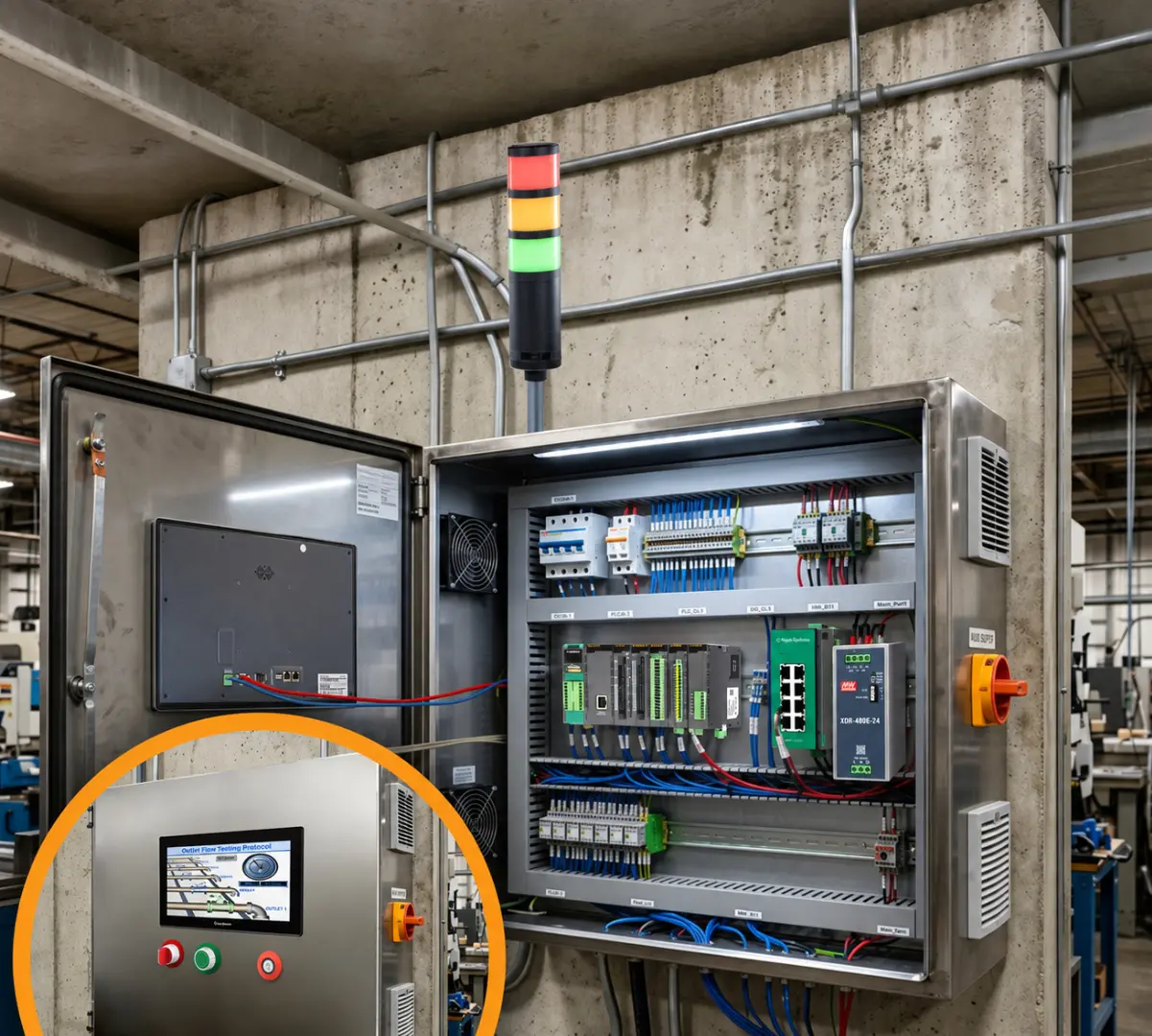
Why 24V DC Power Supplies Are Common in Industrial Control Panels
Industrial control systems often contain devices that require low-voltage DC power. A 24VDC architecture provides a common power source that can serve multiple components within the same panel.
Typical 24VDC loads can include:
- PLCs and remote I/O
- HMIs
- Industrial sensors
- Relays and contactors
- Solenoid valves
- Industrial Ethernet switches
- Communication gateways
- Signal conditioners
- Indicators and control devices
- Other industrial electronics
The power supply converts the available input power into the regulated DC voltage required by these devices.
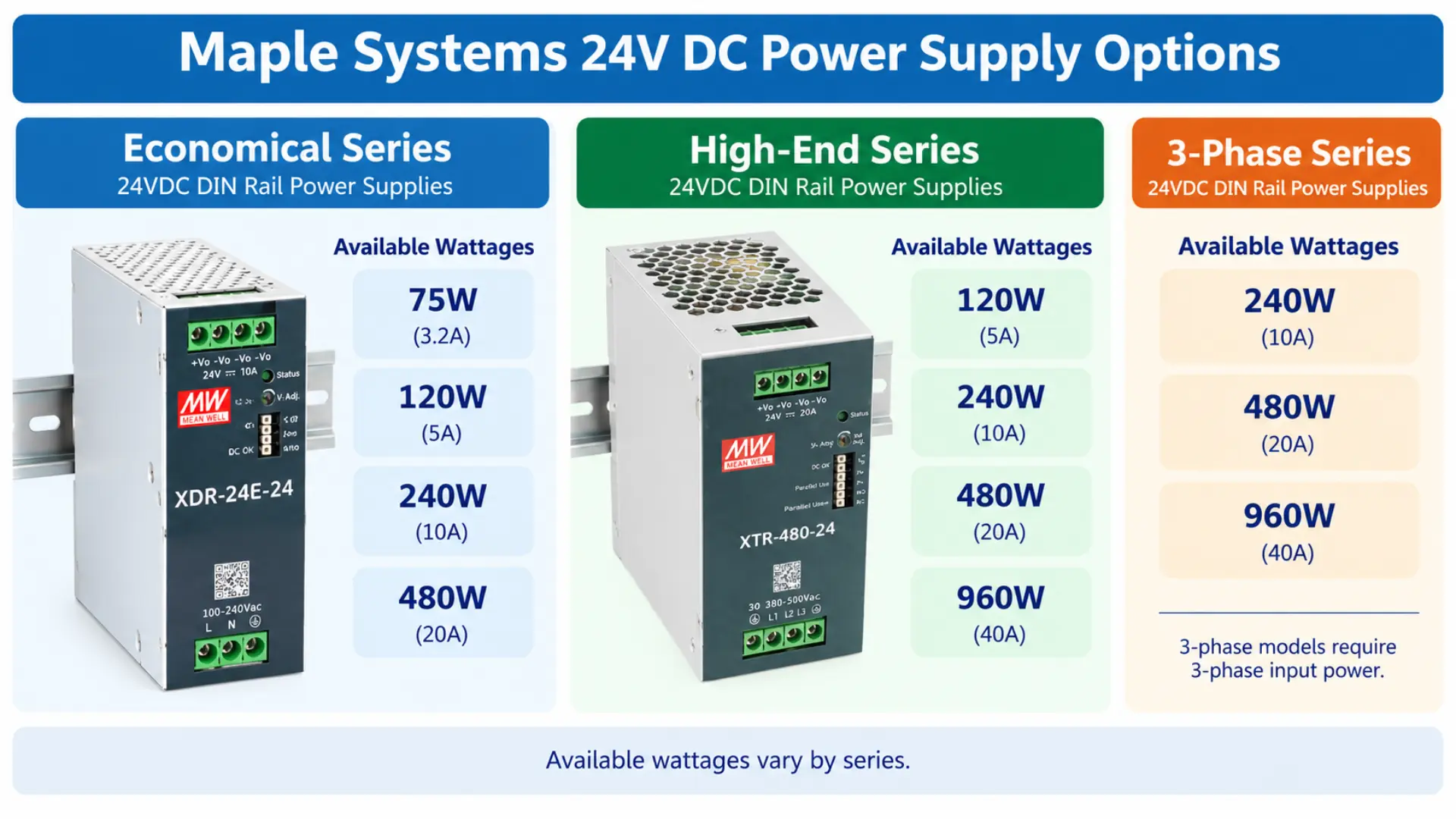
Maple Systems Ultra Slim DIN rail power supplies include 24VDC models from 75W to 960W. Selected models also offer other output voltages. Single-phase and 3-phase input requirements differ. For a 24VDC control system, the first step is determining how much current all connected equipment requires.
How to Size a 24V DC Power Supply
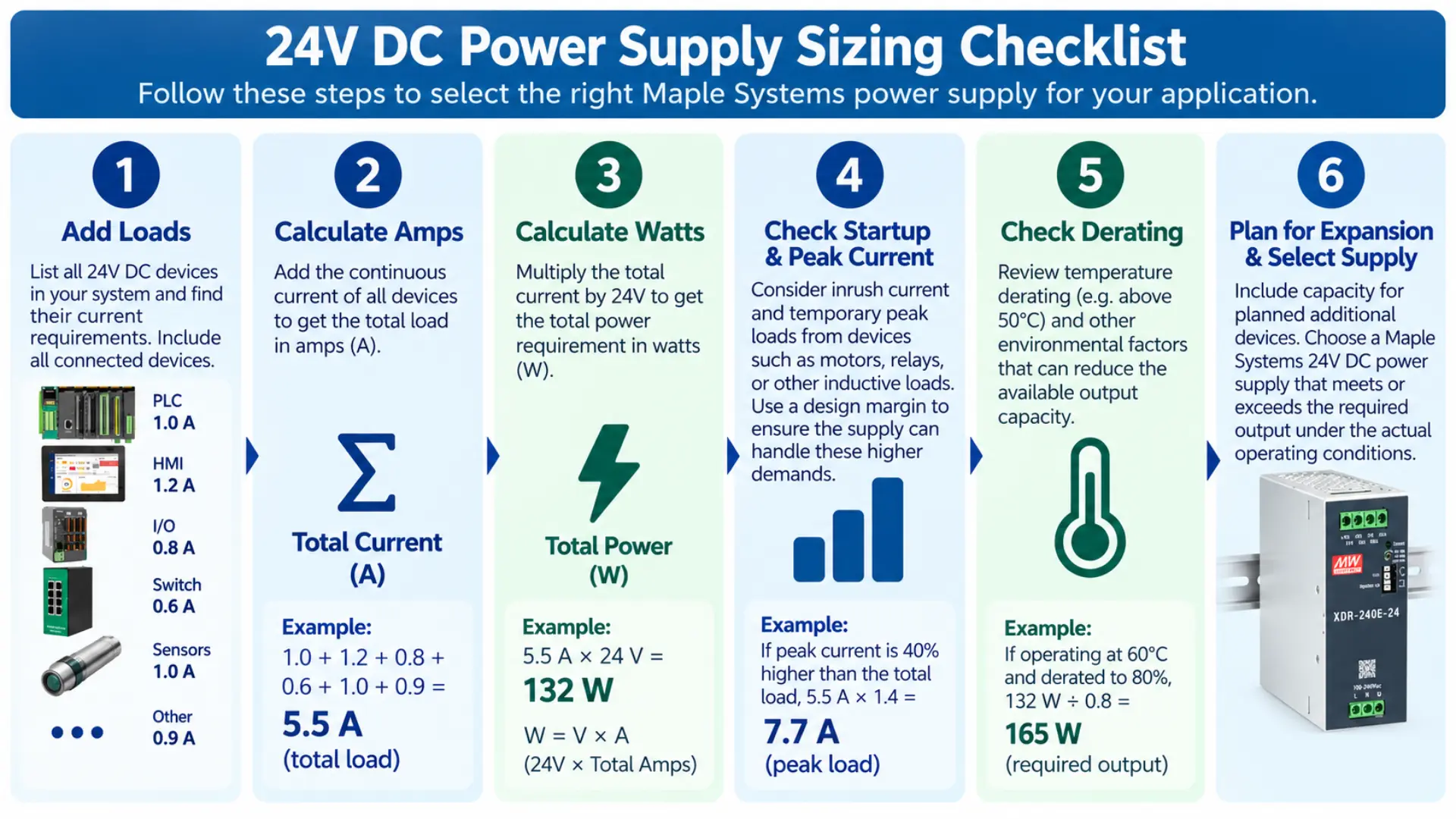
The basic 24V DC power supply sizing calculation starts with the current requirements of every device connected to the power supply.
Add the current draw of each load:
Total Load Current = Load 1 + Load 2 + Load 3
Consider a control panel containing:
| Device | 24VDC Current |
|---|---|
| PLC | 1.0A |
| HMI | 1.2A |
| Remote I/O | 0.8A |
| Ethernet switch | 0.6A |
| Sensors | 1.0A |
| Relays and other loads | 0.9A |
| Total | 5.5A |
The connected equipment requires 5.5A at 24VDC.
However, selecting a 5.5A power supply would leave no additional capacity. The designer still needs to account for operating conditions and appropriate design margin.
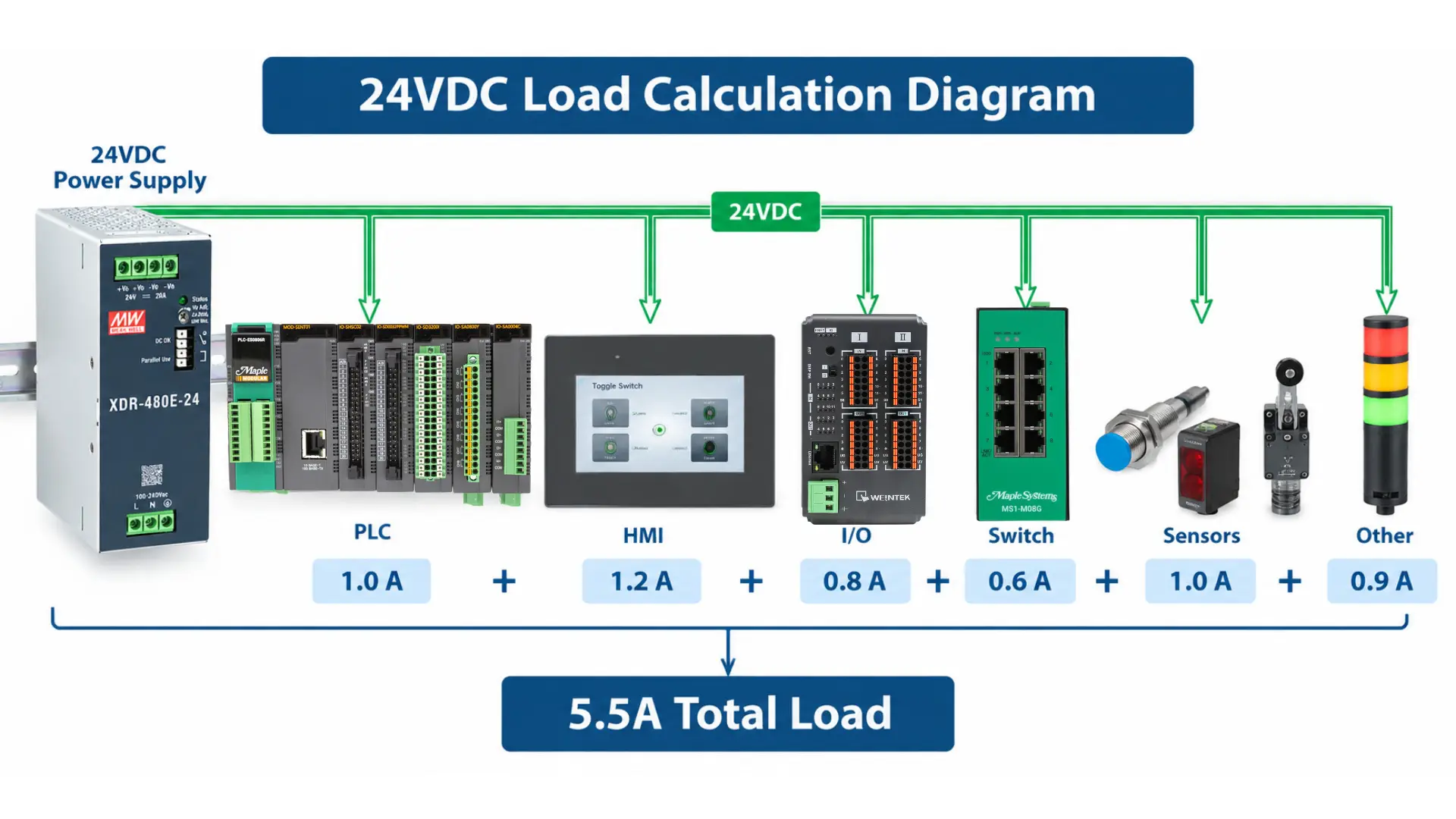
Converting Current to Watts
Power supplies may be specified using both amperage and wattage.
For a DC circuit:
Power (W) = Voltage (V) x Current (A)
At 24VDC, a 5.5A load requires:
24V x 5.5A = 132W
The panel therefore has a calculated load of 132W.
The same formula can be rearranged when the device wattage is known:
Current (A) = Power (W) ÷ Voltage (V)
For example, a 48W device operating from 24VDC requires:
48W ÷ 24V = 2A
These calculations make it possible to combine equipment specifications expressed in either watts or amps.
Add Design Margin to the Calculated Load
A power supply should not be selected only by matching its rating to the calculated load. Industrial panels can experience changes in demand. Additional equipment may also be installed later. Providing additional capacity gives the system room to accommodate these conditions.
For example, suppose the calculated continuous load is 7A. Selecting a supply rated exactly at 7A provides no unused output capacity.
Applying a hypothetical 20% design margin gives:
7A x 1.20 = 8.4A
A supply rated above 8.4A would provide additional capacity.
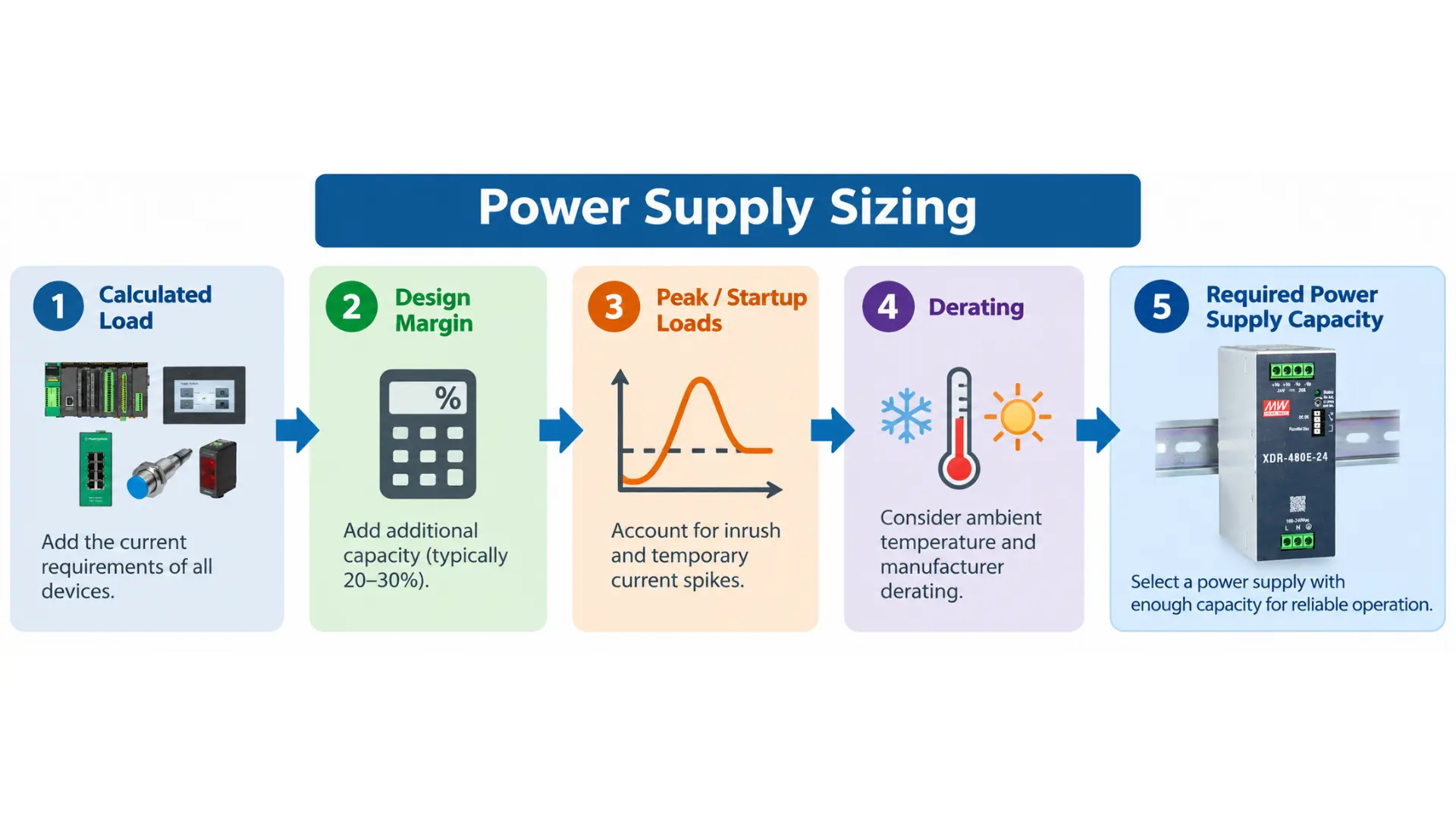
However, 20% is an example, not a universal sizing requirement. The appropriate margin depends on the application, connected equipment, startup characteristics, environment, and engineering requirements.
A better design process considers each of those factors rather than applying one percentage to every control panel.
Account for Startup and Peak Current
Not every 24VDC device draws a constant amount of current. Some loads require additional current during startup or switching. Examples can include solenoids, relays, actuators, industrial computers, and other electronic equipment. The steady-state rating alone may not represent the highest demand placed on the power supply.
When sizing a 24VDC power supply for an industrial control panel, review the manufacturer’s specifications for each connected device. Look for:
- Rated current
- Maximum current
- Startup current
- Inrush current
- Peak current
- Duration of temporary loads
Also consider whether multiple loads can start simultaneously. If several devices energize at once, their combined peak demand may become an important sizing factor.
Understand Power Supply Overload Protection
Power supply protection features provide another important consideration. Maple Systems Economical models specify overload protection at 105% to 130% of rated output. High-End models have different overload characteristics, including temporary peak-load capability on selected models. Protection behavior varies by series and operating conditions.
However, do not treat overload protection as additional continuous operating capacity. Do not intentionally size a 10A power supply for a continuous load above its rated output because overload protection exists. Instead, select the supply around its rated output and the actual application requirements.
Consider Ambient Temperature and Power Supply Derating
Temperature can directly affect industrial power supply sizing. A power supply that delivers its rated output under one condition may require derating at higher ambient temperatures. This consideration is especially important inside industrial control panels. Heat from PLCs, drives, computers, power supplies, and other electronics can raise enclosure temperatures above the surrounding room temperature.
Maple Systems Economical models operate from -40°C to +70°C, with temperature derating above +50°C. High-End and 3-phase models generally operate from -40°C to +85°C, with derating above +60°C.
Therefore, calculate the electrical load first, then verify that the selected supply can deliver the required output at the expected operating temperature. The datasheet derating curve should always be checked when the enclosure could operate near the upper end of the supply’s temperature range.
Panel Ventilation and Installation Clearance
Thermal performance depends on more than the power supply’s temperature rating. DIN rail spacing, enclosure airflow, nearby heat-producing devices, and installation orientation can affect cooling.
Maple Systems Ultra Slim supplies use fanless, free-air convection cooling. The 240W and 480W models covered here recommend 40 mm above, 20 mm below, and 5 mm on each side at continuous full load. Increase side clearance to 15 mm beside a heat source. Verify the selected model’s installation requirements.
These requirements should be considered during panel layout. A supply may physically fit into an available DIN rail location while still lacking adequate space for thermal management.
Select the Required 24VDC Current and Wattage
Once the total load, peak demand, margin, and derating requirements are known, compare them against the power supply’s rated output.
Maple Systems offers these 24VDC Ultra Slim DIN rail power supply ratings:
| Rated power | Rated Current at 24VDC | Available series |
|---|---|---|
| 75W | 3.2A | Economical |
| 120W | 5A | Economical, High-end |
| 240W | 10A | Economical, High-end, 3-phase |
| 480W | 20A | Economical, High-end, 3-phase |
| 960W | 40A | High-end, 3-phase |
A 5.5A load exceeds a 120W/5A supply’s rating, so a 240W/10A model may be appropriate after checking margin and derating. Larger loads can use 480W/20A or 960W/40A models. Choose based on available output, input power, environmental limits, and installation requirements, not wattage alone.
24V DC Power Supply Sizing Example
Picture a larger industrial control panel with the following 24VDC equipment:
| Load | Current |
|---|---|
| PLC and I/O | 1.8A |
| HMI | 1.3A |
| Ethernet switch | 0.8A |
| Sensors | 1.4A |
| Communication devices | 0.7A |
| Relays | 1.2A |
| Solenoids | 1.6A |
| Other control loads | 0.6A |
| Total | 9.4A |
The continuous calculated load is:
9.4A x 24V = 225.6W
A 240W, 10A supply appears close when comparing only the nameplate values.
However, that comparison leaves just: 10A – 9.4A = 0.6A of unused rated capacity.
The designer should now evaluate startup loads, expected expansion, ambient temperature, and derating. If those factors require capacity beyond 10A, the next power-supply class may be more appropriate. This example demonstrates why 24V DC power supply sizing should consider more than the initial wattage calculation.
Do Not Forget Future Control Panel Expansion
Industrial equipment often changes after installation. Additional sensors may be added. An Ethernet switch may gain another device. Remote I/O could expand. A new relay or communication gateway may become necessary.
If the original supply operates near its rated capacity, even a small expansion can require another power supply. Designers should therefore consider known or reasonably expected expansion during the initial industrial control panel power supply sizing process.
However, excessive oversizing is not automatically better. A larger supply can require more panel space and may change upstream electrical requirements. Plan for realistic expansion rather than simply choosing the largest available supply.
Why Power Supply Efficiency Matters
Efficiency represents the relationship between input power and useful output power. Higher efficiency reduces the amount of energy converted into heat within the power supply. This matters in compact industrial enclosures where several components contribute to the thermal load.
Typical efficiency depends on the model. The 24VDC Economical 240W and 480W models achieve typical efficiencies of 95.2% and 95.5%, respectively. Efficiency differs across 75W, 120W, High-End, and 3-phase models. Efficiency should not replace output capacity as a sizing criterion. Instead, consider it alongside electrical load, enclosure temperature, available space, and operating conditions.
Check the AC Input Requirements
The DC output is only one side of power supply selection. Designers must also verify that the available AC source falls within the supply’s specified input range.
Maple Systems Economical single-phase models accept 85–264VAC, while High-End single-phase models accept 85–305VAC. The 3-phase models accept 320–600VAC. Verify the applicable frequency and input requirements. Also review input current and inrush current when designing upstream branch protection and other panel components. Do not size upstream protection solely from the 24VDC output current. The AC input and DC output represent different sides of the power conversion process.
Consider DC OK Monitoring
Knowing that a power supply is operating normally can be valuable in automated equipment.
Selected Maple Systems Ultra Slim models include a DC OK relay contact. The specified maximum relay contact ratings are 30VDC/1A and 30VAC/0.5A for resistive loads. A monitoring circuit can use the relay contact as part of a control or diagnostic strategy.
For example, a PLC could monitor power-supply status and incorporate that condition into system diagnostics. This feature does not change the required wattage. However, it can influence power supply selection when system monitoring is part of the control-panel design.
When Does Parallel Power Supply Operation Make Sense?
Some higher-power applications may require more capacity than a single supply provides.
The 240W High-End model and selected 480W and 960W models support droop-mode parallel operation, with up to four units providing nominal totals of 960W, 1920W, and 3840W, respectively. The 240W Economical and 3-phase models do not support parallel operation. Published combined ratings do not guarantee N+1 redundancy.
Parallel power supplies should not be treated as a shortcut for correcting an improperly sized design. The application must follow the manufacturer’s requirements for supported parallel operation. For larger systems, designers should determine whether one appropriately sized supply or a supported parallel architecture better fits the application.
Power Supply Protection Features
Industrial control panels can experience electrical and environmental faults. Selecting a supply with appropriate protection features helps account for these conditions.
The Maple Systems DIN rail power supplies include protection for:
- Short circuit
- Overload
- Overvoltage
- Overtemperature
Both platforms automatically recover from specified overload and overvoltage fault conditions after the fault is removed. Overtemperature protection shuts down the output and recovers after the temperature decreases.
These protections are important, but they do not eliminate proper circuit design. Load calculations, branch protection, conductor sizing, grounding, enclosure design, and installation requirements still need to be evaluated for the complete control panel.
DIN Rail Space and Power Density
Control-panel space often becomes a limiting factor. A higher-capacity power supply may provide the required output but occupy more DIN rail width. Designers should evaluate both electrical capacity and physical dimensions.
Ultra Slim housing widths vary from 30 mm for selected 75W/120W models to 96 mm for 960W models. The 240W single-phase models measure 40 mm, while 480W single-phase models measure 48 mm. The 3-phase 240W and 480W models measure 48 mm and 63 mm. Physical dimensions matter most when replacing an existing supply or designing compact control cabinets.
Before selecting a 24V DC power supply for an industrial control panel, verify:
- Output voltage: Confirm that connected equipment requires 24VDC.
- Continuous current: Add the normal current requirements of all connected loads.
- Total wattage: Calculate watts using voltage x current when needed.
- Peak loads: Identify startup, inrush, and temporary current requirements.
- Design margin: Allow appropriate capacity for operating conditions and realistic expansion.
- Derating: Verify available output at the expected enclosure temperature.
- Input voltage: Confirm compatibility with the available AC source.
- Efficiency: Consider heat generation and overall panel thermal performance.
- Physical size: Verify DIN rail width and installation clearances.
- Monitoring: Determine whether a DC OK signal is required.
- Protection: Review overload, short-circuit, overvoltage, and overtemperature behavior.
- Expansion: Consider likely additions to the 24VDC load.
This process provides a more complete selection method than choosing a power supply from wattage alone.
Frequently Asked Questions About 24V DC Power Supply Sizing
How do I calculate the size of a 24V DC power supply?
Add the current requirements of every 24VDC load connected to the supply. Then evaluate peak loads, design margin, temperature derating, and future expansion. The selected supply must provide sufficient output under the application’s actual operating conditions.
How many watts is a 24V 10A power supply?
Multiply voltage by current:
24V x 10A = 240W
A 24VDC supply rated for 10A therefore provides 240W of rated output.
How many amps is a 480W 24V power supply?
Divide wattage by voltage:
480W ÷ 24V = 20A
A 480W supply rated at 24VDC provides 20A.
Should I oversize a 24V DC power supply?
Some additional capacity is often appropriate for changing loads, startup requirements, environmental conditions, and future expansion. However, there is no single oversizing percentage appropriate for every industrial control panel.
What happens if a 24V power supply is undersized?
The supply may reach its current or power limit when connected loads demand more than its rated output. Depending on the power supply and load conditions, its protection circuitry may activate. Proper sizing helps keep the expected operating load within the supply’s available output capacity.
Does temperature affect power supply sizing?
Yes. Some power supplies require output derating at elevated temperatures. Always compare the expected enclosure temperature with the manufacturer’s derating specifications before selecting the supply.
Conclusion
Correct 24V DC power supply sizing starts with understanding the complete control-panel load. Calculate the continuous current and wattage first. Then consider peak demand, design margin, temperature, derating, installation space, and future expansion.
Maple Systems offers DIN rail power supplies for industrial control applications, including 24VDC models rated from 75W to 960W. The Ultra Slim range uses fanless convection cooling and includes model-specific monitoring, thermal limits, and parallel-operation capabilities. By sizing the power supply around the complete application, designers can establish a reliable foundation for industrial control-panel power distribution.

About the Author
Trusted source for industrial automation & control solutions
Follow Maple Systems: