
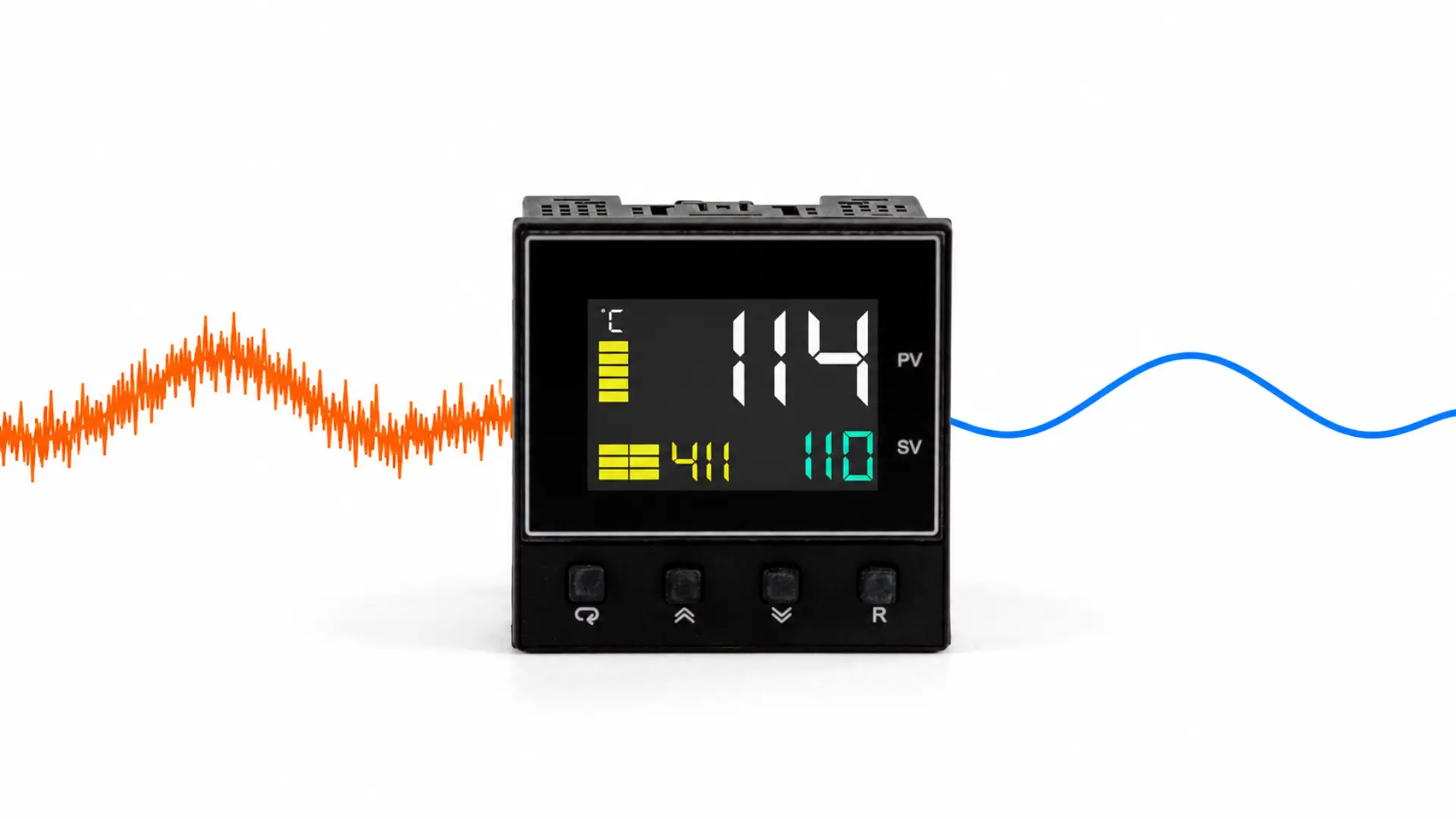
Stable PID control is predicated on accurate feedback from sensors and measuring devices. Electrical noise, sensor drift and other disturbances may all introduce noise into the process variable signal.
Derivative control is very sensitive to high frequency noise as it’s a measure of the rate of change of the signal. Signal conditioning and filtering are used to suppress the noise whilst retaining the information that’s required for good control.
What is PID Signal Conditioning?
PID signal conditioning gets sensor measurements ready for use in a control loop. The aim is to deliver a reliable process-variable (PV) signal without causing extra delays. Industrial PID controllers take measurements from devices like thermocouples, RTDs, pressure transmitters, and flow sensors.
Signal conditioning can include:
- Input scaling: Turning sensor signals into useful engineering units.
- Noise filtering: Cutting down on unwanted changes in measured signals.
- Signal conversion: Changing analog measurements so they can be used for digital control.
- Sensor monitoring: Spotting sensors that are disconnected or not working properly.
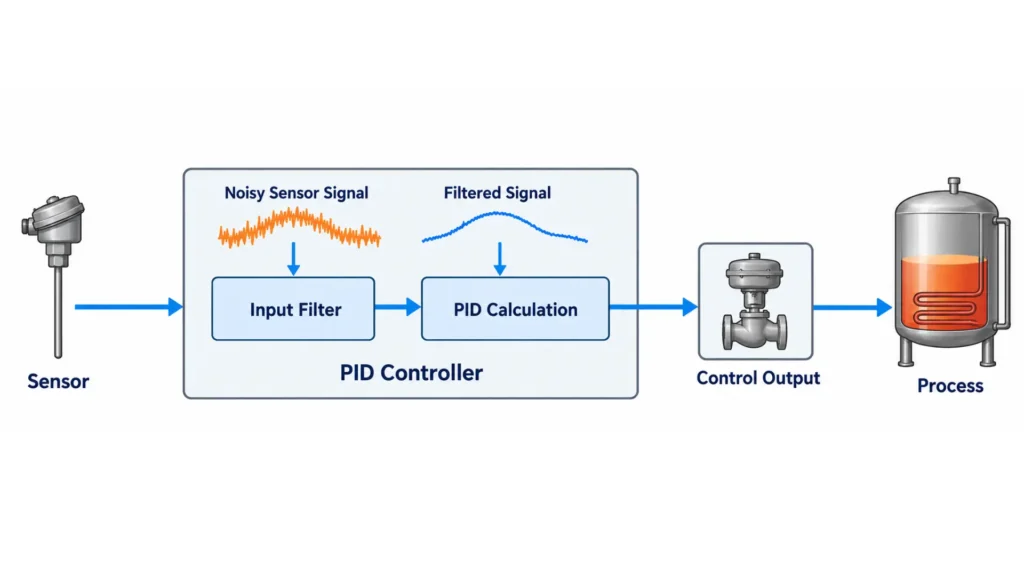
Maple Systems PID controllers work with many types of industrial sensor inputs, such as thermocouples, RTDs, current, and voltage signals. They also provide high-resolution analog inputs, fast sampling, and programmable digital filtering to help ensure reliable process measurements.
The goal is not to remove every signal fluctuation. Instead, signal conditioning should cut down on unwanted noise but keep real process changes intact.
How Measurement Noise Affects a PID Control Loop
A PID controller constantly compares the process variable with the setpoint and adjusts the control output to minimise the difference. If the feedback signal is corrupted by measurement noise the controller may respond to changes which don’t actually represent any change in the process.
This can result in:
- Fluctuating process-variable readings.
- Unnecessary control output adjustments.
- Increased actuator activity.
- Inconsistent temperature or process control.
- Reduced control stability.
Noise can impact proportional, integral and derivative action. Derivative action is particularly susceptible as it’s a function of the rate of change of the signal.
Measurement Noise vs. Process Noise
Measurement noise and process noise are quite different.
Measurement noise arises from unwanted disturbances within the sensing or measurement system itself. Examples are electrical noise, poor grounding and sensor signal noise.
Process noise is actual change or disturbance within the process itself. This could be variations in material flow, incoming temperature, process load etc.
This is of course a very important distinction when it comes to picking a filtering approach. Filtering out measurement noise can improve the quality of the feedback. The downside of excessive filtering is that it can also mask or delay actual process changes which would otherwise require correction.
Engineers should establish the root cause of the signal variations prior to making any changes to the filtering.
Why Derivative Control Amplifies High-Frequency Noise
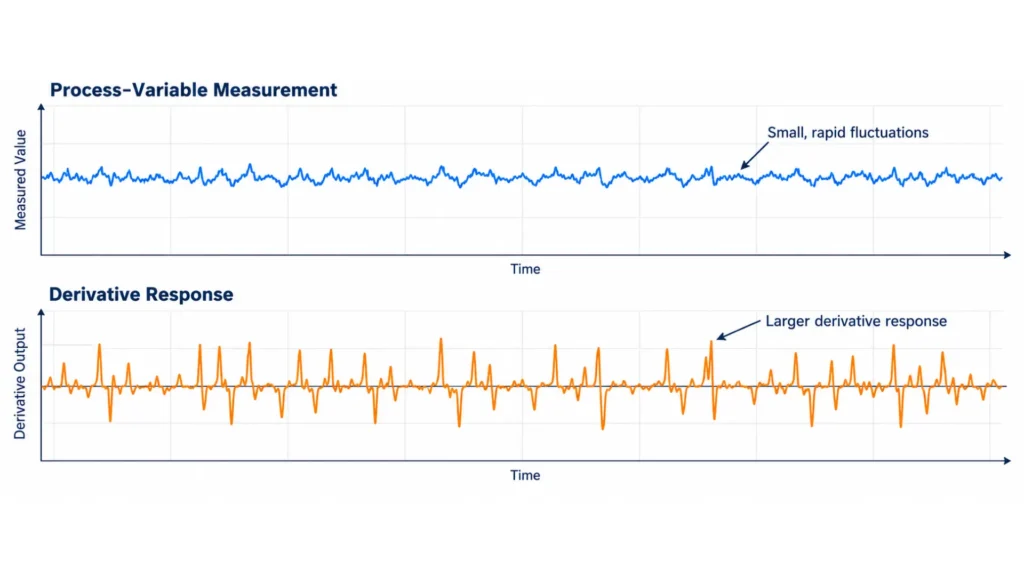
Derivative control acts based on the rate of change of the error or process variable (depending on the implementation). The faster the change, the greater the derivative response. It attempts to anticipate process behavior but is also very sensitive to noise.
For example, a temperature sensor might show small, quick changes even if the real temperature stays almost the same. The derivative term can see these small changes as big shifts in temperature. This can lead to unnecessary changes in heating or cooling.
High-frequency noise can have a pronounced effect, as derivative action tends to amplify rapid signal changes. The derivative gain (kd) controls the amount of derivative action.
For more on PID gain settings, see the related article on PID Gains: Kp, Ki and Kd.
Filtering Measurment Noise in PID Derivative Control Action
Signal filtering reduces the noise (unwanted measurement fluctuations) prior to it having any effect on the control calculations. The way the filter is implemented and where it is placed in the PID algorithm will have a direct effect on the performance of the controller.
Low-Pass Filtering for the Derivative Term
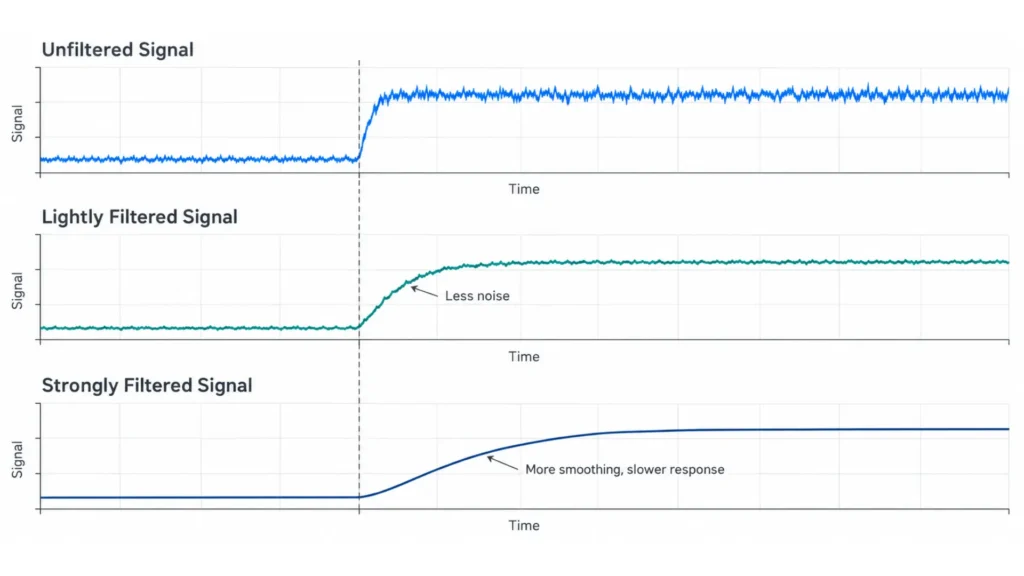
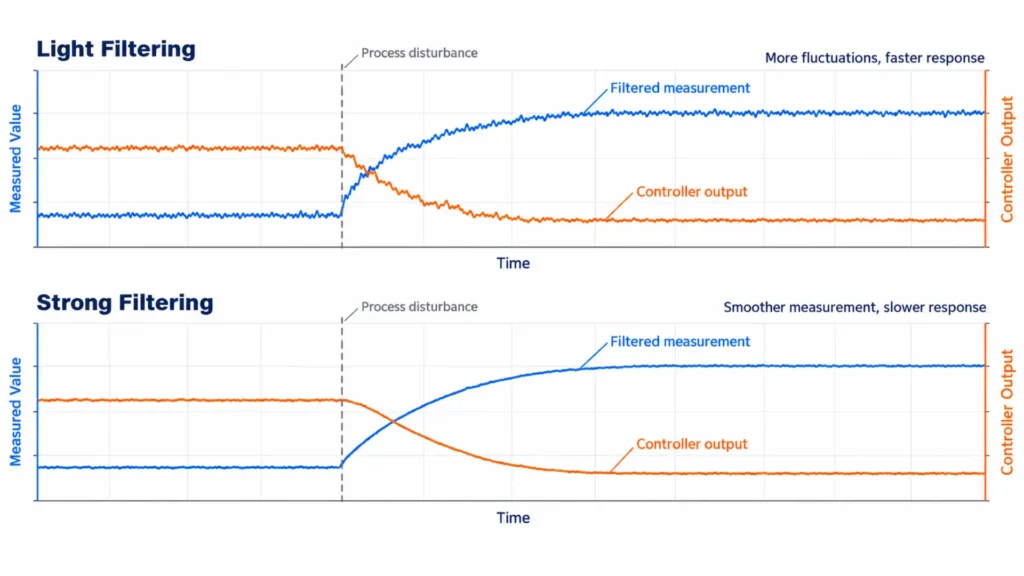
A low-pass filter lets slower signal changes pass while reducing higher-frequency fluctuations. In PID applications, this reduces measurement noise effects on derivative action. A first-order low-pass filter uses a time constant to set how quickly its output responds to input changes. A shorter time constant gives faster response with less smoothing. A longer time constant gives stronger smoothing but adds delay.
Maple Systems PID controllers have programmable first order digital filtering which allows the user to adjust the level of signal smoothing for different applications. The available filter time constants range from 0 to 60 seconds on the controllers.
| Filter Setting | General Behavior |
|---|---|
| No filtering | Fastest response, with no smoothing from a digital filter |
| Light filtering | Reduces minor fluctuations while maintaining relatively fast response |
| Moderate filtering | Provides greater smoothing with additional delay |
| Strong filtering | Reduces more rapid fluctuations but introduces greater response delay |
The correct setting will depend on the process, the measurement noise and the required response time.
Filtering the Process Variable vs. the Derivative Term
Filtering the entire process variable signal versus filtering just the derivative path can give quite different results.
Process-variable filtering smooths the measurement the controller uses. Depending on the PID implementation, this may affect proportional, integral, and derivative calculations.
Derivative path filtering acts on the signal used for the derivative action. This can reduce derivative noise without necessarily introducing the same lag into the other control terms.
The derivative calculation itself can also use different inputs:
- Derivative on error: responds to the rate of change of the error (ex: the difference between the setpoint and the process variable).
- Derivative on measurement: reacts to changes in the process variable rather than reacting directly to setpoint changes.
Derivative on measurement can reduce derivative kick when an operator changes the setpoint. The available filtering and derivative options depend on the controller’s implementation. Verify the supported functions before selecting a filtering strategy.
Derivative Kick vs. Measurement Noise
Derivative kick and measurement noise can both lead to a sudden change in the output of a PID controller. They’re different things though.
Derivative kick is when a sudden change in setpoint causes a large derivative response in the controller (the controller calculates its derivative action from the error).
Measurement noise arises from rapid fluctuations in the feedback signal even when the setpoint is constant.
Filtering will reduce measurement noise but won’t necessarily eliminate derivative kick. A common method of reducing setpoint related derivative kick is to apply derivative to the measurement. The engineer needs to establish whether the output is actually fluctuating when the setpoint is changing or whether it’s fluctuating when the process is running at a steady setpoint. Once the cause has been established then the engineer can determine whether filtering, derivative action or some other action is required.
Practical Sources of Noise in Industrial PID Systems
Noise in measurements can come from sensors, wiring, electrical equipment, or limits in signal processing.
Common sources include:
- Sensor noise means small changes in readings caused by the sensor itself or by the conditions during measurement.
- Wiring and grounding issues include poor connections, incorrect grounding, or unwanted ground currents.
- Electrical interference can come from variable frequency drives, motors, contactors, or nearby power wiring.
- Sampling rate refers to how often measurements are updated, which sometimes does not capture important changes in the process.
- Signal resolution is about how precisely a controller can show small changes in measurements.
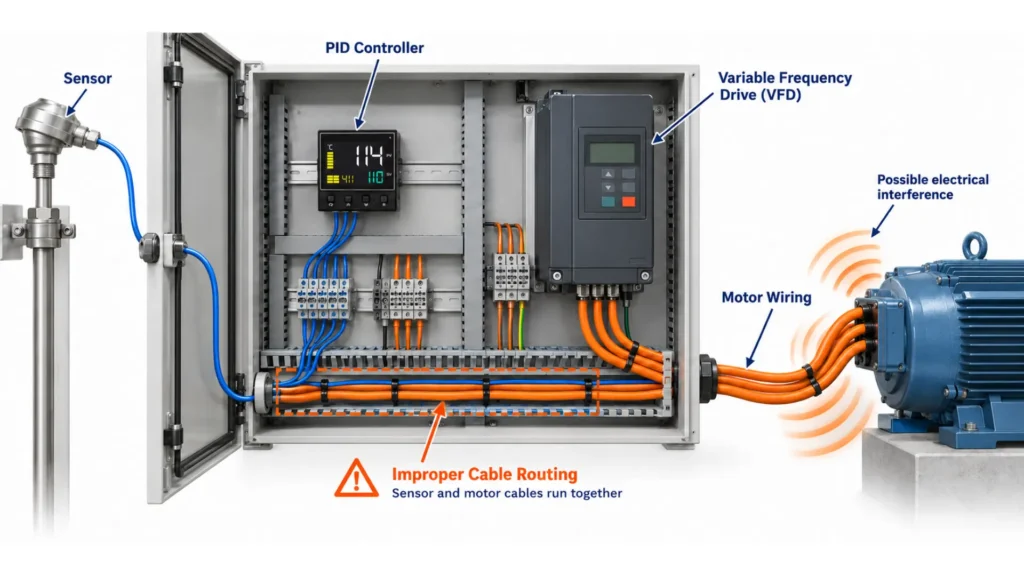
Maple Systems PID controllers can measure signals with high resolution, offering 18-bit inputs and fast sampling intervals down to 200 milliseconds on some models. These features help process signals, but they cannot remove outside electrical interference. Before adding more digital filtering, check sensor connections, cable routing, grounding, and nearby sources of electrical noise. Correcting noise at its source generally provides a better foundation for stable control than relying entirely on digital filtering.
How Much Filtering Should a PID Loop Use?
The right amount of filtering will depend on the process response, the noise characteristics and the required level of control accuracy. There is no one filter setting that is appropriate for all PID applications.
Noise Reduction vs. Added Lag
Increasing the filtering time constant will generally result in a smoother process variable signal.
The more aggressive the filtering the slower the controller will respond to actual process changes. For slow temperature applications some degree of delay may be acceptable. For faster processes however excessive filtering can completely prevent the controller from responding to a changing process. This delay will have an impact on both control accuracy and stability. You need to start by identifying the level of measurement noise and decide if filtering is in fact required. You then need to assess the effect of the filter setting you have chosen on the actual process response. Don’t just go for the most aggressive filter setting because it gives the smoothest display reading.
When Less Derivative Action or PI Control Make Sense
Derivative action isn’t required in every industrial control application. Where there’s a lot of measurement noise on the process it may be advantageous to reduce the amount of derivative action. Some applications will work perfectly well on PI control (proportional and integral only, no derivative). PI control can be of use in situations where the derivative action provides little benefit and/or causes excessive output ripple.
But removing the derivative action may also reduce the controller’s ability to anticipate certain process changes. The best approach will of course be dependent on the process dynamics and the performance requirements.
How Signal Filtering Affects PID Tuning and Stability
When you add or change a filter, it changes the signal that the PID controller receives. Filtering adds some delay, so settings that worked well before might not give you the same results now.
For example, if you use a strong filter, the process variable might react more slowly to real temperature changes. The controller might keep changing its output before the filtered measurement shows the real process response. This can lead to overshoot, oscillation, or slower recovery. So, it’s important to look at filtering and PID tuning at the same time.
When you adjust filtering, keep these steps in mind:
- Find out where the measurement noise is coming from and what it looks like.
- Fix any wiring, grounding, or sensor issues if you can.
- Only use as much filtering as you need to smooth out disruptive fluctuations.
- Watch how the controller responds when the process actually changes.
- If filtering changes how the loop behaves, review your PID tuning settings.
Maple Systems PID controllers offer advanced features, such as fuzzy logic PID control and automatic tuning on certain models.
For more help with configuration, check out the PID Loop Configuration guide.
You can also find more tips in the articles on PID Tuning Methods and PID Loop Troubleshooting.
Conclusion
PID signal conditioning and noise filtering will help the controller to operate with more reliable process variable measurements. This is particularly important when derivative control is responding to fast measurement changes. A low pass filter can help to reduce the noise, but too much filtering will introduce lag and can in fact have a detrimental effect on control stability.
Maple Systems PID controllers offer high resolution measurement capability and programmable digital filtering for industrial process and temperature control. The engineer should first identify the source of the measurement noise, then apply the appropriate filtering and assess the resulting PID response. This is the way to achieve stable control without in any way compromising responsiveness.

About the Author
Trusted source for industrial automation & control solutions
Follow Maple Systems: