
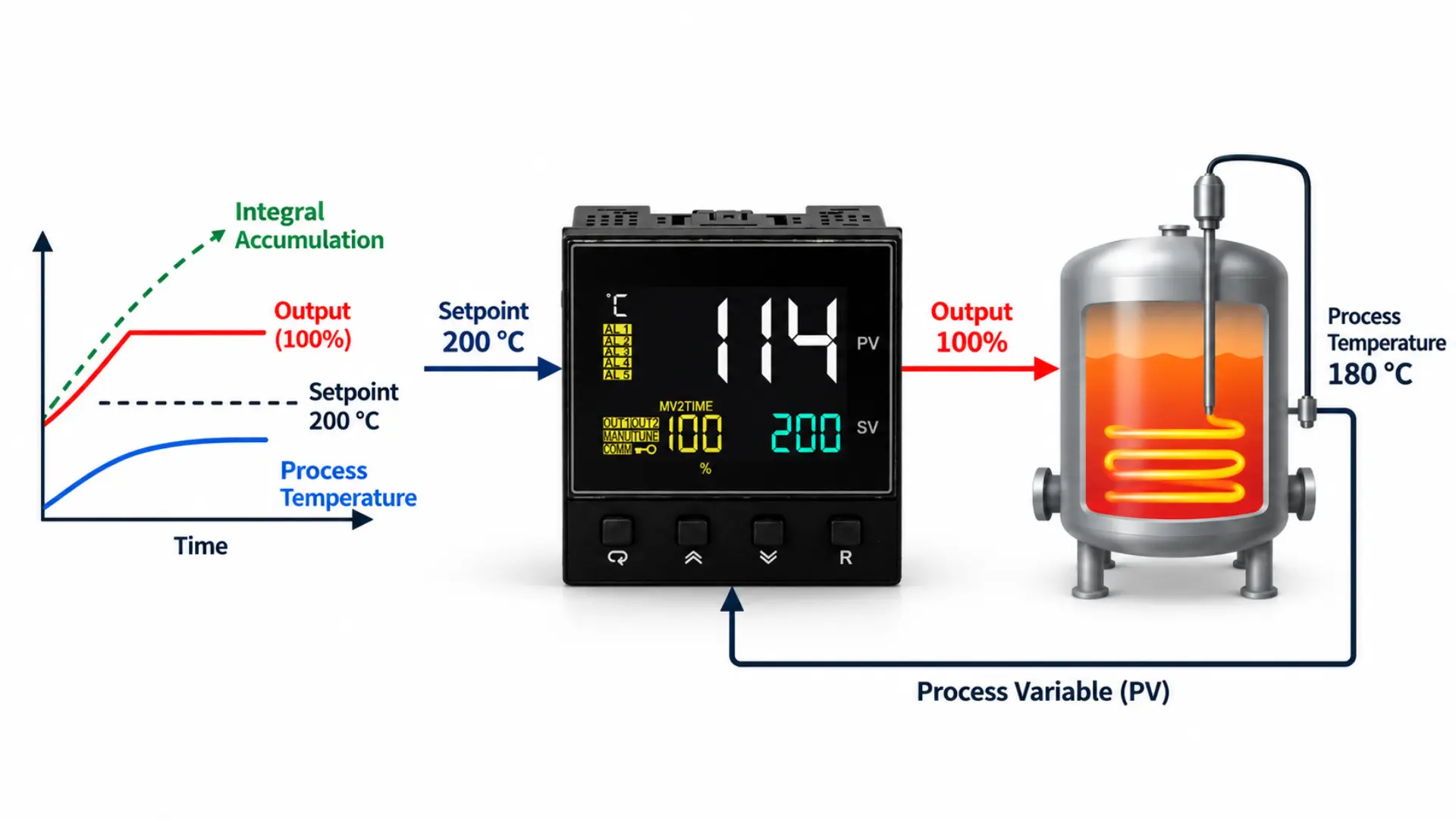
Integral windup occurs when the integral term in the PID is just continually accumulating error as the controller output or actuator hits its limit. The result is that you can end up with excessive overshoot, a very slow recovery and an unstable process.
Anti-windup techniques work by preventing excessive integral accumulation by either limiting or correcting the integral term during the period of output saturation. It’s good to have knowledge of these techniques, which will help you to improve the stability of your PID loop and ensure that you have predictable loop behavior.
What is Integral Windup in a PID Controller?
Integral windup (also known as integrator windup or reset windup) is the situation where a PID controller has accumulated too much integral action for the process to be able to use. The PID controller is constantly comparing the process variable (PV) to the setpoint (SP) and the difference between these is the error. The proportional term reacts to the present error and the integral term reacts to the accumulated error over time. In normal operation the integral action is what eliminates the steady state error. The problem occurs when the controller is asking for more output than the actuator is able to provide.
For instance a heating system may require more heat than its heating element can actually deliver. It may be that even at maximum output the process temperature is still below the setpoint. Without anti-windup the integral term could continue to accumulate even though the actuator is already at full stroke.
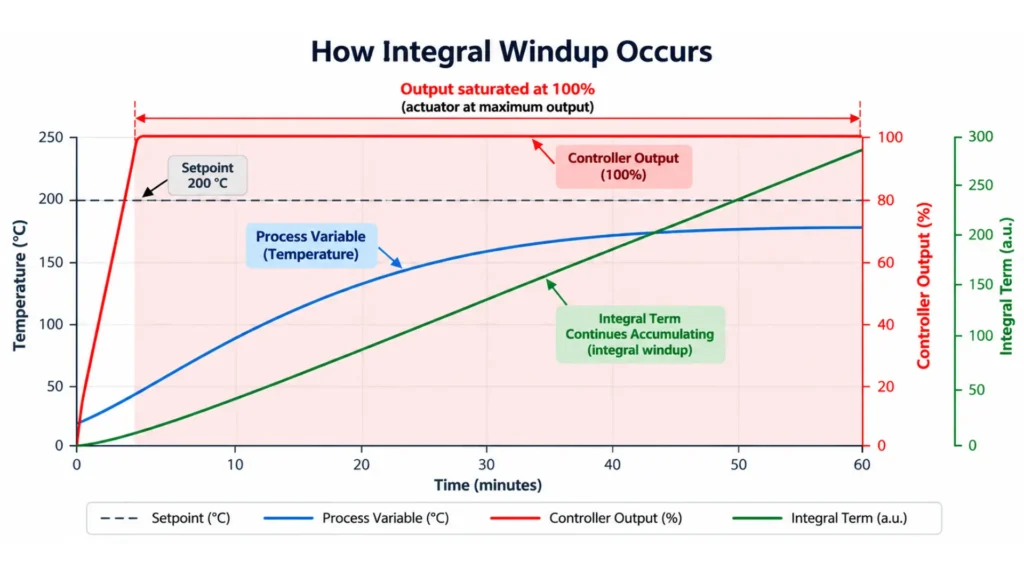
The graph above shows integral windup occurring when a PID controller has reached its maximum output and can’t get to the required temperature. The black dashed line is the 200°C setpoint, the blue line is the actual temperature which is rising but still below that setpoint. The red line is the controller output which has reached and stayed at 100%. The green line is continuing to go up as the integral term is accumulating error (the error is still there) even though the heater can’t actually provide any more output.
How the PID Integral Term Accumulates Error
The PID integral term is the one that accumulates the error (the difference between setpoint and process variable) over time. If the process is consistently below its setpoint the integral term will accumulate in the direction required to reduce that error. This is a useful characteristic in that pure proportional control may leave a steady offset between the setpoint and the actual process value.
Integral accumulation becomes excessive when the controller is unable to correct the error. Take a heating process with a setpoint of 200°F. If the heater can’t provide sufficient energy the temperature may end up at 180°F. The controller will continue to see a 20°F error and its integral term will continue to accumulate (even though the heater can’t actually deliver any more energy). The accumulated integral action stays in the controller until the error reverses or the integrator is otherwise reset. The amount and rate of accumulation will be a function of the controller’s integral settings.
For more on integral gain and its relationship to proportional and derivative action, see Understanding PID Gains: Proportional (Kp), Integral (Ki) and Derivative (Kd).
Why Actuator Saturation Causes Integrator Windup
Actuator saturation is when the actuator reaches its max or min.
Common examples include:
- A heating element at 100% power.
- A control valve at its fully open or fully closed position.
- A motor running at its maximum allowable speed.
- A pump at its available flow.
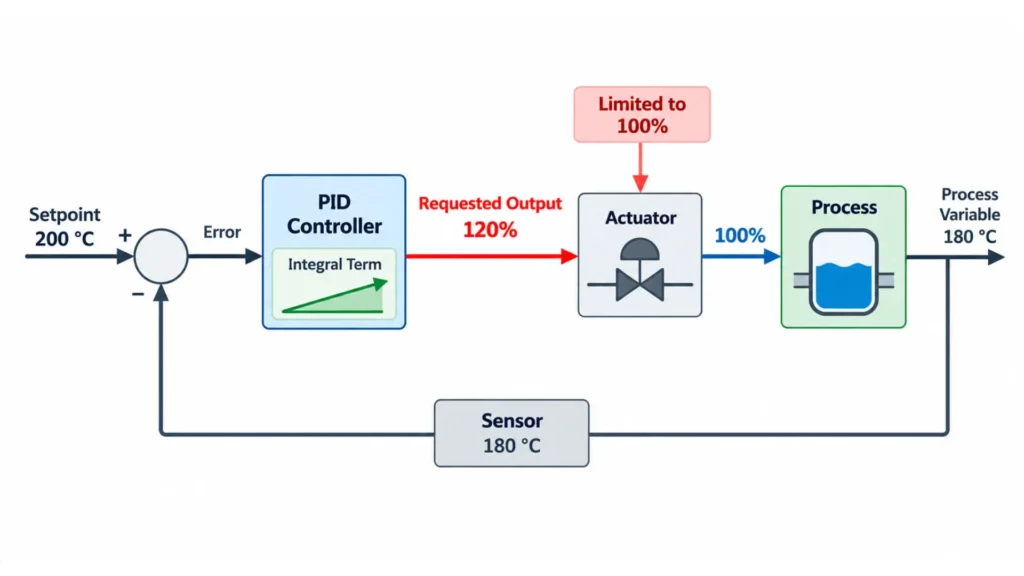
Once an actuator has reached its limit, further controller output will not result in any further change to the manipulated variable. For instance a PID controller may work out that the valve needs 120% output. The valve itself however can’t go beyond 100%. The actual command will be capped at 100% and the integral term will keep on building up.
Output saturation does not in itself stop integral windup. Without some form of protection the controller can continue to accumulate the corrective action that the actuator is simply unable to apply.
Windup can also occur at the lower output limit when the integral term continues to accumulate in the opposite direction.
The diagram above illustrates how a PID controller uses conditional integration to avoid integral windup. Once the control output has been calculated, the controller checks to see if the output is at its limit. If the output is saturated and further integral accumulation would lead to saturation, integration is halted. Otherwise integration proceeds as normal. This is a continuous process and effectively prevents integral windup while still allowing the controller to react to changes in the process.
What Problems Does Integral Windup Cause?
Integral windup can significantly affect PID loop behavior when the actuator saturates. Common symptoms include overshoot, slow recovery, delayed corrective action, and re-oscillation.
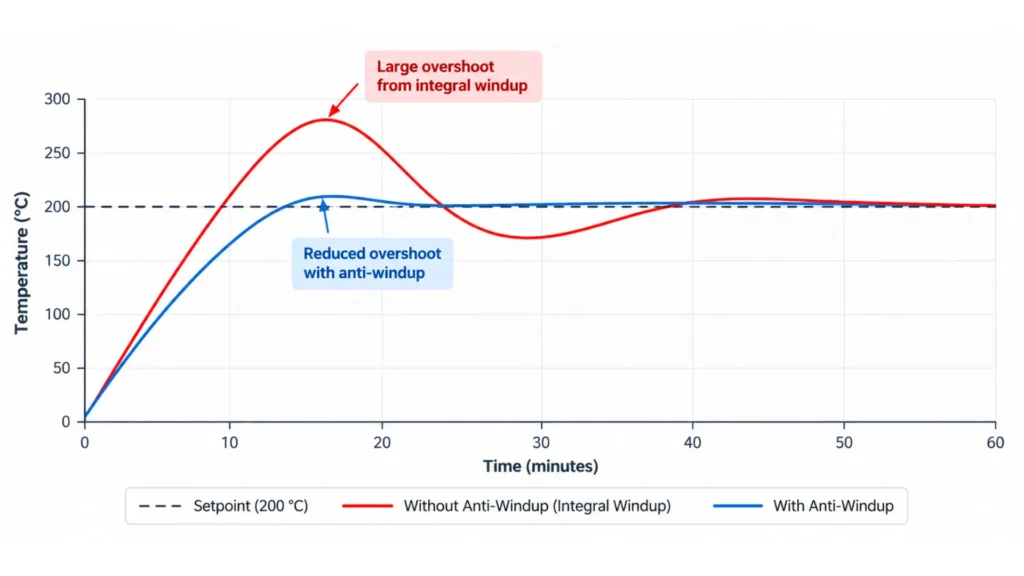
Excessive overshoot: the process variable may continue moving past its set point as the accumulated integral action keeps the controller output high.
Slow recovery: the controller may take time to reduce its accumulated integral before it responds.
Delayed response: even after the process error has changed direction, the controller may continue to command the actuator toward its previous limit.
Oscillation: repeated saturation and delayed recovery can lead to large swings about the setpoint.
Think of an industrial oven running at full heating capacity on startup. As it approaches its setpoint, accumulated integral action may keep the heater at full power longer than it should. The temperature can therefore go above the setpoint. The same thing can happen in a pumping application.
If the pump can’t reach the required pressure, the controller can end up with a lot of accumulated integral action. When conditions change, the stored correction can cause excessive pressure or a very slow return to steady state. This is particularly an issue in processes with high thermal inertia, long response times, and/or tight operating limits.
The diagram above illustrates how conditional integration helps prevent integral windup in a PID controller. The controller calculates its output using proportional, integral, and derivative terms, then checks whether the output is saturated. If the output has reached its limit and additional integral action would increase saturation, integration pauses to prevent excessive accumulation. Otherwise, integration continues normally. This process repeats continuously to maintain stable control and improve recovery when operating conditions change.
How Do Anti-Windup Methods Prevent Integral Windup?
Anti-windup techniques prevent the integral term from accumulating excessively when a PID controller is at its output limits. Instead of letting the integral term grow unbounded, the techniques clamp or correct the accumulated integral. The aim is to prevent the controller from storing more corrective action than the actuator can actually deliver. The two most common industrial approaches are integral clamping with conditional integration and back-calculation.
Integral Clamping and Conditional Integration
Integral clamping limits the integral’s contribution to a given range. Once the integral has reached its set limit it will not accumulate any further. This prevents the integral contribution from becoming too large during a sustained control error. Conditional integration is a similar approach but looks at whether or not further integration would actually lead to output saturation.
If the heater is at 100% and the process is still below the setpoint then conditional integration can simply stop any further accumulation in the direction of maximum heating. If however the error reverses and integration would be causing the controller output to go down then the integral term should be allowed to reduce. The difference is that if you just completely turned off the integral action when the output was saturated you could be delaying recovery. Conditional integration therefore stops any further windup whilst allowing the integral term to unwind when the error reverses. Integral clamping is fairly straightforward to implement and works quite well in applications where the output limits are reasonably well known.
However integral with fixed integral limits the limits have to be chosen very carefully. Limits that are too tight will in effect reduce the controller’s ability to eliminate the steady state error.
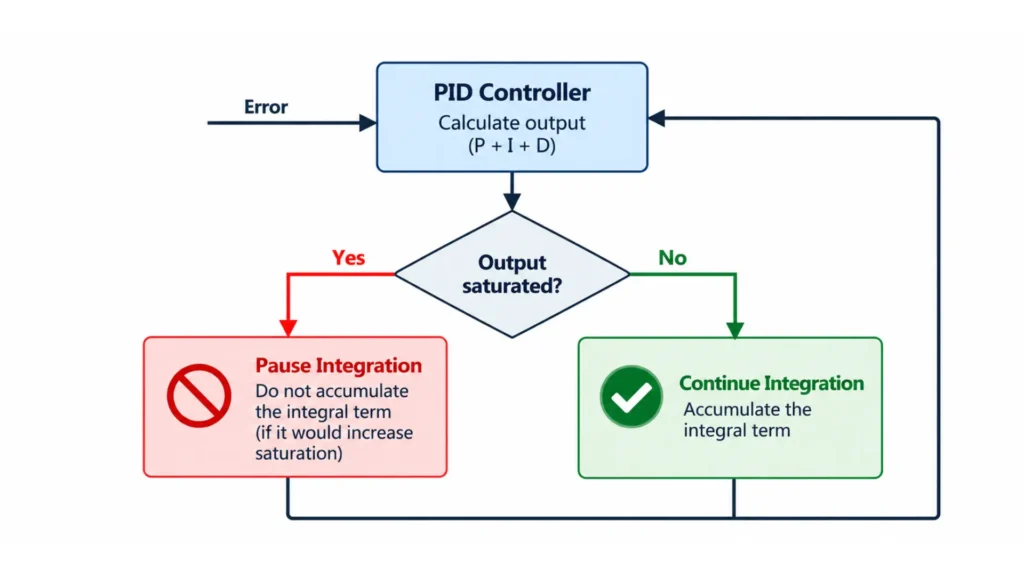
The diagram above shows how conditional integration prevents integral windup in a PID controller. The controller computes its output from the P, I and D terms, then checks to see if the output is at its limit. If the output is at its limit and further integral action would result in saturation then integration is switched off to prevent the integral term from building up. If the output is not at its limit then integration proceeds as normal. This is a continuous process and helps to prevent the integral term from building up excessively while still allowing the controller to react to changing process conditions.
Back-Calculation Anti-Windup
Back-calculation uses the feedback from the limited controller output to correct for excessive integral accumulation. It compares the controller’s requested output with the output which is actually available. If the requested output is greater than the available output then it uses that difference to correct the integrator.
For instance the controller may calculate an output of 120% whilst the actuator command is constrained to 100%. Back-calculation will detect the discrepancy and apply a corrective signal to the integral term. This serves to prevent the integrator from holding on to an excessively high integral contribution. As operating conditions change the controller will be able to recover more rapidly as there will be less of an excessive integral action to carry over. The rate at which the correction is applied is a function of the anti-windup design and its tracking parameters.
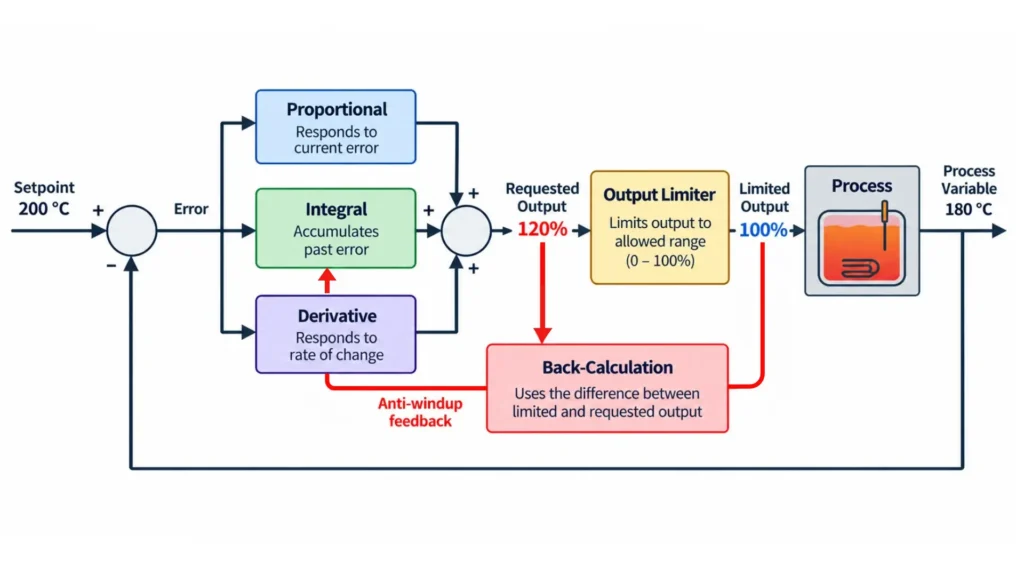
Back-calculation can give you a smoother recovery than just turning off the integration, especially if the actuator has been saturated for a long time. It does require a suitable correction mechanism and some care in how it’s set up to prevent any undesirable interaction with the main PID loop.
How to Choose an Anti-Windup Method for a PID Loop
Selecting an anti-windup method will depend on the process characteristics, the actuator limitations and the controller functions available. Both clamping and back-calculation can mitigate the effects of integral saturation, just in different ways.
| Anti-Windup Method | How it Works | Best Fit | Main Trade-Off |
|---|---|---|---|
| Integral clamping | Restricts the integral contribution to defined limits. | Applications with known operating limits and relatively simple control requirements. | Poorly selected limits can restrict useful integral action. |
| Conditional integration | Pauses integration when additional accumulation would worsen output saturation. | Processes with frequent or predictable actuator saturation. | Requires logic that correctly identifies when integration should stop or resume. |
| Back-calculation | Uses the difference between requested and limited output to correct the integrator. | Processes requiring controlled recovery from prolonged saturation. | Requires appropriate tracking behavior and additional configuration. |
For straightforward applications integral clamping or conditional integration may be quite adequate. Back-calculation would be the preferred option if you want a smoother recovery from saturation. Regardless of the method employed, assess a number of operating conditions.
Actuator capacity: Can the actuator achieve the required process conditions under normal operating loads?
Output limits: Ensure that the controller limits match the actual operating range of the equipment being connected.
Process response: How quickly does the process respond when the actuator goes into or out of saturation?
Integral settings: Check whether the integral action is suitable for the process dynamics.
Controller capabilities: Determine which anti-windup functions the control system supports. The available methods and the way they are implemented will vary.
Anti-windup helps with the recovery from output saturation, but it can’t make up for inadequate equipment capacity. For instance, restricting integral accumulation will not allow an undersized heater to get above its heating capacity. It doesn’t in any way remove the need for correct PID tuning.
Integral Windup vs. Poor PID Tuning
Integral windup and poor PID tuning can cause the same symptoms, such as overshoot, oscillation, and process instability.
However, the root causes are different. Integral windup happens when the integral term accumulates excessively while the controller output or actuator is held at its limit. Poor PID tuning occurs when the P, I, or D settings don’t suit the process. A poorly tuned PID loop can oscillate even when its output is well within the available operating range.
For instance, too much integral action can cause repeated overshoot, with the actuator never actually reaching its maximum output. On the other hand, a well-tuned PID loop can still suffer from windup if it’s subjected to extended saturation and there is no anti-windup provision. The difference is clear when you compare the controller output with the process behavior.
| Condition | Integral Windup | Poor PID Tuning |
|---|---|---|
| Output saturation | Common contributing condition | Not required |
| Integral accumulation | Excessive during limiting | May be overly aggressive without saturation |
| Overshoot | Often appears after prolonged saturation | Can occur during normal operation |
| Recovery | May be delayed by stored integral action | Depends on tuning and process dynamics |
| Corrective approach | Apply suitable anti-windup protection | Adjust PID parameters and verify process response |
Identifying output saturation is the first step in diagnosing suspected integral windup. If the controller output is at its limit and the process error persists, check whether integral accumulation is preventing recovery. If oscillation occurs without saturation, the problem is likely PID tuning, measurement noise, process delay, or another control issue.
For a more general discussion of controller tuning, see the Complete Guide to PID Loop Tuning Methodologies.
Conclusion
Integral windup occurs when a PID controller is integrating error while its output or actuator is at a limit. The accumulated integral action can then result in excessive overshoot, a very slow recovery and an unstable process.
Anti-windup techniques (integral clamping, conditional integration and back-calculation) all serve to deal with the accumulation.
The correct approach is going to be dictated by the actuator limits, the process response and the controller capabilities. When combined with appropriate PID tuning and correctly set output limits it can go a long way to ensuring more predictable and stable industrial process control.

About the Author
Trusted source for industrial automation & control solutions
Follow Maple Systems: