
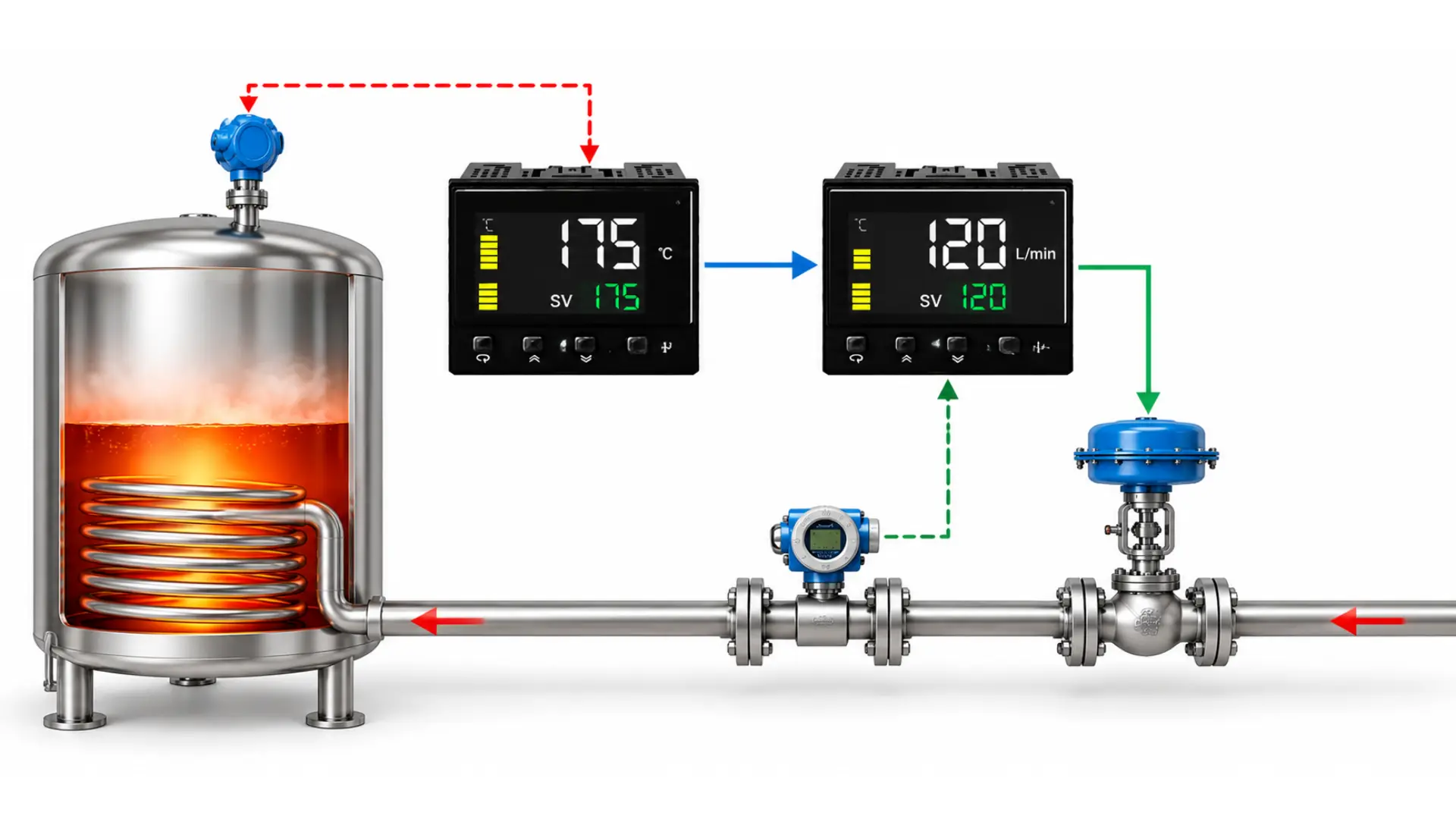
Cascade PID is a multi-loop control strategy employing nested feedback loops to control an industrial process. It involves two controllers working in tandem, each acting on a different process variable. The outer loop is responsible for controlling the main process variable, the inner loop controls a faster-acting intermediate variable. The benefit of this approach is that it can compensate for disturbances before they have a major impact on the process as a whole.
Cascade control is of use in a number of applications (temperature, pressure, flow, etc). It’s only really worthwhile in those situations where the process variables are interrelated and it’s important to understand how the loops interact in order to know when cascade control is in fact an advantage over a standard single loop PID.
What is Cascade PID Control
Cascade PID control uses two connected feedback loops to regulate a process. Each loop measures a different variable and performs a specific control function. The primary controller regulates the main process variable, such as temperature or pressure. The secondary controller regulates an intermediate variable that directly influences the primary process.
Unlike conventional single-loop PID control, cascade PID uses two interconnected controllers. The primary controller does not directly adjust the final control element. It simply sends a setpoint to the secondary controller. The secondary controller is what actually moves the final control element to keep its process variable at the required value. The benefit of this is that you have a much faster secondary loop which can deal with disturbances before they have a significant impact on the primary process variable.
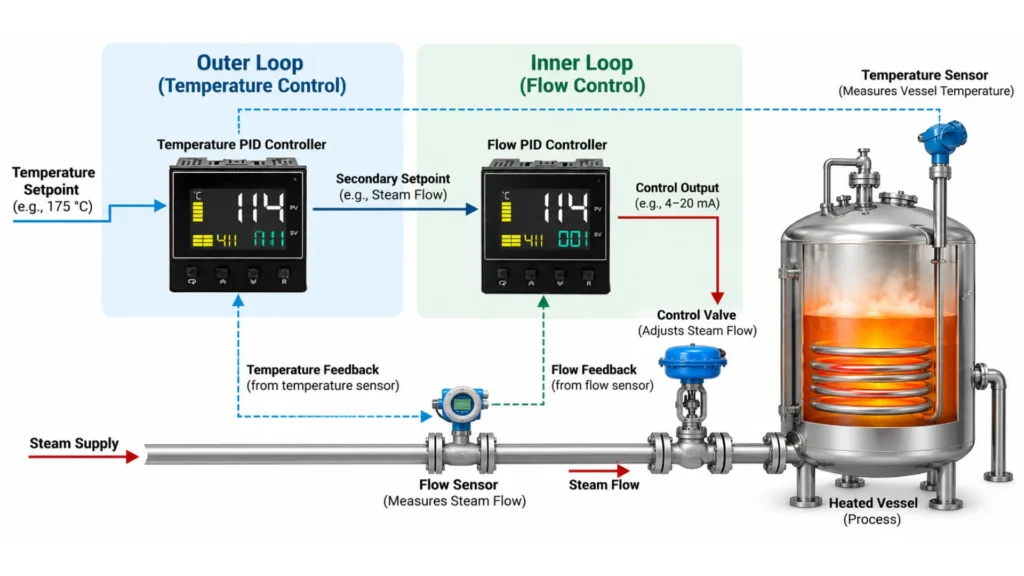
For example, a heating system may use vessel temperature as the primary variable and steam flow as the secondary variable. When steam supply pressure changes, the secondary controller can adjust the steam valve to maintain the requested flow. This helps reduce temperature fluctuations within the vessel. Cascade control works best when the secondary variable responds faster than the primary variable.
Cascade PID Control Architecture: Inner and Outer Loops
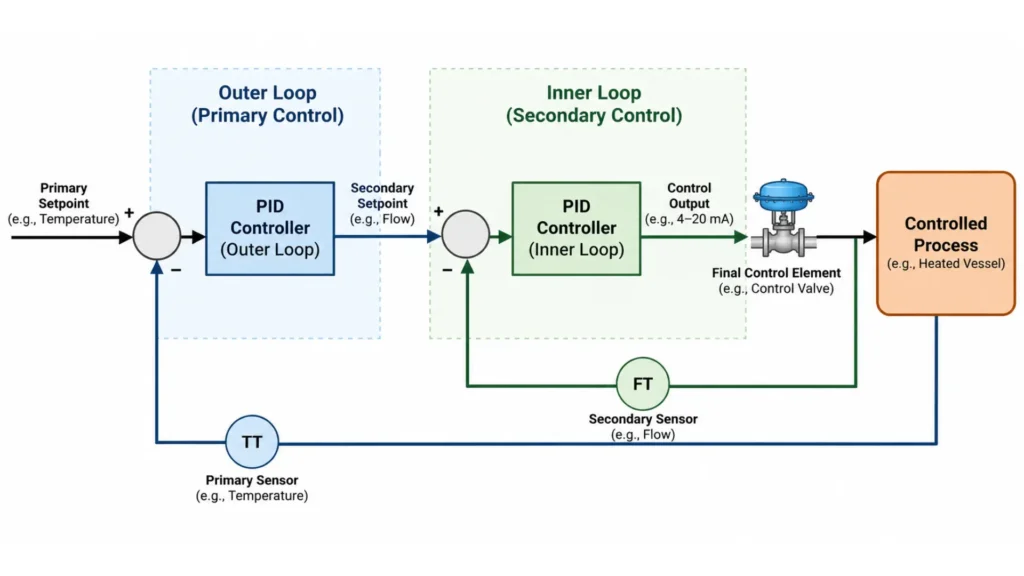
A cascade PID control architecture has two nested feedback loops (the outer loop and the inner loop). Both loops operate continuously, but each performs a different function. The outer loop is monitoring the main process variable and setting the setpoint for the secondary variable. The inner loop is then regulating the intermediate variable and in turn adjusting the final control element.
A typical cascade control sequence follows these steps:
- The primary sensor measures the primary process variable.
- The outer controller compares the measurement to its setpoint.
- The outer controller works out the required inner-loop setpoint.
- The inner controller compares its measurement to the setpoint.
- The inner controller adjusts the final control element.
- Both controllers are constantly monitoring their respective process variables.
The inner loop provides faster corrective action when disturbances affect the intermediate variable. Industrial PID controllers support thermocouple, RTD, current, and voltage measurements for process regulation. Maple Systems PID controllers also offer high-resolution analog inputs, digital filtering, autotuning, and Modbus RTU communication.
These capabilities support industrial PID applications. A complete cascade system also requires a supported way to connect the outer controller’s output to the inner controller’s setpoint. This connection may involve dedicated controller functions or an external control system depending on the equipment.
Primary Controller and Outer Loop
The primary controller, or outer controller, manages the main process variable. This variable is the operating condition that should stay close to its setpoint. For instance, a temperature controller keeps the temperature steady inside an industrial heating vessel. The outer controller constantly checks the measured temperature against the setpoint and figures out what adjustments are needed.
Rather than directly adjusting the heating valve, the outer controller sends a new flow setpoint to the secondary controller. If the vessel temperature drops, the outer controller will ask for more heating fluid. The secondary controller will then modify the valve to achieve the new flow. The outer loop will generally be the slower reacting of the two as it’s dealing with the whole process.
Secondary Controller and Inner Loop
The secondary, or inner, controller manages a faster intermediate variable. This variable directly affects the main process variable. For example, in a steam-heated vessel, the inner controller controls the steam flow through a valve. The outer controller sets the needed steam flow, and the inner controller compares this setpoint with the actual flow.
The inner controller changes the valve to keep the flow rate at the set level. If the steam supply pressure drops, the flow might decrease. The inner controller notices this and moves the valve to bring the flow back up, as long as there is enough capacity. This adjustment can happen before the vessel temperature changes much.
For cascade control to work well, the inner loop needs to react much faster than the outer loop. If the secondary loop is slow, it can cause delays and reduce the benefits of cascade control. A quick inner loop can fix problems before the primary controller needs to step in.
Why Use a Cascade PID Control Loop?
The main benefit of a cascade PID control loop is faster disturbance rejection. In a conventional single-loop system a disturbance may have to impact the main process variable before the controller even sees it. For a slow process this can allow a small disturbance to build up into a much larger deviation. Cascade control provides an additional measurement and feedback loop which will detect certain disturbances earlier.
Its two main benefits are quicker disturbance rejection and better regulation of slow processes which are affected by the faster variables. Take the case of a steam-heated tank where the outer controller is responsible for the tank temperature and the inner controller for the steam flow. If the steam supply pressure were to increase, the steam flow could go up even if the temperature setpoint was unchanged.
With single loop temperature control the controller won’t react until the extra heat has raised the tank temperature. With cascade control, the inner flow controller sees the increase and adjusts the valve to bring the flow back to what it was. That correction is made before the disturbance has a significant effect on the tank temperature.
Cascade control offers several benefits:
- It reduces fluctuations in the main process variable.
- It corrects disturbances in the inner loop more quickly.
- It helps the system run more consistently even when supply conditions change.
- The outer controller needs to make smaller adjustments.
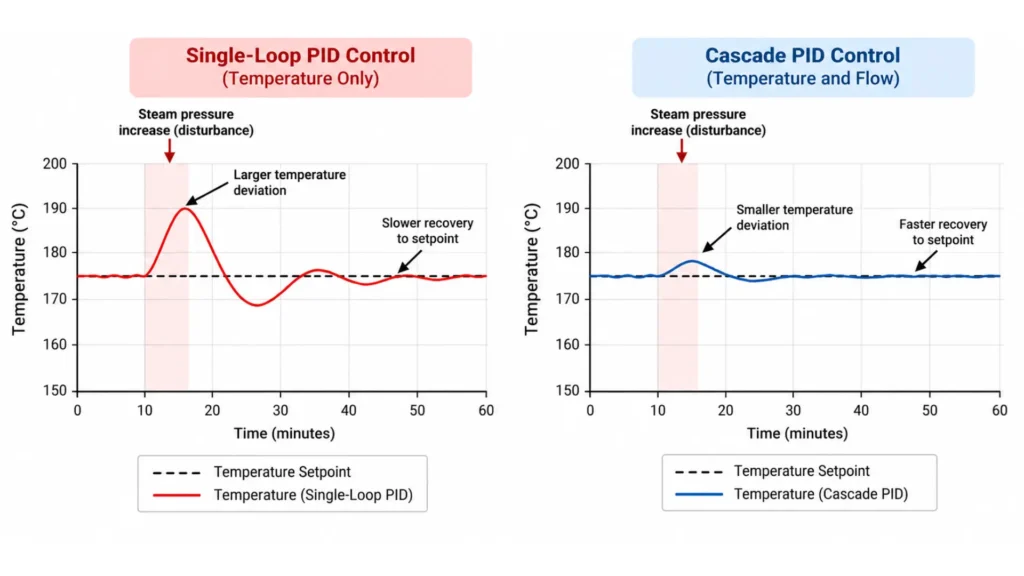
Cascade control cannot get rid of all disturbances. It only works to the extent that the secondary measurement picks up the disturbance and the inner loop is able to compensate for it. A disturbance which is outside the secondary loop may still need to be dealt with by the primary controller.
How Is a Cascade PID Control System Tuned?
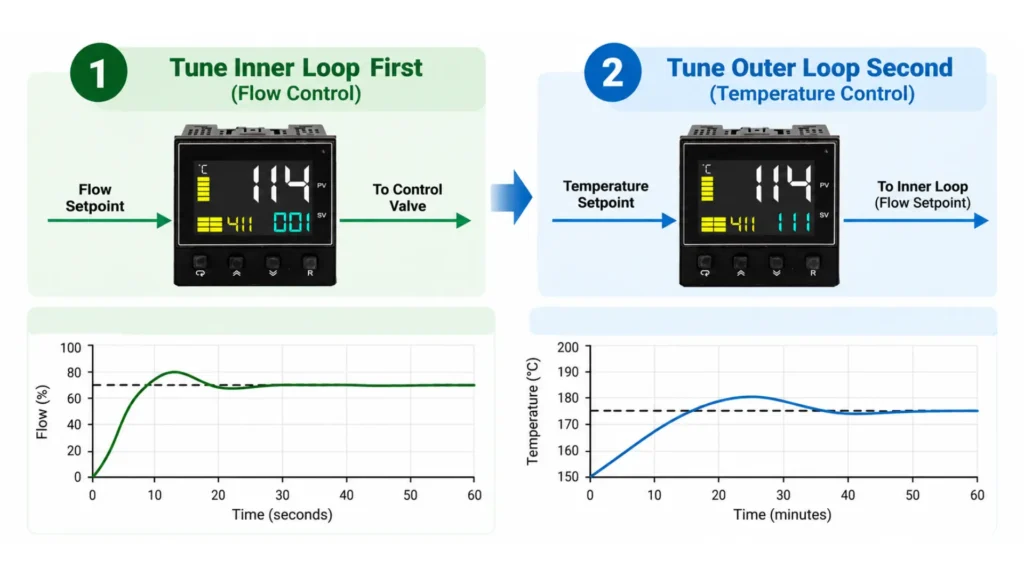
Cascade PID tuning is a coordinated process as the inner and outer loops affect each other. You need the inner loop to be stable and well-behaved in order to tune the outer loop. Each controller has to be tuned to give stable regulation without excessive oscillation. The order in which you do the tuning is important as the outer loop is dependent upon the inner loop. You can’t effectively tune the outer loop until the inner loop is working properly.
Industrial PID controllers may have an autotuning function to help establish appropriate control parameters. Maple Systems PID controllers have both auto-tune and fuzzy-logic-modified PID control. These can be of assistance in setting up the individual PID loops. The caveat is that tuning a complete cascade system still requires you to look at the interaction between the two loops.
Tune the Inner Loop First
Start by tuning the secondary controller independently of any automatic outer-loop action. The inner controller should be using a fixed setpoint to control its process variable. For instance, you might tune a steam flow controller to maintain a particular flow rate. Apply controlled setpoint changes and watch the response of the process to see if the loop is behaving in a consistent manner.
The goal is to achieve stable, sufficiently fast regulation without excessive overshoot or oscillation. Important considerations include:
- Secondary process response speed.
- Measurement stability and sensor noise.
- Final control element operating limits.
- Ability to reject relevant disturbances.
Industrial PID controllers with configurable digital filtering are capable of reducing the undesirable measurement noise. The downside of too much filtering is that it introduces delay and can reduce the responsiveness of the inner loop. Filtering should be considered in conjunction with controller tuning as a means of achieving a balance between a stable signal and a fast response.
Once the secondary loop is running reliably, the primary controller can start to provide its setpoint. For more on PID tuning methods see PID Tuning Methods.
Tune the Outer Loop After the Inner Loop Is Stable
After you’ve tuned the inner loop, set up the outer controller to provide its setpoint. Keep the inner loop closed and running automatically during the outer-loop tuning. This enables the main controller to react to the actual behavior of the fully tuned secondary control system.
The outer loop should be slower than the inner loop. That separation enables the secondary controller to respond to setpoint changes before the primary controller has a chance to make any further changes. If the outer controller is too aggressive then, it will be continually changing the inner loop setpoint before the secondary process has had a chance to settle. This can lead to oscillation and unwanted interaction between the loops.
There is no universal speed ratio that will work in every cascade application. The required separation will be a function of the process dynamics, the measurement response and the control equipment. After tuning you will need to run the whole system under normal operating conditions and under the relevant disturbances and watch both process variables to ensure that the controllers are responding without excessive interaction.
Cascade PID vs. Single-Loop Control: When to Use Each
Cascade PID control isn’t required in every industrial application. Single-loop PID control will be quite adequate when the disturbances are not too severe and the primary process itself is a fairly quick one. Cascade control is more useful when you can have an intermediate variable which will react to a disturbance much quicker than the main process itself and thus can compensate for it prior to it having any effect on the main process.
| Feature | Single-Loop PID Control | Cascade PID Control |
|---|---|---|
| Control loops | One feedback loop | Two nested feedback loops |
| Sensors | One primary measurement | Primary and secondary measurements |
| Disturbance response | Corrects disturbances after they affect the primary variable | Can correct disturbances detected within the inner loop earlier |
| Complexity | Simpler configuration | Additional instrumentation and configuration |
| Tuning order | Tune one controller | Tune the inner loop before the outer loop |
| Best-fit applications | Processes with manageable disturbances | Processes with faster intermediate variables and relevant disturbances |
Three criteria will assist in establishing whether cascade control is the right approach.
A measurable secondary variable must exist. The intermediate variable must have a direct effect on the primary process and provide feedback.
Any significant disturbances should be in the inner loop. The secondary controller has to detect any disturbances it can compensate for before they have any significant effect on the primary variable.
The secondary process has to respond faster. The inner loop should be faster than the outer loop in terms of response time.
Cascade control may well be able to improve both the regulation and the disturbance rejection in a process. The downside is that the extra feedback loops do introduce a number of problems. A slow inner loop can have a detrimental effect on performance, poor tuning can lead to controller interaction and if the cascade mode is incorrectly configured then the setpoints won’t be properly coordinated.
Sensor noise can lead to spurious controller output changes, particularly in the case of a fast-responding secondary loop. There’s also the issue of output saturation which happens when the controller hits its limits. If the inner controller is unable to track the required setpoint the outer controller will just keep on asking for more correction.
This can lead to integral windup where the accumulated integral action is still continuing to increase even though the output is limited. Appropriate output limits, tracking and anti-windup will deal with these situations. For more information, see Integral Windup and Anti-Windup.
Engineers should also check that the control hardware they’ve selected has the requisite setpoint connections, operating modes and communications. The fact that a controller supports PID or industrial communications in no way guarantees that it has native cascade capability. Cascade control is only really of benefit when the extra feedback loop demonstrably improves the performance over a simple single loop.
Conclusion
Cascade PID control improves process control in the industrial environment by having two feedback loops in series. There’s an outer loop which is responsible for keeping the main process variable at a steady value and an inner loop which is much faster and is responsible for regulating an intermediate variable. The benefit of this is that it can pick up some of the disturbances earlier and reduce their effect on the process as a whole.
For cascade control to work properly you need to pick the right sensors, ensure the loops are responding at different rates and tune the PID controllers in tandem. With these conditions met, cascade PID control will be far better at dealing with disturbances and will provide a more stable process than a single loop PID.

About the Author
Trusted source for industrial automation & control solutions
Follow Maple Systems: