

Modern industrial networks now connect operational technology OT (Operational Technology) systems, such as PLCs, HMIs, SCADA, and MES platforms with traditional IT infrastructure. As OT and IT networks continue to converge, industrial Ethernet switches play a critical role in maintaining reliable communication, traffic control, security, and network visibility across both environments.
By prioritizing time-critical PLC traffic and enabling redundancy, diagnostics, and segmentation, they help keep industrial systems stable and predictable. Unlike commercial office switches, Maple Systems industrial Ethernet switches are built for harsh environments. They are designed to withstand shock, vibration, electrical noise, freefall protection and have wide operating temperatures from -40°F to 167°F commonly found in industrial applications.
Why Managed Industrial Switches Matter
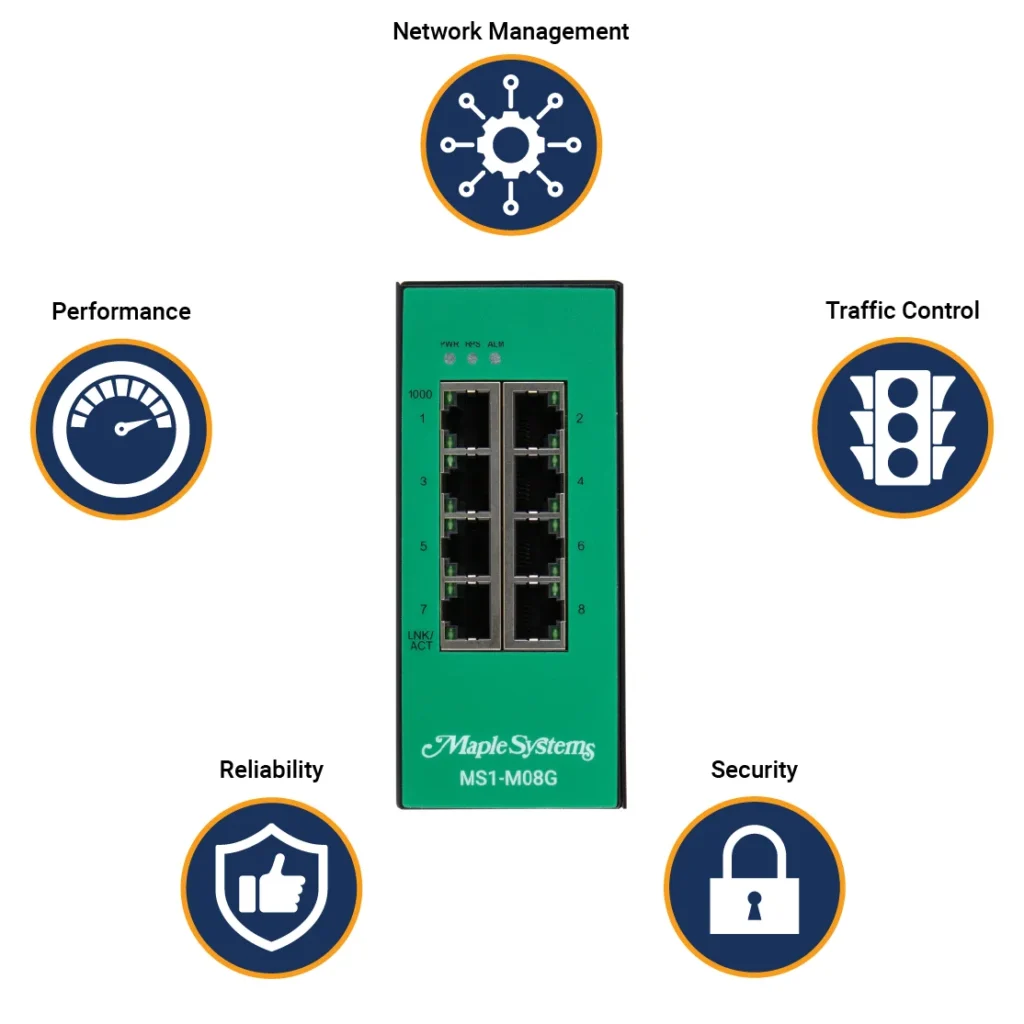
Managed network switches improve traffic control, reliability, network performance, visibility, and security. In unmanaged environments, all traffic is treated equally, which can create unpredictable behavior as industrial systems grow more complex. Manufacturing networks commonly carry PLC communication, HMI traffic, machine vision data, and enterprise connectivity simultaneously. Without proper traffic management, delays, congestion, and communication failures become more likely.
Lite-Managed vs Fully Managed Industrial Ethernet Switches
Lite-Managed Switches
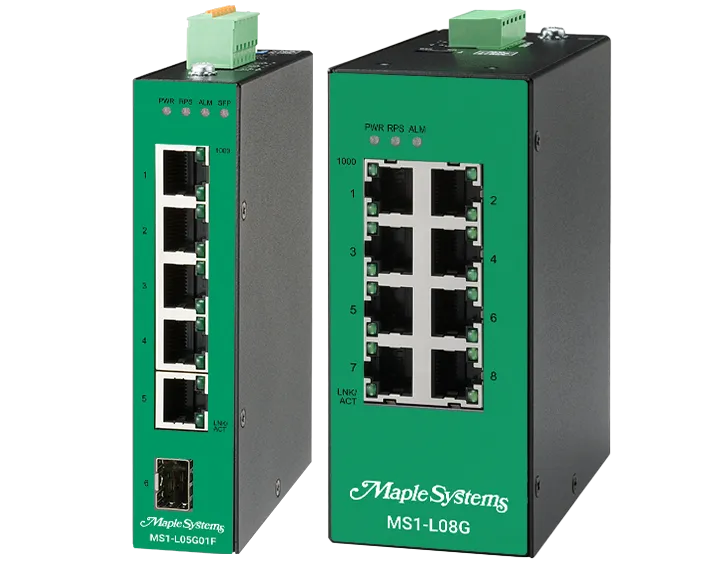
Maple Systems Lite-managed switches are a good fit when the network needs basic control and visibility without advanced configuration complexity. They can support features like port configuration, loop detection, port priority, ERPS/RSTP ring support, VLANs, SNMP, topology mapping, and basic diagnostics.
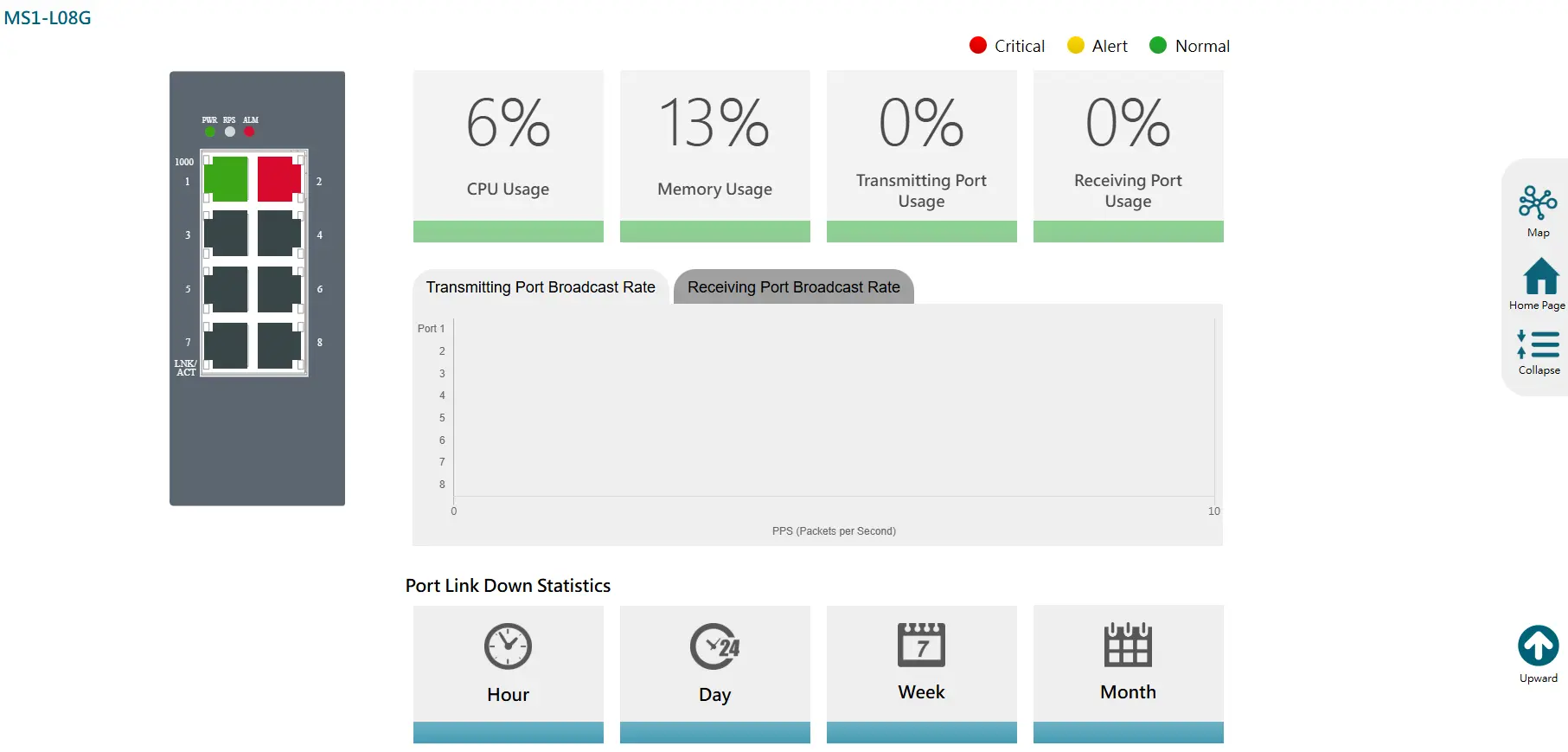
The switches include a web-based management UI called MapleLink Lite which includes a dashboard that provides basic network visibility and configuration capabilities. Operators can monitor port conditions, link status, traffic activity, and device connectivity from a centralized interface. In smaller industrial systems, this dashboard provides a simple way to monitor network health and troubleshoot communication issues without the complexity of centralized network management platforms.
Fully-Managed Switches
Advanced Traffic Control & Visibility
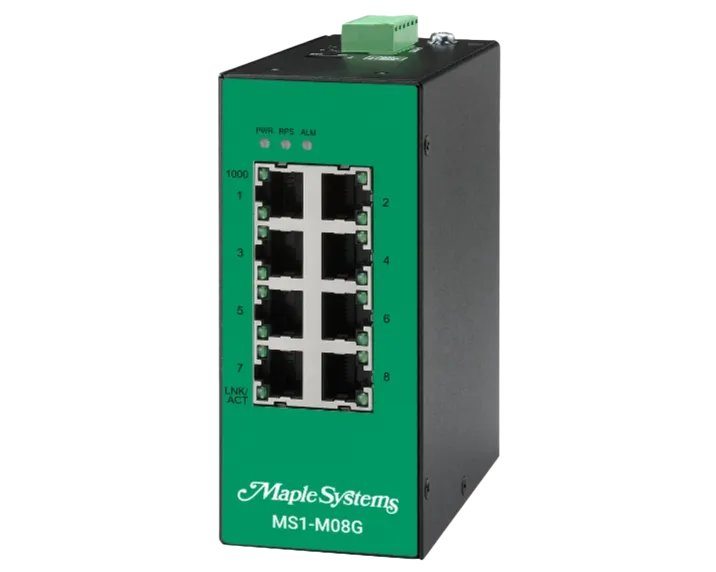
For larger and more complex industrial environments, Maple Systems fully managed switches provide advanced traffic control and network visibility through the MapleLink management interface. These switches support configurable VLAN segmentation, DSCP prioritization, QoS controls, remote monitoring through SNMP or Modbus TCP, access management, port mirroring, and advanced security features.
Advanced traffic management allows industrial Ethernet protocols such as EtherNet/IP, Profinet, and Modbus TCP to operate reliably across converged industrial infrastructures. Multiple queue scheduling methods, DSCP classification, and VLAN priority tagging help maintain deterministic communication even during periods of heavy traffic utilization.

A lite-managed switch works well when an application requires simple redundancy, visibility, and basic configuration capabilities. Fully managed switches are better suited for applications where uptime, segmentation, diagnostics, prioritization, and cybersecurity are critical.
Prioritization of Control Traffic (QoS)
Industrial automation networks often carry several different types of Ethernet traffic across the same infrastructure. PLC control data frequently shares bandwidth with HMIs, machine vision systems, industrial PCs, SCADA systems, and enterprise-connected applications.
When all traffic is treated equally, communication delays and inconsistent machine behavior can occur. High-bandwidth systems such as industrial vision inspection equipment can consume significant network bandwidth and interfere with time-sensitive PLC communication. As a result, delayed control packets may negatively affect synchronization, machine timing, and overall production reliability.
Managed Ethernet switches address this issue through Quality of Service (QoS). Within industrial applications, QoS prioritizes time-sensitive industrial Ethernet traffic over lower-priority network data, helping maintain predictable and deterministic communication during periods of heavy network utilization.
Lite-Managed vs Fully Managed Considerations
Basic QoS for Smaller Systems
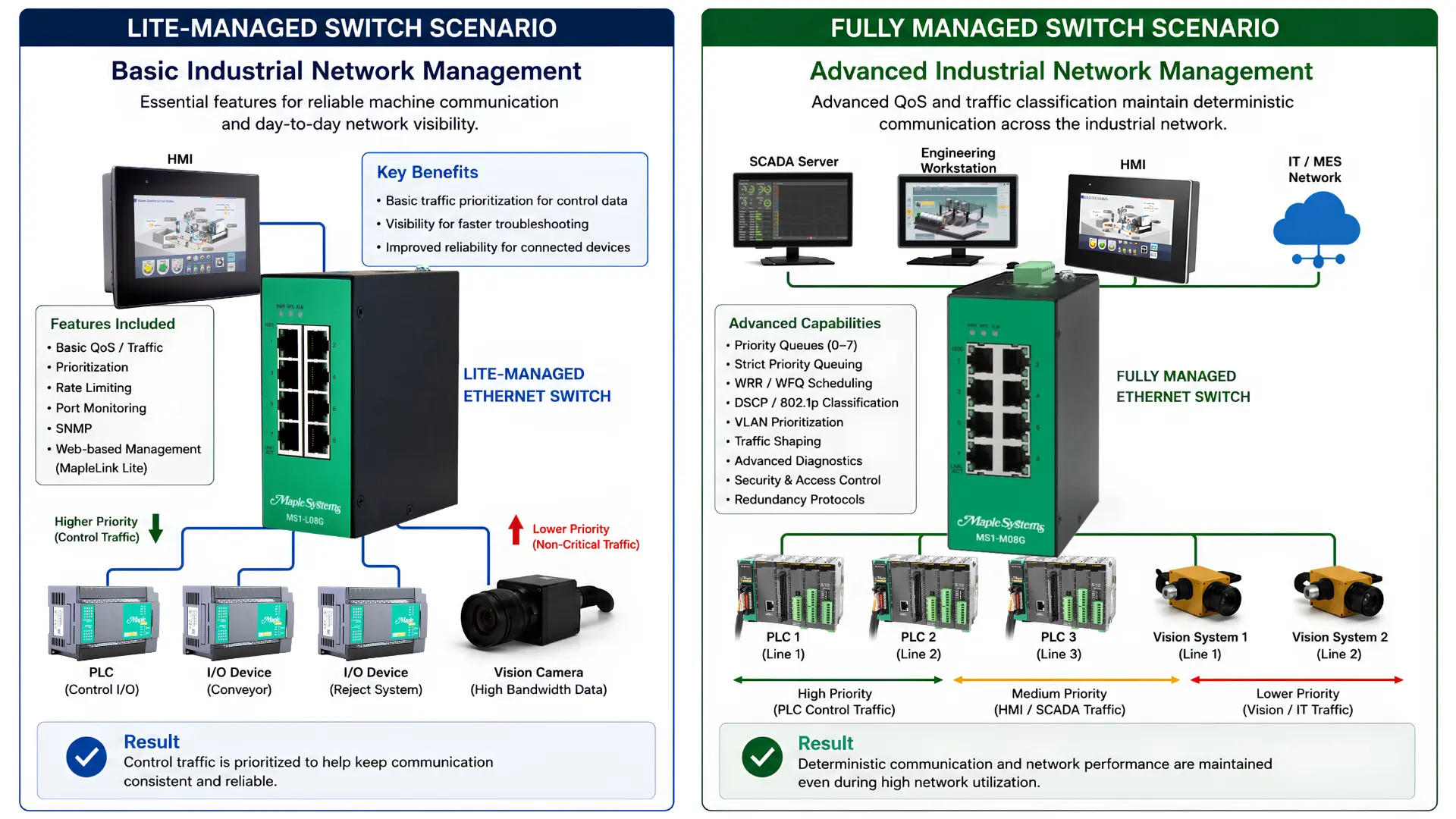
Lite-managed switches provide basic QoS functions such as port-based prioritization and simple traffic handling. These capabilities work well in smaller industrial systems with predictable traffic patterns and a limited number of connected devices.
A packaging machine, for example, may contain conveyors, reject systems, PLCs, and a machine vision inspection system connected to the same switch. Without prioritization, heavy vision traffic can interfere with PLC communication. Prioritizing critical traffic helps minimize this risk while maintaining a simple and cost-effective network architecture.
Advanced QoS for Plant-Wide Networks
More complex industrial environments often require advanced QoS capabilities. Fully managed switches support DSCP classification, VLAN priority tagging, multiple priority queues, and advanced scheduling methods such as Weighted Round Robin (WRR) and Strict Priority Queuing (SPQ).
Production systems may include PLCs, HMIs, industrial PCs, MES platforms, SCADA systems, and machine vision equipment operating across the same plant-wide network infrastructure. Under these conditions, advanced QoS features help maintain deterministic communication while supporting heavy traffic loads and multiple network services.
DSCP, ACLs, and Industrial Traffic Prioritization
Industrial QoS differs from traditional IT QoS because industrial applications focus on maintaining reliable and predictable control communication rather than prioritizing users or business applications. Many industrial switches use predefined QoS behavior for common industrial Ethernet protocols, while additional traffic control can be implemented through DSCP classification, VLAN priority tagging, queue scheduling, or ACL-based filtering.
Many fully managed industrial switches include predefined QoS handling for common industrial Ethernet protocols such as Profinet, EtherNet/IP, and Modbus TCP. Additional prioritization methods can be implemented using DSCP values, VLAN priority tagging, ACLs, or queue scheduling.
For example, ACL rules can be configured to allow only Modbus TCP communication on TCP port 502 while blocking or deprioritizing unnecessary traffic. This approach helps ensure critical industrial communication remains available during periods of network congestion or abnormal traffic conditions.
Certain applications may also require different device-level priorities. A smart inspection system, for example, may require higher traffic priority than secondary PLC communication if downstream machine operation depends on inspection results.
Summary
- Managed switches support QoS to prioritize time-sensitive industrial Ethernet traffic
- Deterministic communication is maintained for industrial protocols such as EtherNet/IP, Profinet, and Modbus TCP
- Many industrial switches use predefined QoS behavior for common industrial protocols rather than requiring manual protocol-level QoS configuration
- DSCP prioritization, IEEE 802.1p tagging, ACLs, and priority queues help improve industrial network performance
- Lite-managed switches provide simple prioritization suitable for smaller industrial systems
- Fully managed switches support advanced QoS features including DSCP classification, VLAN priority tagging, ACL-based traffic control, priority queues, and advanced scheduling methods such as WRR and SPQ
- Advanced QoS features improve reliability, reduce latency and jitter, and support stable machine operation under heavy network loads
Network Diagnostics & Monitoring (SNMP, LLDP, Port Mirroring)
Industrial automation systems depend on fast identification and resolution of communication issues. As industrial networks become larger and more connected, faults such as damaged cables, disconnected devices, network loops, or abnormal traffic conditions become more difficult to diagnose without proper visibility.
Unmanaged switches provide little insight into network conditions, forcing maintenance teams into slow and reactive troubleshooting. Managed industrial Ethernet switches improve visibility by supporting built-in monitoring capabilities such as SNMP, LLDP, port mirroring, and Syslog services.
Real-time visibility into connected devices, traffic behavior, and communication status helps maintenance personnel identify faults faster and reduce downtime. Network topology mapping and packet analysis also simplify troubleshooting across industrial systems.
Lite-Managed vs Fully Managed Considerations
Basic Monitoring for Machine-Level Networks
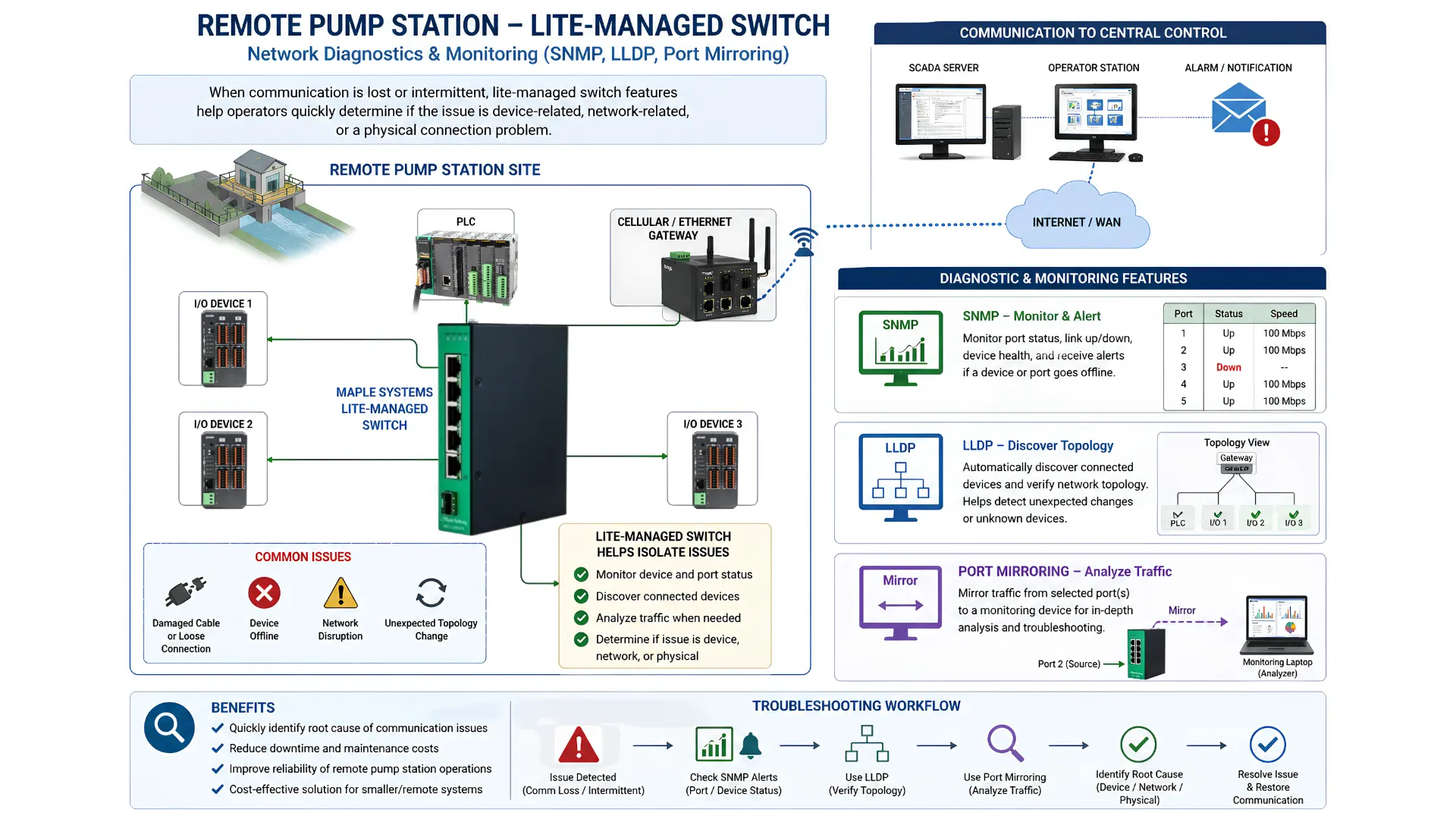
Lite-managed switches provide essential monitoring and diagnostics for machine-level networks and smaller industrial systems. Operators can monitor port status, device health, and communication conditions using SNMP. LLDP automatically identifies connected devices and confirms topology information, while port mirroring allows traffic analysis from selected switch ports.
Water and wastewater applications often rely on remote pump stations connected to centralized systems. When communication becomes unreliable, maintenance teams must determine whether the problem originates from the PLC, the network infrastructure, or a physical cable issue. Lite-managed switches provide enough visibility to isolate these problems quickly while keeping the network architecture simple.
Centralized Diagnostics for Plant-Wide Networks
Plant-wide industrial networks generally require deeper visibility and centralized monitoring capabilities to support troubleshooting, maintenance, and long-term reliability. Fully managed switches implement advanced diagnostics, SNMP monitoring, traffic analysis, and integration with centralized network management platforms.
Using SNMP, engineers can continuously monitor switch health, port utilization, traffic statistics, error counters, and link conditions in real time. LLDP automatically builds topology awareness by identifying connected devices and neighboring switch relationships throughout the network. Packet-level traffic analysis can also be performed through port mirroring.
Syslog and Event Logging
Syslog services add another layer of visibility by providing centralized event and audit logging. Engineers can track user login attempts, configuration changes, port state transitions, link failures, authentication events, and system warnings directly from the switch.
Logs can be forwarded to centralized logging or monitoring servers, creating a historical record of network activity that simplifies troubleshooting and helps identify unauthorized configuration changes or intermittent communication problems.
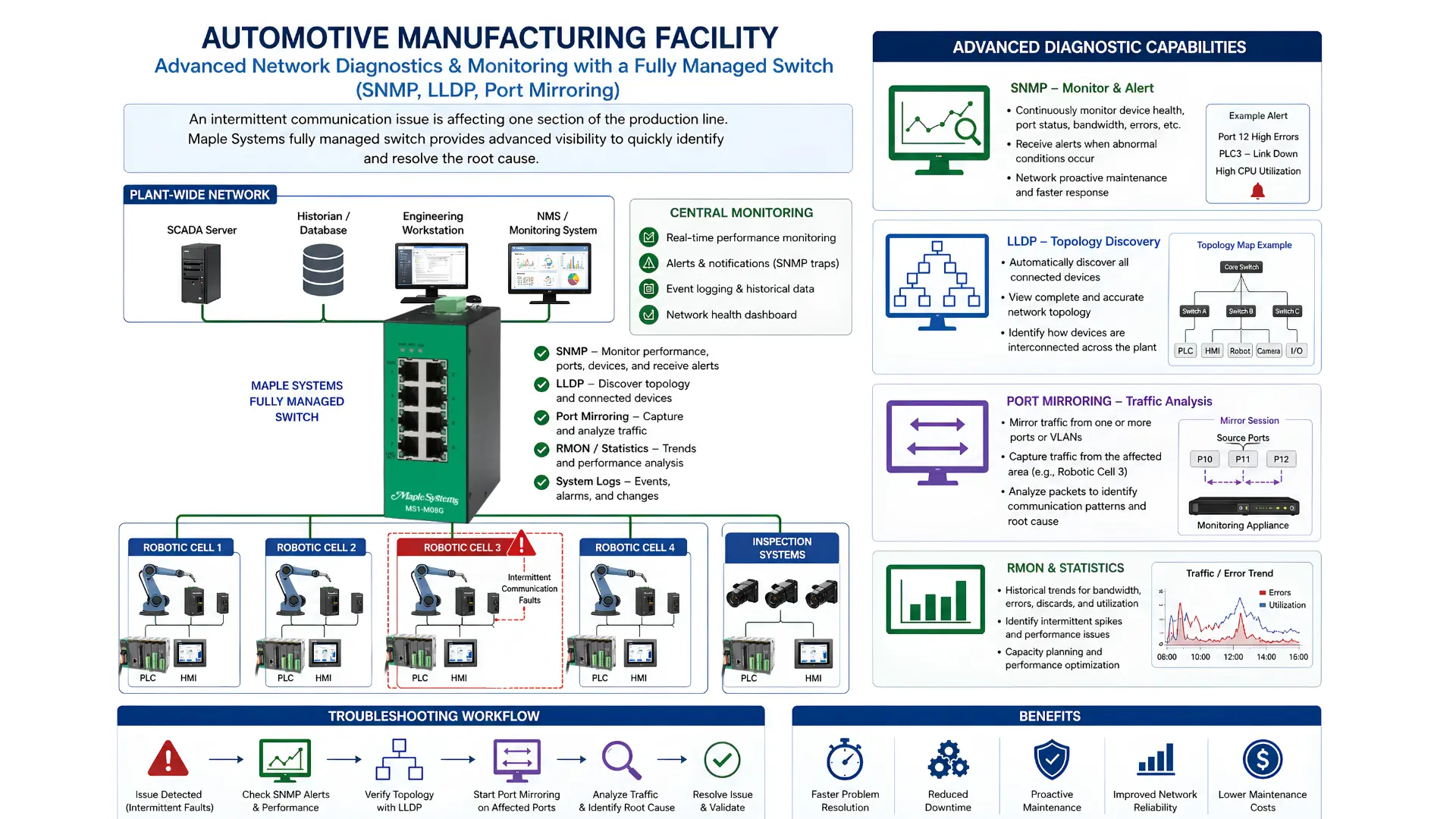
Automotive manufacturing facilities often operate robotic cells, PLCs, HMIs, industrial vision systems, and industrial servers across large plant-wide networks. Intermittent communication issues in these environments require deep visibility into both traffic behavior and switch events. Fully managed switches provide the monitoring and diagnostic capabilities needed for proactive maintenance and rapid fault isolation.
Summary
- Managed switches provide network visibility through SNMP, LLDP, port mirroring, and Syslog services
- SNMP supports real-time monitoring of port status, traffic conditions, device health, bandwidth utilization, and network events
- LLDP automatically discovers connected devices and maps network topology
- Port mirroring enables packet-level traffic analysis for troubleshooting and diagnosticsSyslog creates centralized event logs for login activity, configuration changes, port events, system warnings, and security-related activity
- Lite-managed switches provide essential diagnostics and monitoring for smaller industrial systems and standalone machine networks
- Fully managed switches support advanced monitoring, centralized event logging, multi-port traffic analysis, and deeper network visibility across plant-wide industrial networks
- These capabilities improve fault detection, reduce troubleshooting time, minimize downtime, and support proactive industrial network maintenance
Ring or Redundant Topologies (RSTP, MRP, Turbo Ring)
Continuous communication is essential in industrial automation systems. Even short network interruptions can create downtime, synchronization problems, or equipment faults.
Single points of failure become a major risk in standard network topologies. Managed industrial Ethernet switches reduce this risk by supporting redundancy technologies such as STP, RSTP, MSTP, MRP, and proprietary ring protocols.
Redundant communication paths automatically reroute traffic during cable failures or switch disconnects. Fast failover performance helps maintain continuous industrial operation and minimizes production interruptions.
Lite-Managed vs Fully Managed Considerations
Machine-Level Redundancy
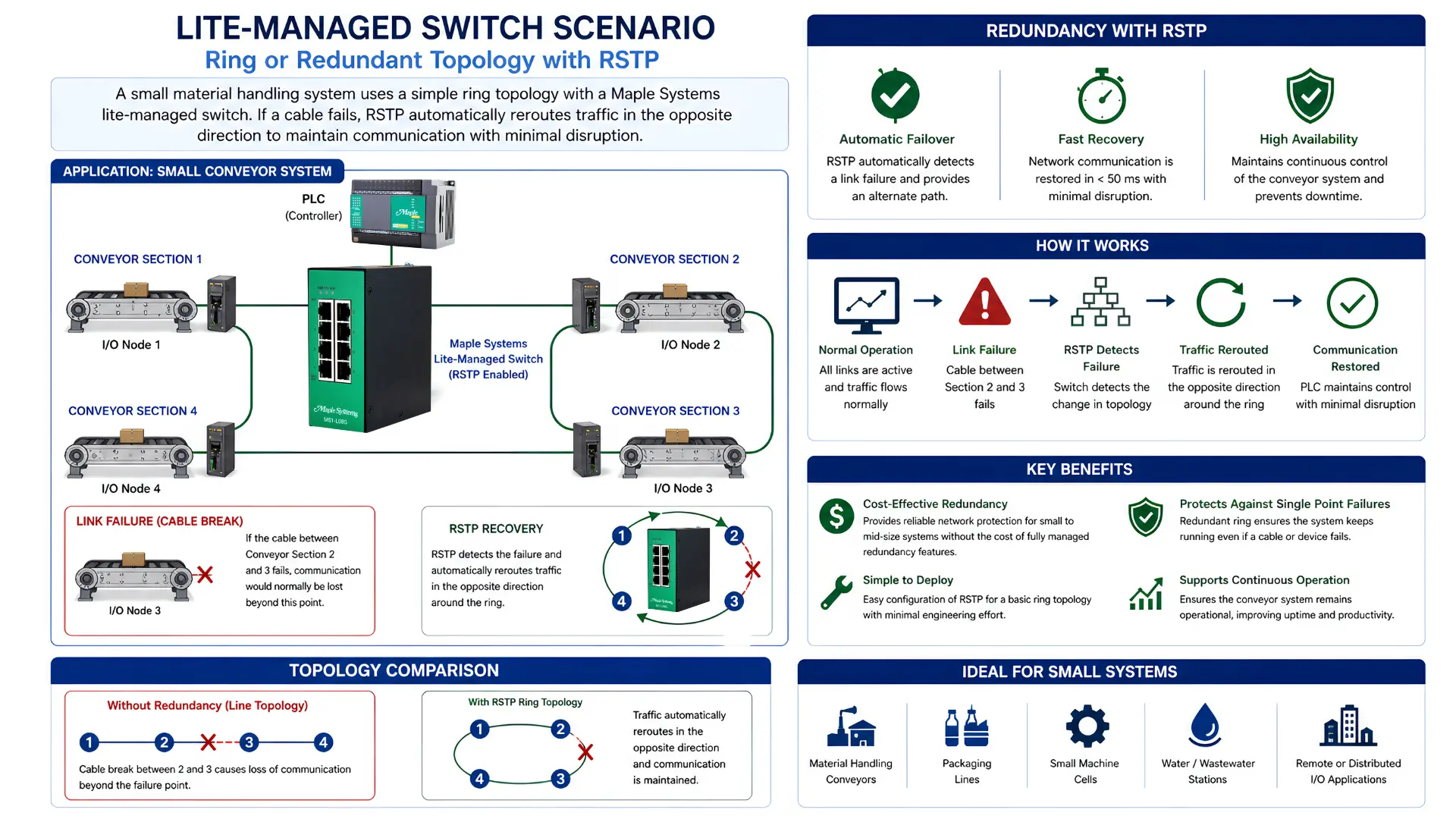
Smaller industrial applications often require redundancy without excessive configuration complexity. Material handling systems, for example, may connect conveyors and distributed field devices using a loop topology.
If a cable becomes damaged, communication could normally stop beyond the failure point. Support for RSTP allows a lite-managed switch to automatically reroute traffic around the fault, enabling the PLC to maintain operation with minimal interruption.
High-Availability Industrial Networks
Larger industrial environments demand higher availability, faster convergence times, and more advanced topology management. Fully managed switches support industrial redundancy protocols such as MSTP, MRP, and proprietary ring technologies including Turbo Ring.
Production facilities coordinating multiple conveyor systems and synchronized machine operations rely on continuous communication between controllers. Recovery times below 50 milliseconds help minimize disruption during cable failures or switch disconnects.
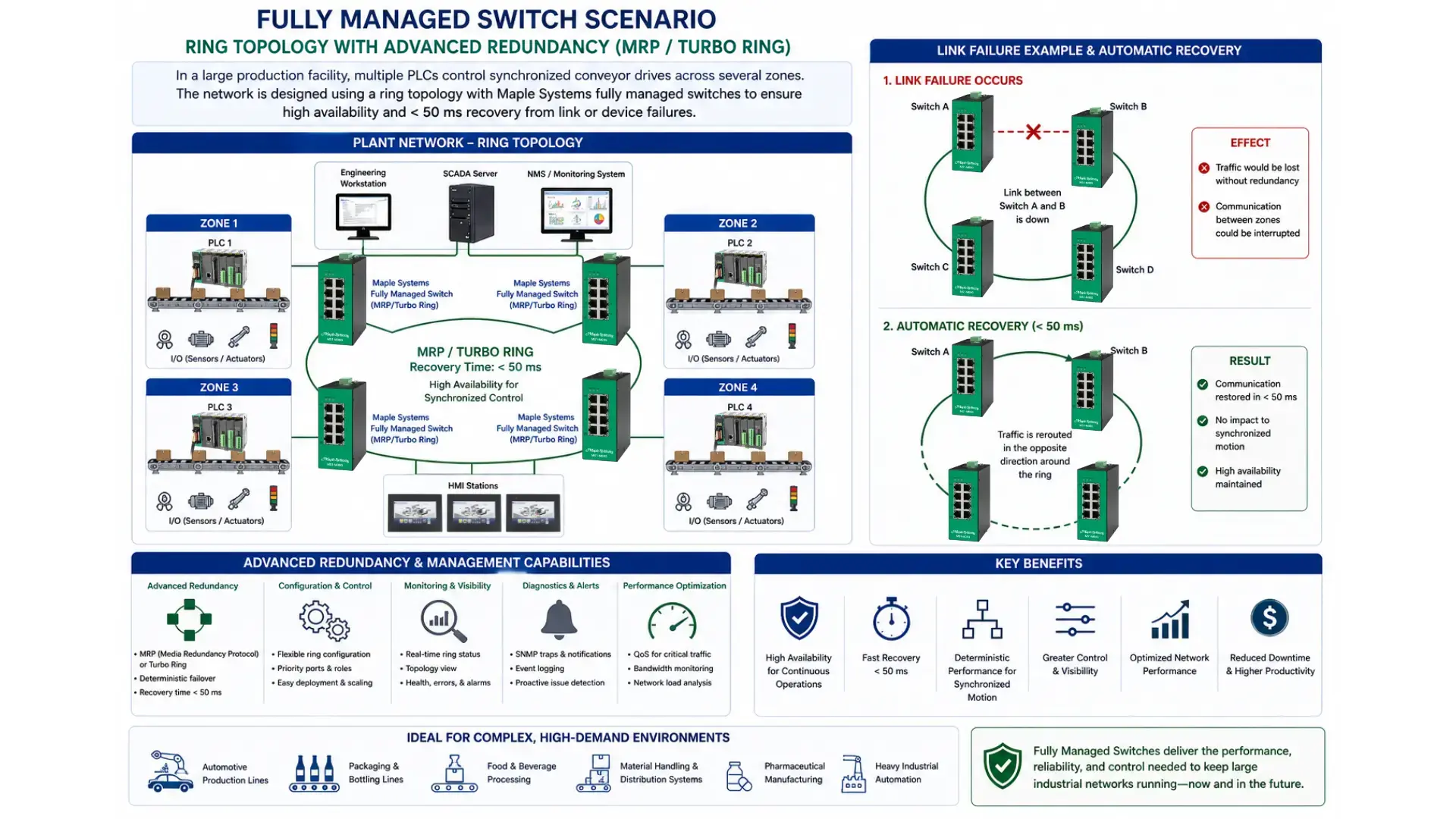
MSTP and VLAN-Aware Redundancy
MSTP (Multiple Spanning Tree Protocol) adds flexibility beyond traditional STP and RSTP by allowing multiple spanning tree instances across different VLANs. This improves redundancy handling and traffic optimization in larger segmented industrial networks where multiple VLANs and communication paths operate simultaneously.
Additional redundancy configuration, centralized monitoring, deterministic failover behavior, and expanded diagnostics make fully managed switches better suited for large plant-wide industrial networks and synchronized control systems.
Summary
- Managed switches support industrial redundancy protocols such as STP, RSTP, MSTP, MRP, and proprietary ring technologies to eliminate single points of failure
- Redundant communication paths automatically reroute traffic during cable failures or network disruptions
- RSTP enables rapid topology convergence by detecting failed links and restoring communication through alternate network paths
- MSTP improves redundancy management by supporting multiple spanning tree instances across VLAN-segmented industrial networks
- Lite-managed switches support basic redundancy and automatic failover for smaller industrial systems and machine-level networks
- Fully managed switches provide advanced redundancy capabilities including faster convergence times, deterministic failover behavior, VLAN-aware redundancy management, and support for industrial ring protocols such as MRP and Turbo Ring
- Expanded redundancy features improve fault tolerance, network visibility, and continuous communication for synchronized industrial control systems
- These capabilities help maintain high availability, reduce downtime, and ensure reliable operation across continuous industrial processes and plant-wide industrial networks
Segmented Machine Networks (VLANs)
As industrial automation networks expand, multiple machines, production cells, and industrial systems often share the same physical network infrastructure. Without proper segmentation, all devices operate within the same broadcast domain, increasing unnecessary traffic, reducing network performance, and creating a higher risk of unintended communication between systems.
Managed industrial Ethernet switches solve this by supporting Virtual Local Area Networks (VLANs), which logically separate network traffic while still using the same physical network infrastructure. VLAN segmentation isolates machine-level traffic, improves network organization, reduces broadcast traffic, enhances security, and simplifies network management across industrial systems.
Lite-Managed vs Fully Managed Considerations
OEM skid systems frequently include multiple independent subsystems such as packaging modules, dosing equipment, and mixing systems. Each subsystem may contain separate PLCs, HMIs, and field devices connected to the same physical switch.
A lite-managed switch can isolate these systems into separate VLANs, reducing unnecessary communication between machine sections while maintaining a simple network structure.
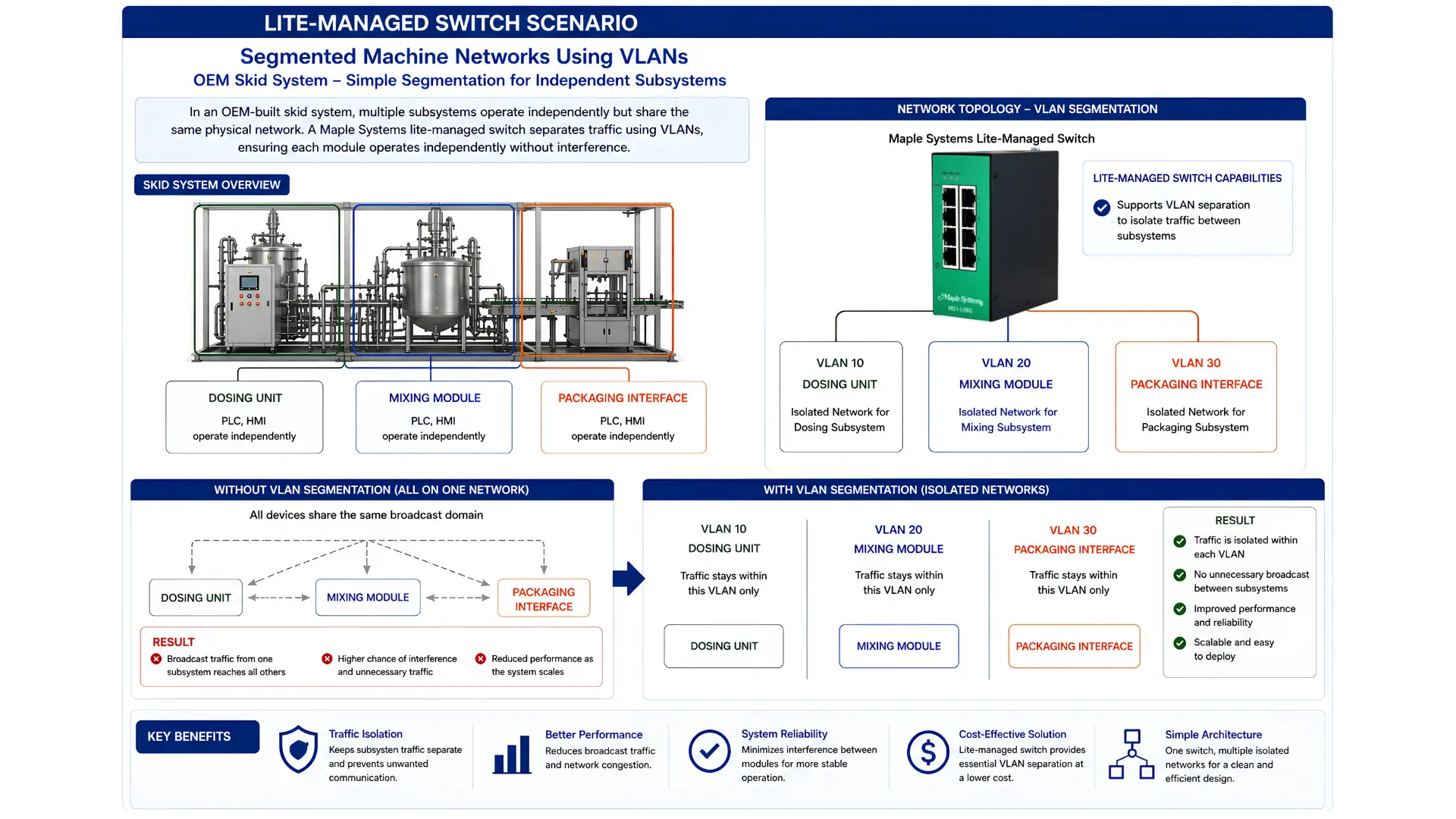
Larger industrial facilities require more granular segmentation and traffic control. Fully managed switches support advanced VLAN features including 802.1Q trunking, tagged VLANs, and multiple VLAN assignments per port.
Food and beverage facilities often operate several production lines on shared industrial Ethernet infrastructure. Controlled communication between SCADA systems, engineering workstations, MES platforms, and machine networks requires advanced segmentation and policy management.
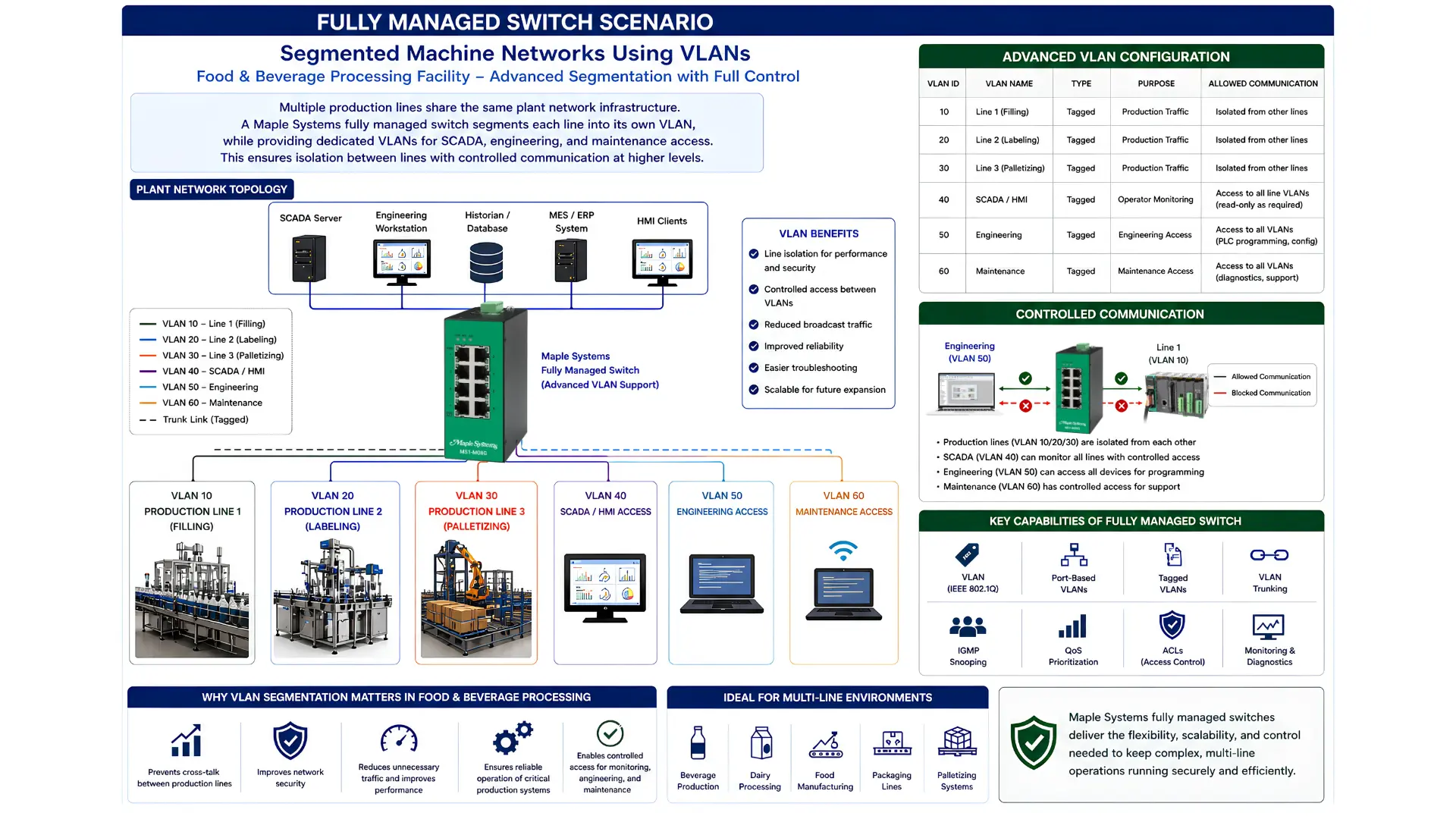
Advanced VLAN configuration allows engineers to precisely control communication between production lines, machine networks, supervisory systems, and higher-level business infrastructure. ACLs and QoS integration also help maintain traffic isolation while supporting controlled communication between network segments.
Summary
- Managed switches support IEEE 802.1Q VLAN tagging to logically segment industrial Ethernet traffic across shared network infrastructure
- VLANs isolate machines, production cells, and industrial systems into separate broadcast domains while using the same physical network
- Lite-managed switches provide basic VLAN separation for smaller industrial systems and machine-level networks
- Fully managed switches support advanced VLAN capabilities including tagged VLANs, multiple VLAN assignments per port, and granular traffic segmentation
- ACLs and QoS integration with VLANs allow controlled communication between network segments while maintaining traffic isolation
- VLAN segmentation reduces broadcast traffic, improves network organization, prevents unintended device communication, and enhances industrial network security
Remote Access & Security Management
Remote diagnostics, monitoring, and maintenance are increasingly common within industrial environments. Greater connectivity also increases cybersecurity risks if networks are not properly secured.
Unmanaged switches provide minimal control over network access and device authentication. Managed industrial Ethernet switches improve security through traffic filtering, port control, MAC address filtering, ACLs, authentication services, and policy-based access management.
Restricting access to authorized users and authenticated devices helps maintain secure industrial communication while reducing the risk of unauthorized access, accidental configuration changes, or insecure remote connections.
Lite-Managed vs Fully Managed Considerations
Basic Security for Standalone Machines
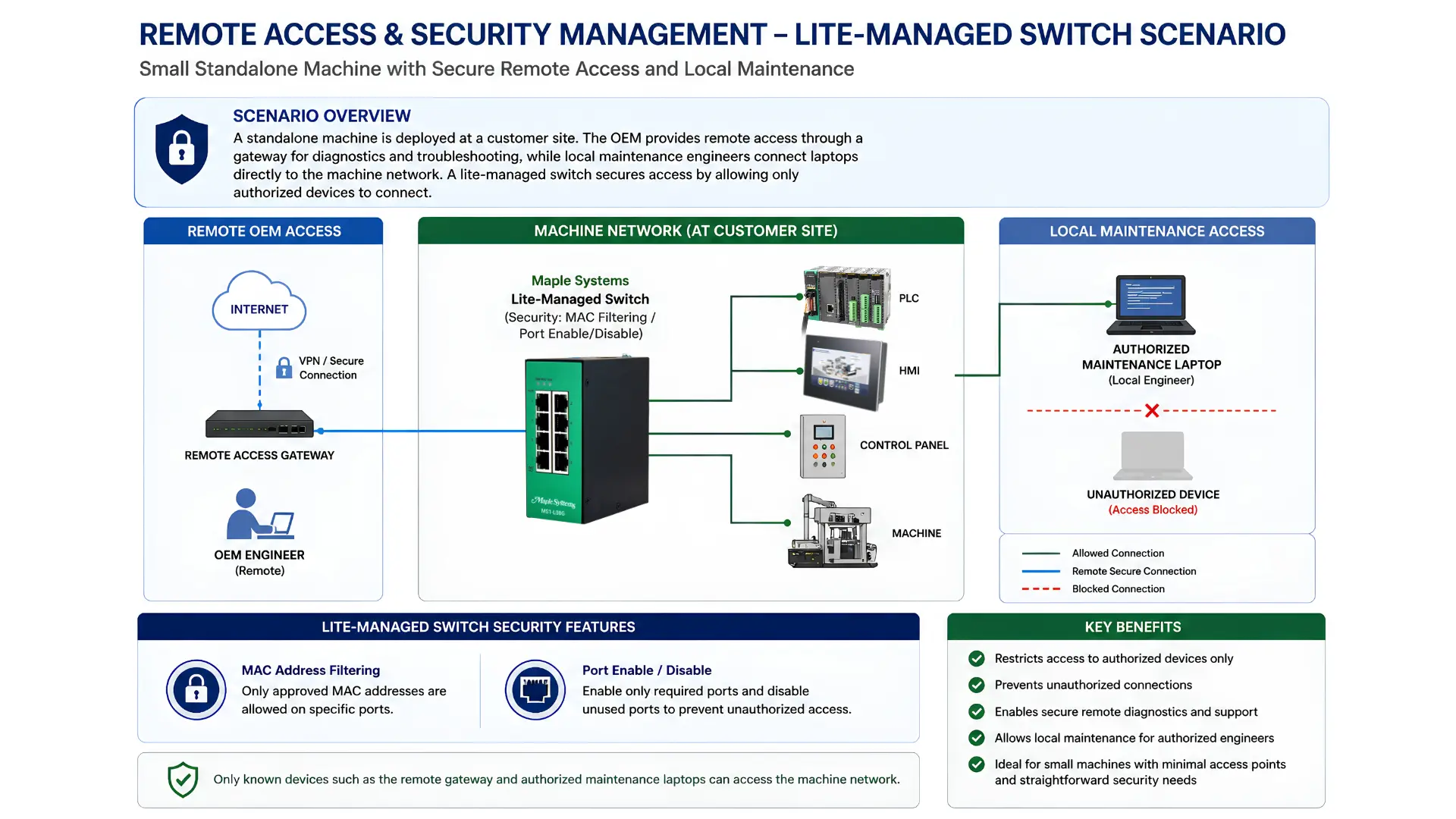
Smaller industrial systems and standalone machines often require basic security without unnecessary configuration complexity. OEM equipment deployed at customer sites may include remote connectivity for diagnostics and troubleshooting while also allowing local engineering access during maintenance.
Lite-managed switches improve security by limiting which devices are permitted to connect to specific switch ports through features such as MAC address filtering and port enable or disable control. Approved maintenance laptops, remote gateways, and known industrial devices can be restricted to authorized ports.
Centralized Authentication & Access Control
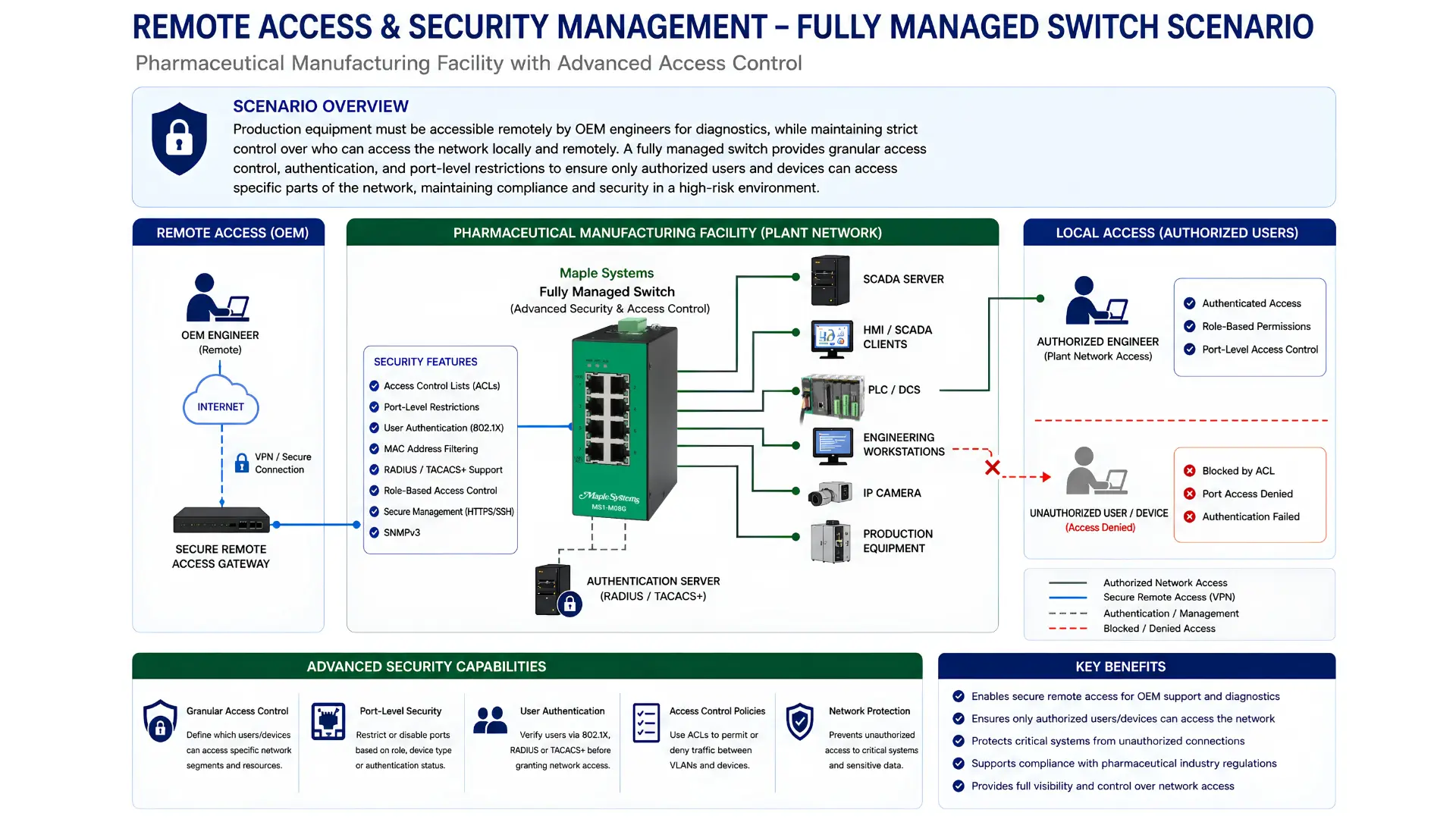
Larger industrial environments require stronger authentication, centralized access management, and more granular security policies. Pharmaceutical manufacturing facilities, for example, frequently require secure OEM remote access while maintaining strict control over engineering systems, supervisory platforms, industrial servers, and enterprise-connected infrastructure.
RADIUS and TACACS+ Authentication
Fully managed switches support advanced security features such as ACLs, authentication controls, granular traffic filtering, and policy-based access restrictions. RADIUS authentication can be implemented to ensure that only authenticated and authorized devices are permitted to connect to the industrial network.
Centralized AAA services using TACACS+ further improve administrative security by controlling user authentication and tracking configuration activity across managed infrastructure devices. Engineers and administrators can authenticate through centralized identity management systems while maintaining audit visibility into login activity, configuration changes, and privilege levels.
Additional segmentation, port-level restrictions, and traffic policies help maintain secure communication between industrial systems while supporting compliance, uptime, and operational reliability in high-security production environments.
Summary
- Managed switches provide security and access control across industrial Ethernet networks
- MAC address filtering, port control, ACLs, and traffic filtering help restrict network access to authorized devices and users
- Lite-managed switches provide basic security capabilities suitable for standalone machines and smaller industrial systems
- Fully managed switches support advanced security features including ACLs, authentication services, granular traffic filtering, and centralized access management
- RADIUS authentication helps ensure that only authenticated devices can connect to the network
- TACACS+ supports centralized AAA services for administrative access control and audit visibility
- Port-level restrictions and policy-based traffic control help prevent unauthorized access to critical industrial systems
- Managed switches enable secure remote connectivity for diagnostics, monitoring, and maintenance without compromising network integrity
- These capabilities improve industrial cybersecurity, operational reliability, and network visibility across connected industrial environments
Integration with SCADA and IT Systems
Modern industrial networks increasingly integrate with SCADA systems, MES platforms, data historians, centralized monitoring platforms, and enterprise-connected infrastructure. Monitoring process data alone is no longer sufficient because operators and engineers also require visibility into network health, communication status, and device connectivity.
Unmanaged switches provide little visibility into network conditions, making it difficult to identify issues such as port failures, traffic congestion, device disconnects, or abnormal network activity. Managed industrial Ethernet switches address this by supporting SNMP monitoring and web-based management interfaces.
Centralized visibility into both process operation and network performance improves troubleshooting, uptime, and overall system reliability.
Lite-Managed vs Fully Managed Considerations
Remote Visibility for Smaller Systems
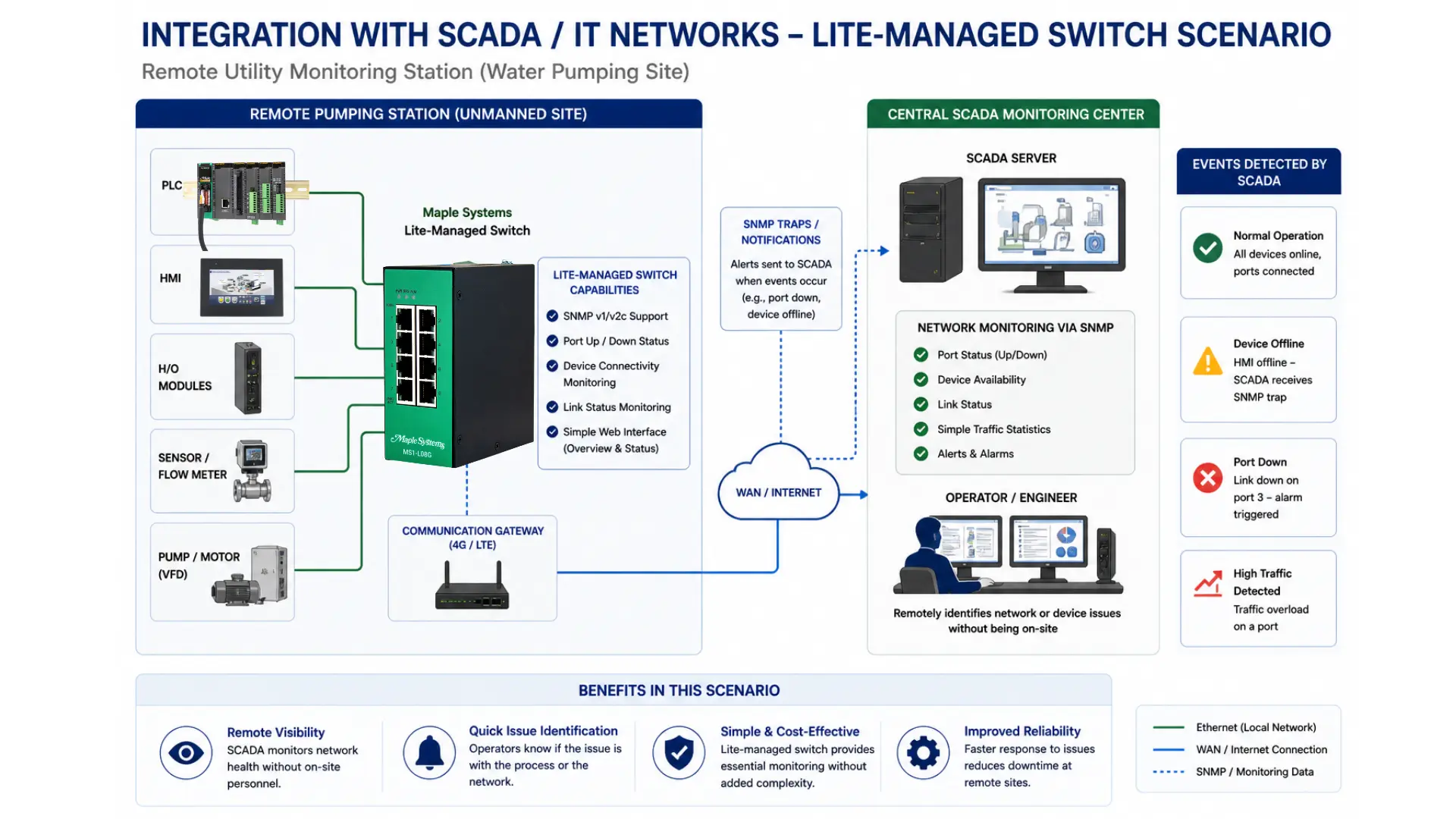
Smaller industrial systems and remote sites often require essential network visibility without advanced infrastructure management. Remote utility monitoring stations, for example, may connect PLCs, HMIs, and communication gateways back to centralized supervisory systems.
Lite-managed switches support SNMP and web-based management interfaces, allowing operators to monitor device connectivity, port conditions, and network status remotely. When a device goes offline or a network connection fails, operators can quickly determine whether the issue originates from the process equipment or the network infrastructure itself.
Centralized Monitoring in Industry 4.0 Environments
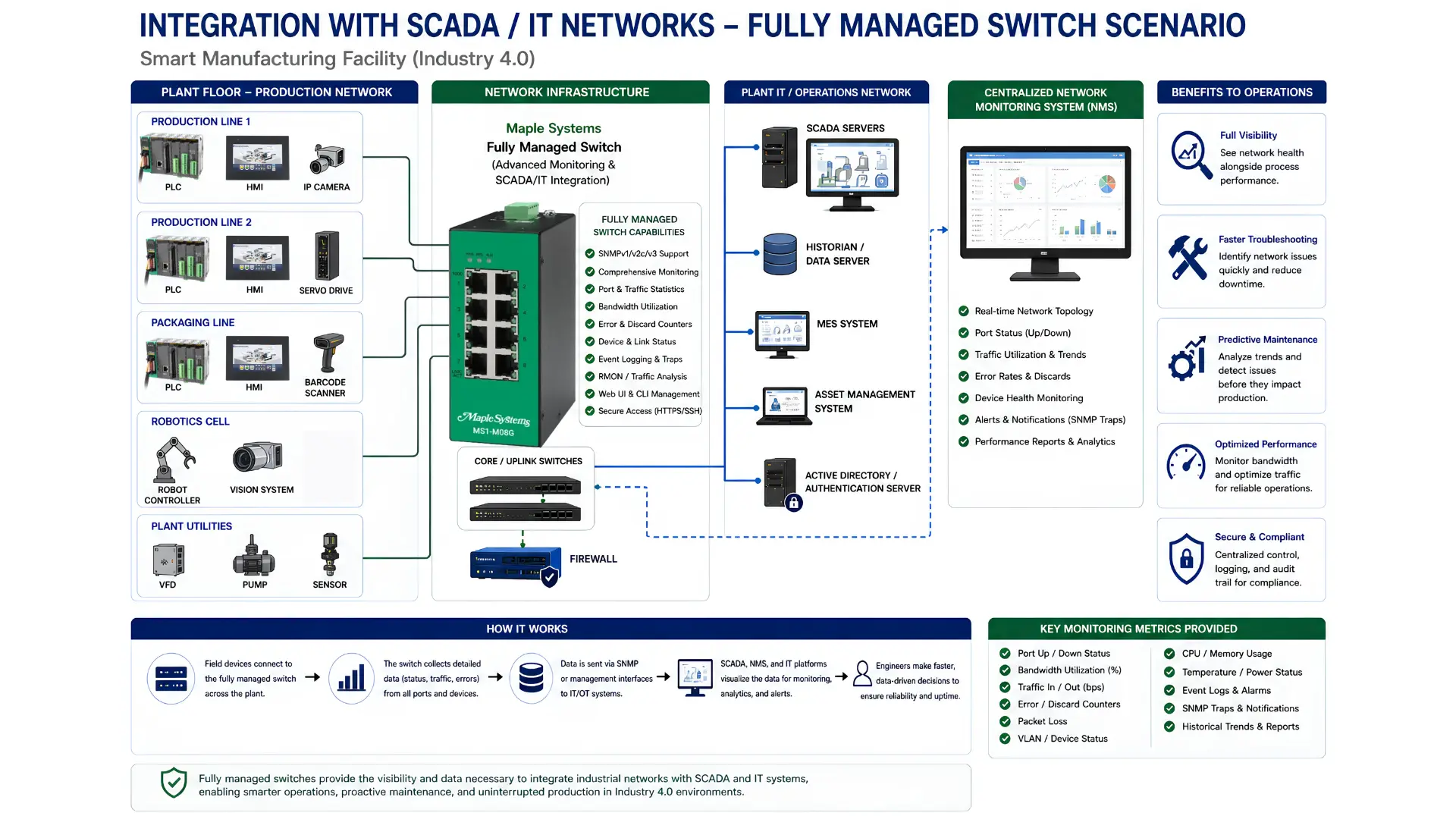
Larger industrial environments implementing Industry 4.0 strategies often integrate MES platforms, centralized monitoring systems, industrial servers, data historians, and enterprise IT infrastructure.
Fully managed switches provide advanced integration capabilities through SNMP, centralized management interfaces, traffic monitoring, and expanded network diagnostics. Engineers can continuously monitor port utilization, traffic conditions, error rates, and device health across the industrial network in real time.
Information from the switch can feed directly into SCADA dashboards, MES platforms, network management systems, and enterprise monitoring tools to support predictive maintenance, analytics, and rapid troubleshooting.
Fully managed switches also provide greater visibility across plant-wide industrial networks, helping engineers identify whether issues originate from industrial control systems, network infrastructure, or enterprise-connected services.
Dual Homing and Redundant Uplinks
Some industrial environments also require redundant uplink connectivity to maintain communication with supervisory systems, cloud platforms, or remote monitoring infrastructure. Dual Homing allows a switch or industrial device to maintain multiple upstream network paths, helping preserve connectivity if one uplink, ISP connection, or gateway becomes unavailable.
Remote industrial sites and IIoT-enabled applications often depend on outbound telemetry, VPN connectivity, SCADA communication, or cloud data streaming. If a primary WAN or ISP connection fails, traffic can automatically transition to a secondary connection with minimal disruption.
These capabilities improve network resiliency for predictive maintenance systems, centralized monitoring, remote management, and enterprise-connected industrial applications where continuous connectivity is critical.
Summary
- Managed switches support integration with SCADA systems, network monitoring platforms, and enterprise infrastructure through SNMP and web-based management interfaces
- SNMP enables switches to report port status, traffic conditions, device health, and network events to centralized monitoring systems
- Web-based interfaces provide local and remote visibility into network configuration, diagnostics, and industrial communication status
- Lite-managed switches provide basic SNMP monitoring and network visibility for smaller industrial systems and remote sites
- Fully managed switches support advanced monitoring, detailed traffic statistics, event logging, centralized management integration, and expanded network visibility across plant-wide systems
- Centralized monitoring platforms can generate alerts for communication failures, abnormal traffic conditions, or disconnected industrial devices
- Integration of industrial network data improves troubleshooting, fault isolation, predictive maintenance, and operational visibility across connected industrial environments
- Redundant uplink technologies such as Dual Homing help maintain connectivity to SCADA systems, cloud platforms, and remote monitoring infrastructure during WAN or ISP failures
Final Takeaway
Modern industrial automation networks require more than basic connectivity. Reliable, secure, and high-performance communication has become essential as industrial systems continue expanding.
Managed industrial Ethernet switches provide capabilities such as QoS traffic prioritization, network diagnostics, redundancy, VLAN segmentation, security controls, and network monitoring integration. These features help maintain deterministic communication, reduce downtime, improve visibility, and support stable industrial operation.
Choosing Between Lite-Managed and Fully Managed Switches
Fully managed switches are designed for larger plant-wide industrial networks that require advanced traffic prioritization, DSCP-based QoS, configurable VLANs, security controls, diagnostics, redundancy, and centralized visibility.
Lite-managed switches are ideal for standalone machines and smaller industrial networks that require basic traffic control, monitoring, redundancy, and segmentation while keeping the network architecture simple and cost-effective.
Building Future-Ready Industrial Networks
Investing in the right managed switch is critical for building a stable, scalable, and future-ready industrial Ethernet network. As industrial systems continue evolving toward more connected and data-driven operation, managed switches play a major role in maintaining reliable communication, network performance, cybersecurity, and operational visibility.
Next Steps
Selecting the right industrial Ethernet switch depends on the requirements of the application.
Evaluate:
- The size and complexity of the industrial network
- The need for deterministic communication and QoS traffic prioritization
- Requirements for diagnostics, monitoring, and network visibility
- The importance of redundancy, failover performance, and uptime
- Security, access control, and remote connectivity requirements
- The level of integration needed with SCADA systems, MES platforms, and enterprise networks
Smaller industrial systems and standalone machines often benefit from lite-managed switches because they provide a balance of simplicity, visibility, and basic traffic control.
Larger or mission-critical industrial networks typically require fully managed switches to support advanced QoS, VLAN segmentation, diagnostics, redundancy, and security capabilities needed for reliable industrial communication.ssion-critical industrial networks, fully managed switches deliver the advanced QoS, VLAN segmentation, diagnostics, redundancy, and security capabilities required to maintain reliable industrial communication.
Resources & Documentation
- Industrial Network Switch Operations Manual – Managed Series
- Industrial Network Switch Operations Manual – Lite-Managed Series
- MS1-M08G Quick Start Guide
- MS1-L05G01F Quick Start Guide
- MS1-L08G Quick Start Guide
- MS1-L08G Datasheet
- MS1-L05G01F Datasheet
- MS1-M08G Datasheet
More
Tutorials
Sample Projects
Software Downloads
See our Support Center for a complete list of Quick Start and Installation Guides

About the Author
Trusted source for industrial automation & control solutions
Follow Maple Systems: