
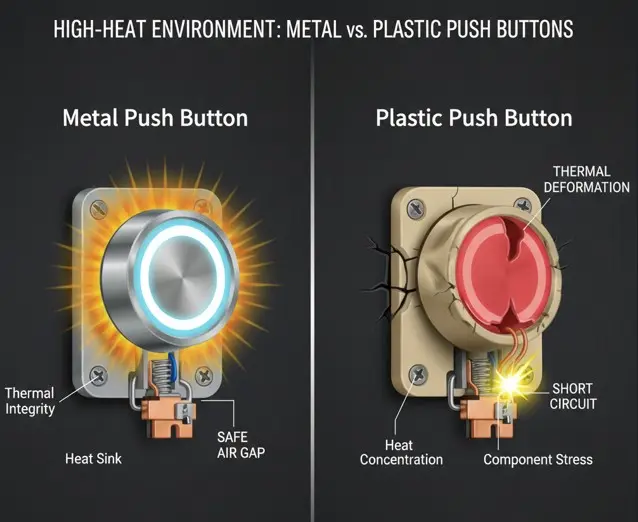
In industrial design, the choice between metal and plastic push buttons often comes down to a trade-off between upfront cost and long-term reliability. While plastic is a versatile and cost-effective insulator for household or low-stress applications, it frequently fails in high-temperature environments. For engineers and facility managers, understanding the technical failure points of plastic, as well as the resilience of metal, is essential for maintaining system safety and operational uptime.
Thermal Integrity
In high-temperature environments, the primary risk to plastic is not just immediate melting, but thermal degradation and creep. Unlike plastic, which can soften, deform, or become brittle (age) under heat, metal retains its structural shape. This prevents the mounting from loosening and ensures internal components remain aligned.
- Plastic Failure: Under high heat (e.g., machinery, furnaces, automotive engines), plastic components can warp, deform, or become brittle. This deformation can lead to the button sticking in the “pressed” position or loosening in its mounting hole.
- Metal Advantage: Stainless steel and aluminum retain their shape and structural integrity at significantly higher temperatures. They do not soften, ensuring consistent operation.
- Mechanical Creep: Under constant heat and mechanical load (like the tension of a mounting screw), plastic undergoes “creep”—a slow, permanent deformation. Over time, this causes the mounting to lose its “bite,” leading to the button becoming loose or “wobbly” in the panel.
- Dimensional Stability: In a control panel where a plastic button is mounted in a metal housing, the plastic will expand significantly more than the metal around it. This “CTE (coefficient of thermal expansion) mismatch” can cause the button to bind or, conversely, to loosen as it later contracts.
Electrical Safety
Structural integrity is not just an aesthetic concern; it is a fundamental safety requirement. As high ambient temperatures cause plastic housings to soften, the internal rigidity required to hold electrical terminals in place is lost.
If the internal plastic framework deforms, the connecting screws and terminals can shift. This movement reduces the safe “air gap” between conductive parts, significantly increasing the risk of arcing or a short circuit. Metal push buttons, often constructed from stainless steel or aluminum, provide a rigid, non-flammable housing that ensures terminals remain precisely aligned, even under extreme thermal loads.
Heat Dissipation
Illuminated buttons face heat from two directions: the ambient environment and the internal light source. When using buttons with integrated incandescent bulbs, the localized heat can melt plastic lenses or shades. Metal buttons dissipate this heat more efficiently and typically use glass or high-heat-resistant inserts that will not warp over time.
Metal buttons (especially those made of aluminum or brass) have high thermal conductivity. They act as a heat sink, drawing heat away from the internal bulb and the electrical contacts and dissipating it into the control panel or the surrounding air. This keeps internal components within their safe operating temperature range, significantly extending the life of the bulb and the switch mechanism.
Plastics are natural insulators, meaning they trap heat inside the button housing. In illuminated units using incandescent or high-output LED bulbs, this trapped heat can exceed the plastic’s heat deflection temperature (HDT), leading to a warped or “melted” appearance on the lens or shade.
Summary: When to Choose Metal
While plastic buttons are suitable for budget-conscious, indoor, or light-duty projects, metal push buttons are the industry standard for environments where reliability cannot be compromised. By resisting deformation, preventing electrical faults, and managing internal heat, metal components provide a safer, more durable, and ultimately more cost-effective solution for high-temperature industrial applications.
Additional Resources
Check out our other articles:
Complete Your Control Panel
At Maple Systems we offer control panel components, from HMIs to buttons to PLCs. Contact our sales team for pricing, availability, and support.
Email [email protected] or call (425) 745-3229.

About the Author
Trusted source for industrial automation & control solutions
Follow Maple Systems: