
Real-time alarms display when certain events in your process occur and show the current status of a process. When real-time alarms are triggered, they remain on the display window until they are acknowledged, or the alarm condition returns to its normal state. Display real-time alarms with different text colors to delineate the state of the alarm (active unacknowledged, active acknowledged, or inactive unacknowledged), severity, date and time, etc.
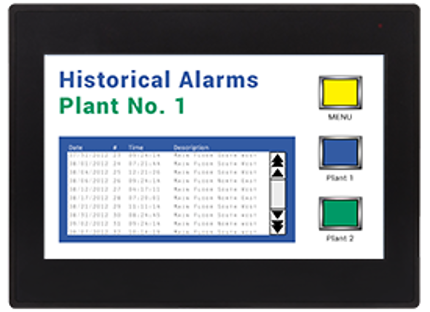
Historical alarms are a sequential history of your application’s alarm activity. Stored in non-volatile memory, they remain even when the machine is turned off. Historical alarms can be displayed with the severity level, date, and time the alarm occurred, when it was acknowledged, and when it returned to normal. A historical alarm list can also be uploaded to the PC and saved as a CSV file using MAPware-7000.
In Native Ladder, it is recommended to use Internal Registers (BW) for the alarm words. Since the Internal Coils (B) comprise the individual bits of the BW words, they can then be used to trigger the individual alarms. You must create the tags for the alarm words (BW) and the alarm bits (B). The alarm bit (B) tags can be used to trigger alarms in the ladder logic.
In IEC mode, create an Alarm word tag, then create a BOOL array to use with the Set Bit function (Registers) to turn on individual bits in the Alarm word and trigger individual alarms.
Software Downloads & Upgrades
Manuals & Guides
- HMC Series Installation Guide
- MAPware-7000 Programming Manual
- MAPware-7000 Ladder Logic Guide
- Mapware-7000 Getting Started Guide
- HMC3000 I/O Module Guide
- HMC7000 I/O Module Guide
- MAPware-7000 IEC61131 Programming Guide
Videos
- Product Overview
- Part 1: Introduction and Installation
- Part 2: Creating a Native Ladder Project
- Part 3: Adding and Initializing Tags
- Part 4: Adding Logic
- Part 5: Creating an HMI Screen
- Part 6: Duplicationg an HMI Screen
- Part 7: Downloading and Testing the Project
- Part 8: Creating an IEC Project
- Part 9: Creating a UDFB
- Part 10: Adding a Structure Text UDFB
- Part 11: Adding Power Up and Main Routine Logic
- Part 12: Creating Screen Objects
- Part 13: Downloading the Project and Online Monitoring
- Alarms
Sample Projects