
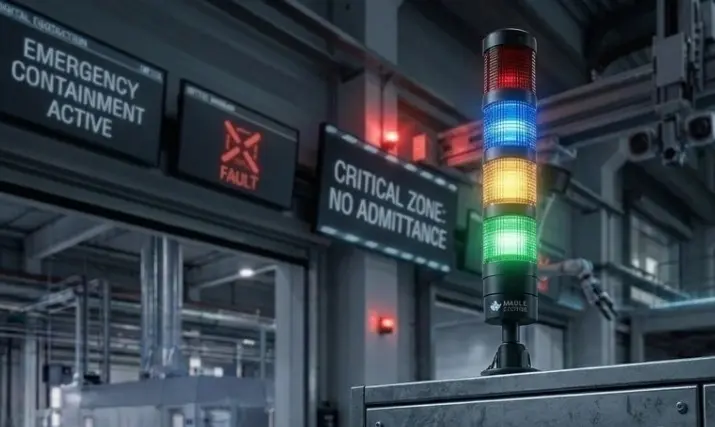
In a fast-paced industrial environment, clear communication is the difference between seamless production and costly downtime. Stack lights, also widely known as tower lights or signal towers, serve as the visual voice of a machine, providing real-time status updates that are visible from across the factory floor. By using a standardized color-coded system, these multi-tier beacons allow operators and supervisors to monitor equipment health at a glance, ensuring that potential issues are identified long before they escalate into mechanical failures.
Beyond simple status indication, modern stack lights are integral components of a facility’s safety and efficiency strategy. Usually mounted directly onto control boxes or machine frames, these rugged devices translate complex internal PLC data into simple, actionable visual cues. Whether it’s a steady green light signaling peak performance or a flashing red tier accompanied by an audible siren, stack lights provide a universal language that keeps personnel safe and production lines moving.
The Beacon of Efficiency: Understanding Stack Lights for Control Boxes
Efficiency on the shop floor depends on instantaneous communication, which is why stack lights have become the indispensable “visual voice” of modern automation. These columnar signaling devices allow operators to monitor equipment status from across the plant, eliminating the need to stand directly in front of a console and freeing them to manage multiple workstations simultaneously.
By mounting stack lights directly onto control boxes or machine panels, facilities gain a 360-degree status window that traditional HMI screens simply cannot provide. These vertical towers typically feature up to five modular color tiers—such as red, amber, and green—that integrate directly with a PLC (Programmable Logic Controller). This direct connection ensures that as soon as a machine state changes, the stack light reacts in real-time, using universal color-coding to signal peak performance or alert personnel to a breakdown. This immediate visual feedback loop is what makes stack lights the most efficient tool for reducing response times and maximizing machine uptime.
Status at a Glance: Maximizing Efficiency Through Color and Sound
The efficiency of a stack light lies in its ability to communicate complex machine states through a simple, universal language of color. While specific meanings can vary by facility, most industrial environments follow the IEC 60073 standard to ensure that any operator can “read” a machine’s status from a distance without confusion
The Standard Color Hierarchy
A well-configured stack light typically uses a vertical hierarchy—with red at the top for maximum visibility—to signal different levels of urgency:
- White/Clear (General Status): Frequently used for user-defined or neutral conditions. This might indicate the machine has power and is “ready” but not yet running, or it may signal a completed production run.
- Red (Danger/Fault): Indicates a critical condition or emergency stop. A solid red light often means the machine has halted due to a fault, while a flashing red signal typically indicates an unacknowledged alarm that requires immediate intervention.
- Amber/Yellow (Warning): Signals an abnormal condition that hasn’t stopped production yet but requires attention. Common triggers include low material levels, over-temperature warnings, or a process nearing its limit.
- Green (Normal Operation): The “all-clear” signal. It confirms the machine is running in automatic mode and production is proceeding as planned.
- Blue (Mandatory Action): Often used to request specific external help, such as a material refill, a supervisor’s assistance, or a quality assurance check.
Maximizing Efficiency with Flashing and Sound
To further boost efficiency, many facilities use flashing patterns to distinguish between levels of urgency within the same color. For example, a steady amber light might mean “material is low,” while a flashing amber light means “material is empty—stop imminent”. When paired with an audible buzzer (often 70–105 dB), these visual cues become impossible to ignore, ensuring that even in the loudest, busiest sections of a plant, the “voice” of the machine is heard.
Engineered for Every Environment: Versatile Mounting & Durability
To ensure maximum visibility and seamless integration, stack lights offer a range of flexible mounting configurations tailored to your facility’s unique layout.
Optimized Placement Options:
- Direct & Surface Mount: Ideal for control box tops, providing a sleek, low-profile appearance that integrates directly into the machine’s silhouette.
- Pole Mount: For mid-height or low-profile equipment, elevated poles (available in various lengths) ensure the signal remains visible over machinery and obstacles.
- Wall & L-Bracket Mount: Perfect for side-mounting on panels, pillars, or cabinet frames, especially when top-mounting isn’t an option due to space constraints.
Industrial-Grade Durability:
- Designed to thrive in the most demanding settings, these units carry high Ingress Protection ratings, such as IP65 or IP67, providing total protection against dust and high-pressure water or oil.
Seamless Integration:
- To simplify installation, units are available in multiple power configurations, including 24V DC for direct PLC integration and 120/240V AC for standard power feeds.
Hardware vs. Strategy: A Stack Light is the Tool; an Andon is the System
In many facilities, the terms stack light and Andon are used interchangeably, but there is a distinct difference between the hardware and the strategy.
- The Stack Light (The Hardware): This is the physical signaling device mounted to your control box. Its primary job is to reflect the machine’s health. It is usually triggered automatically by a PLC to show if a motor is running, a cycle is complete, or a fault has occurred.
- The Andon (The System): “Andon” is a lean manufacturing concept (originating from the Toyota Production System) that refers to a visual management system. While it uses stack lights as the display, the focus is on process health. An Andon signal is often triggered manually by an operator to “stop the line” due to a quality defect or a safety concern.
The Bottom Line: You use a stack light to build an Andon system. One is the tool; the other is the communication strategy that keeps your production line perfect.
Conclusion
In the modern industrial landscape, stack lights are far more than just colorful beacons; they are a critical link in the chain of shop floor communication. By transforming complex machine data into instantaneous, actionable visual cues, these towers empower your team to react faster, reduce downtime, and maintain a safer work environment.
Whether you are integrating a simple three-tier light for a standalone CNC machine or building a sophisticated Andon system for a global production line, choosing the right signaling solution is an investment in your facility’s overall efficiency. When every second of uptime counts, let your control boxes speak clearly—so your operators can stay focused on what matters most: moving production forward
Additional Resources
Check out our other articles
- A Guide to Industrial Pushbuttons
- Understanding How Push Buttons Work
- Control Cabinet Fundamentals for Industrial Automation
Complete Your Control Panel
At Maple Systems we offer control panel components, from HMIs to buttons to PLCs. Contact our sales team for pricing, availability, and support.
Email [email protected] or call (425) 745-3229.

About the Author
Trusted source for industrial automation & control solutions
Follow Maple Systems:
Share: