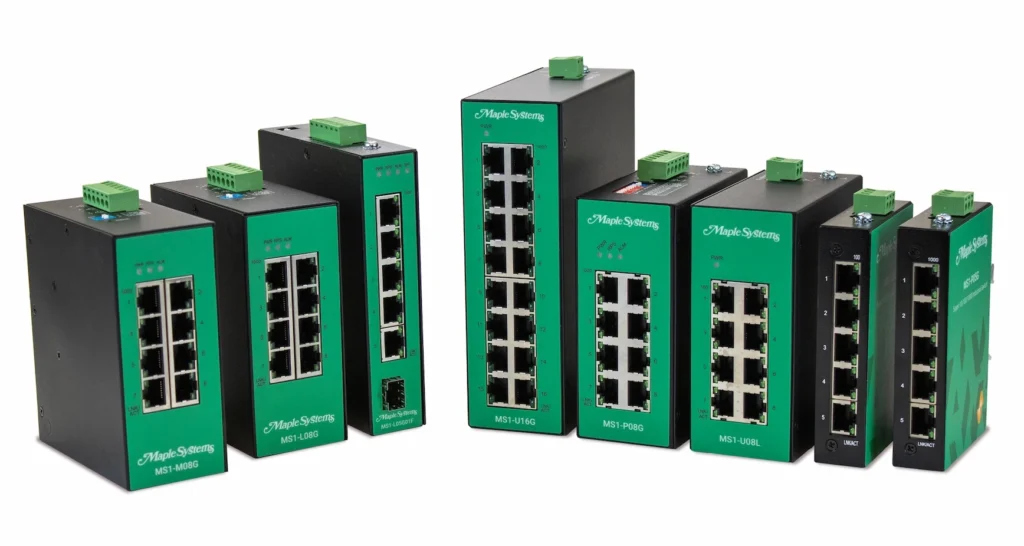
Commercial switches rely on a single power supply to power the switch, while industrial switches typically run off DC power, and have redundant power inputs. This allows the weakest link (the power supply) to have a hot standby back up, insuring maximum up time.
Industrial switches are designed for harsh environments, featuring an IP rating for dust and water resistance, as well as ESD, EMI, power surge, over-voltage, and power spike protection to withstand extreme conditions. These switches are built to endure temperature fluctuations, vibration, and moisture, making them ideal for factories, outdoor, and industrial settings. In contrast, commercial switches are typically used in controlled office or business environments, offering standard performance without the extensive protection found in industrial models. While commercial switches are more affordable and easier to manage, industrial switches ensure durability and reliability in more demanding environments.
Some Industrial switches are also designed for specific use cases like maritime, subway, or railway stations. These switches would be accommodated with their respective certifications.