
A Brief History of FactoryTalk
Before FactoryTalk, Rockwell Software operated as a collection of separate products, such as RSView32, RSLink Classic, and RSSql and RSBizWare. Many of which were acquired or developed in isolation. In the early 2000’s, Rockwell recognized that customers needed different software applications (HMI, Historian, Batch) to share the same data and security settings without manual duplication.
Between 2000 and 2005, Rockwell introduced RSView Enterprise, which included RSView Machine Edition (ME) and Site Edition (SE), and FactoryTalk. The goal was to bring all their software into a single platform. By the late 2000s, Rockwell started “rebranding” their entire catalog. “RS” names were largely replaced by “FactoryTalk” names to signify their integration into the common services platform.
Today, FactoryTalk is used to bridge the gap between Operational Technology (OT) on the plant floor and Information Technology (IT) at the enterprise level. It helps reduce downtime through predictive analytics, improves quality via real-time monitoring, and simplifies regulatory compliance (such as 21 CFR Part 11) through automated audit trails.
FactoryTalk Popularity
FactoryTalk maintains its status as the “central nervous system” of the Rockwell Automation ecosystem. Because it provides a seamless, high-performance bridge between Allen-Bradley hardware and enterprise-level intelligence. Today, this software suite continues to dominate the market; it integrates everything from real-time HMI visualization and machine-level control to advanced AI-driven analytics.
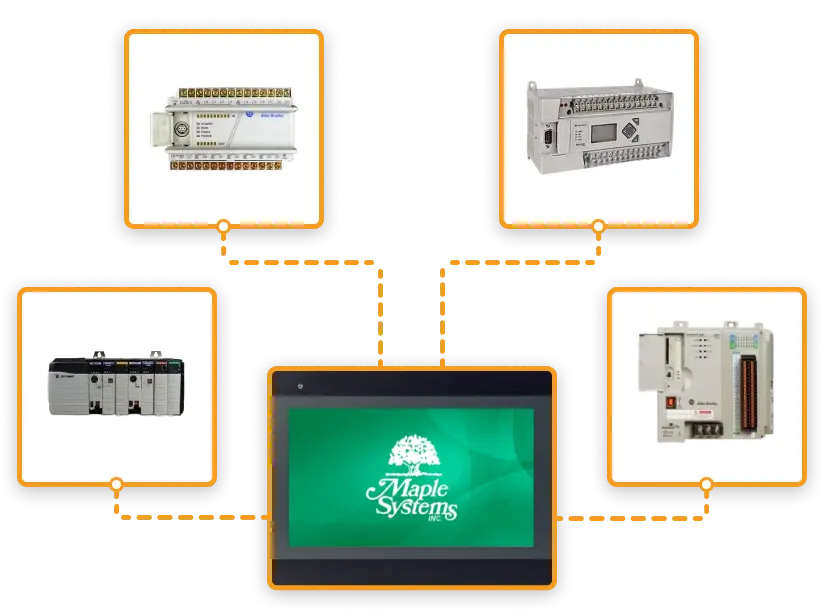
- FactoryTalk is engineered to work with Allen-Bradley controllers, like the ControlLogix, CompactLogix, and MicroLogix PLCs.
- FactoryTalk is widely considered the industry standard for highly regulated and complex sectors.
- Rockwell has successfully modernized the suite for the current “Industry 4.0” era.
- Because FactoryTalk is so common, there is a massive pool of trained engineers and technicians globally who already know how to use it.
FactoryTalk PC Requirements
Maximize your ROI by aligning your hardware directly with the specific demands of the FactoryTalk® suite. Note that requirements differ significantly between standard HMI operator clients and resource-heavy engineering stations. For modern deployments, you must select industrial hardware that prioritizes long-term platform stability and advanced thermal management to ensure 24/7 plant floor reliability. Furthermore, specify systems with ample processing “overhead” to handle future software patches and feature updates. Ultimately, choosing a high-performance Industrial PC with these features prevents premature obsolescence and eliminates costly downtime as your technology evolves..
- Operating Systems: Windows 10/11 IoT LTSC for Client (HMI) applications; Windows 11 Pro/Enterprise for Engineering Stations.
- CPU: At least a 4-core processor (Intel Core i5 standard or equivalent) for Client (HMI) applications. 8-Core Intel Core i7 for Engineering Stations.
- RAM: 8 GB minimum for Client (HMI) applications. 16 GB to 32 GB for Engineering Stations, and 1 TB+ for Server Applications.
- Storage: A minimum of 256 GB SSD storage is strongly recommended for Client (HMI) applications, a minimum of 512 GB SSD for Engineering Stations.

Industrial PCs to Run FactoryTalk
Rugged, Reliable PC Hardware
Our embedded industrial PCs offer a high-quality market solution, specifically optimized to run FactoryTalk® and other major SCADA platforms. Moreover, you can fully customize each unit with your choice of processor, memory, and operating system to perfectly meet your specific operational needs. Because these systems feature extensive built-in I/O connections for seamless device integration, a Maple Systems PC serves as an ideal, cost-effective alternative to more expensive proprietary hardware. Ultimately, choosing this flexible platform allows you to avoid high upfront costs and expensive support agreements without sacrificing performance.
PanelView HMI vs Maple Systems HMI
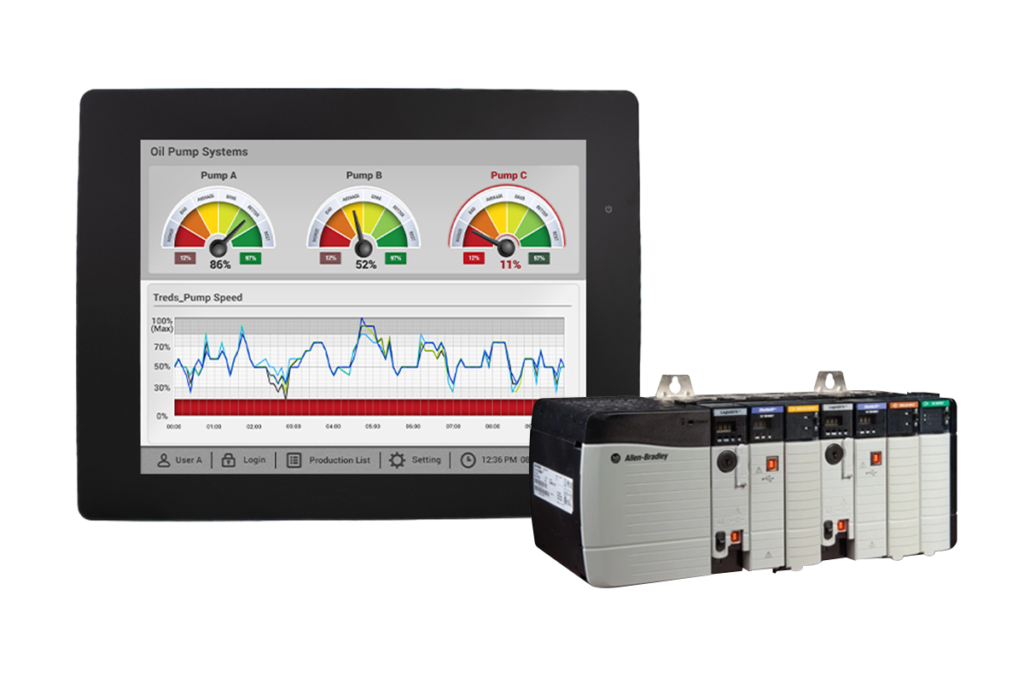
Allen-Bradley maintains a dominant market share in industrial automation, a position that frequently allows them to command premium pricing for their hardware. Furthermore, while software like FactoryTalk View ME is specifically optimized for PanelView HMIs, these proprietary combinations are by no means your only option.
Consequently, many organizations are re-evaluating their infrastructure due to the high upfront costs of PanelView hardware and the recurring expenses of Rockwell support agreements. In light of these financial pressures, a Maple Systems solution is increasingly worth a look as a high-performance, cost-effective alternative. Ultimately, switching to a more flexible provider can provide similar industrial functionality while significantly reducing your total cost of ownership.
High Performance HMI Hardware
Integrate one of our HMIs with an Allen-Bradley PLC or controller with just a few click. Our HMIs support Allen-Bradley PLCs and we offer step-by step instructions on how to connect one of our HMIs to an Allen-Bradley PLC, complete with videos and connection guides.
No matter which solution works best for your application, we NEVER require an expensive support agreements. That’s right, free support. No contracts. Save thousands of dollars on expensive service contracts.
FAQ: Can your devices be used with Rockwell FactoryTalk View SCADA platform?
Contact Maple Systems
Contact our sales team for pricing, availability, and support.
Email [email protected] or call (425) 745-3229.

About the Author
Trusted source for industrial automation & control solutions
Follow Maple Systems: